Free NewsletterPro Login
S&P 500 6,287 +0.42%
DOW 44,521 -0.18%
NASDAQ 21,103 +0.71%

Warning: Undefined variable $funds in /var/www/briefs.co/htdocs/wp-content/plugins/oxygen/component-framework/components/classes/code-block.class.php(133) : eval()'d code on line 491

Warning: foreach() argument must be of type array|object, null given in /var/www/briefs.co/htdocs/wp-content/plugins/oxygen/component-framework/components/classes/code-block.class.php(133) : eval()'d code on line 491
/* the link was here */

Runware's Modular AI Pods Take On Big Tech's Giant Data Centers

Published Aug 4, 2026
[tts_player]
Share:
Summary:
  • Runware introduced the Sonic Inference Pod, a portable modular data center for AI inference, on August 4, 2026.
  • The company has 10 pods deployed across the U.S., Europe, and Asia-Pacific, with 160 sites ready to power them.
  • In December, Runware raised $50 million in Series A funding for image-generation infrastructure.

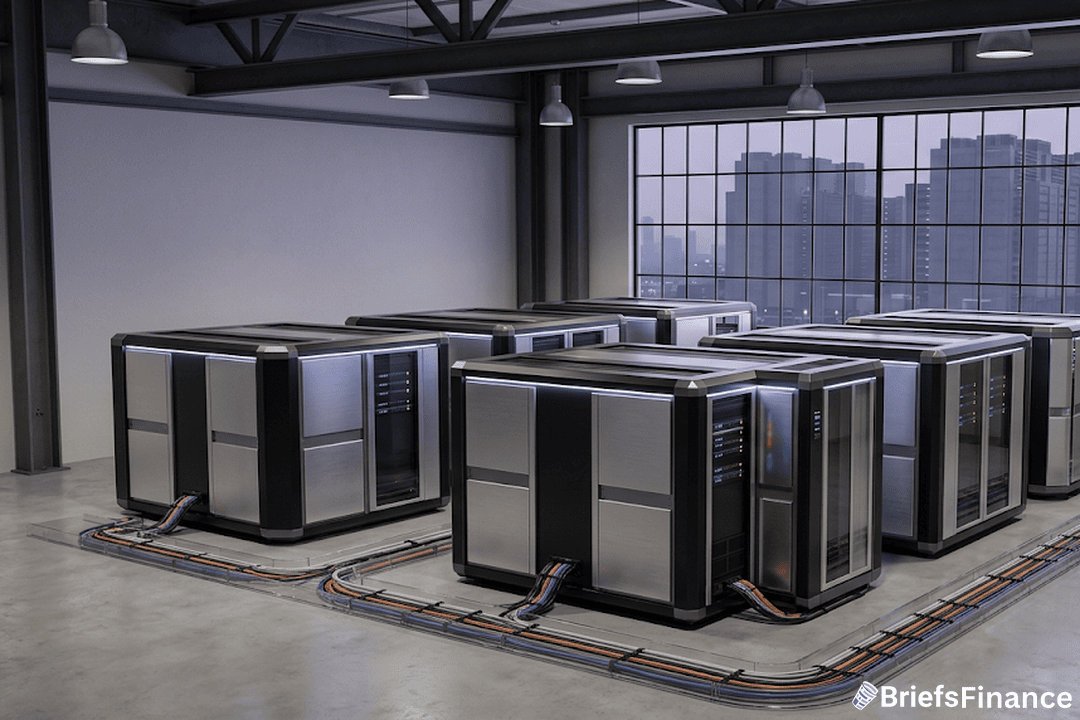
The big names in AI are spending hundreds of billions on giant data centers that take years to build. A small company called Runware thinks the future might fit in a pod that you can ship anywhere.

Most of the AI hardware conversation has been about huge facilities. OpenAI is reportedly close to a $500 billion deal for a data center in Ohio. But Runware's co-founder and CEO, Flaviu Radulescu, does not see those giant projects as a threat. He sees his pods as a complement to them.

"Distributed compute, positioned closer to end users for faster inference, is what will win in the long term," Radulescu said.

Instead of building one massive building, you drop in a pod wherever power is available. If you need more capacity, you add another pod.

The design uses a closed-loop cooling system that requires no water, and it can be set up in days. A typical data center takes months or years.

AI data centers are controversial in some communities because they use a lot of power and water, and they can push up utility costs for residents. Runware counters that its units reduce those downsides: they draw from current power supplies, skip the inefficiency of long-distance transmission, and require no water for cooling.

One Network, Many Pods

All of the pods run together as one network. When a request comes in, the system sends it to whatever pod has open capacity and is closest to the user. If one pod goes offline, the traffic just moves to another one.

Get the free Always Be Buying eBook and learn the simple system for building wealth on any income

"Customers who want dedicated hardware get whole pods to themselves," Radulescu said.

The current customer list includes Higgsfield AI and Wix, two companies that need steady inference power.

Why Building This Is Hard

Radulescu is not worried about competitors copying the idea. He points out that the hardware work is slow and the talent pool is small. A single error in a circuit board design can set a project back months.

"A mistake in a circuit board design costs months between redesign, simulation, fabrication, testing, and delivery," he said. "Every one of those calls needs someone who understands exactly what each component does and what breaks if it's gone."

The bigger challenge might be energy. Radulescu expects AI power use to keep climbing, since inference demand is rising more quickly than data centers can be constructed. What he does think he can control is how the demand gets met.

Radulescu put it simply: "That means less new grid and less water for the same amount of compute."

Runware would like to run on renewable power someday, but the company is honest that it is not there yet. For now, the pitch is simple: more efficient AI, closer to the people using it, without waiting years for a building to go up.

What This Means for the AI Buildout

Runware's model is aimed at a bottleneck that has already shaped the AI industry: the enormous gap between the demand for compute and the time needed to build traditional data centers. Large campuses require huge capital and years of construction, and they often meet community resistance because of power and water use.

Runware's bet is that the next wave will be smaller, nimbler, and distributed.

Faster deployment means new AI features can reach your phone, your website builder, or your favorite app without waiting for a mega-campus to open. If portable data centers actually work, your electricity bill and your water supply could feel less pressure from the AI boom while the services keep getting faster.

Download the free Always Be Buying eBook and start putting your money to work today
Disclosure

Recent News

1 2 3 48

Get Market Briefs delivered to your inbox every morning for free!

No fluff. No noise. No politics. Just finance news you can read in 5 minutes.

Blogs

June 29, 2026
Portfolio Diversification: Why Putting All Your Eggs in One Basket Destroys Wealth
  • Real diversification means spreading investments across all 11 economic sectors plus bonds, alternatives, and cash so no single bet can sink the portfolio.
  • Different sectors perform at different times, so a diversified portfolio captures upswings while smoothing the brutal drawdowns that wipe out concentrated bets.
  • Total market index funds offer the simplest path to diversification, and annual rebalancing is what keeps the structure working over time.
Read More
June 29, 2026
Non Taxable Income: What It Is and Why It Matters
  • Non taxable income is money you receive that you don't owe income tax on.
  • The tax code treats workers, investors, and business owners very differently, and investors often come out ahead.
  • Learning how income is taxed is a quiet superpower for keeping more of what you earn.
Read More
June 29, 2026
Semiconductor Stocks: A Simple Guide for Investors
  • Semiconductor stocks are companies that design and make computer chips, the brains inside nearly every modern device.
  • The AI boom has turned chips into one of the market's most important and most watched groups.
  • They offer big growth potential, but come with high valuations and a notoriously cyclical history.
Read More
June 25, 2026
How Stocks Work: A Simple Guide for Beginners
  • A stock is a slice of ownership in a company - buy one, and you own a piece of the business.
  • You make money two ways: the share price rising over time, and dividends paid to shareholders.
  • The simplest path for most beginners is buying into the whole market through a low-cost index fund.
Read More
June 25, 2026
Stop Loss vs Stop Limit: What's the Difference?
  • A stop loss order sells your stock once it hits a trigger price, prioritizing getting you out.
  • A stop limit order only sells within a price range you set, prioritizing price over a guaranteed exit.
  • The trade-off: a stop loss almost always executes; a stop limit might not if the price moves too fast.
Read More
June 25, 2026
Energy Stocks: A Simple Guide for Investors
  • Energy stocks are companies that produce and supply the power the world runs on, from oil and gas to newer sources.
  • They make up one of the 11 sectors of the market and tend to move with energy prices and big-picture shifts.
  • Like any sector, the key is diversification and understanding the forces driving demand.
Read More
June 18, 2026
What Is a Stop Loss Order? A Simple Guide
  • A stop loss order automatically sells a stock once it falls to a price you set.
  • It's a tool to cap losses or lock in gains without watching the market all day.
  • It works best for active strategies, and can backfire if used carelessly on long-term holdings.
Read More
June 18, 2026
Best S&P 500 Index Fund: How to Choose One
  • The best S&P 500 index fund for most investors is simply the cheapest, most established one that tracks the index well.
  • Funds like VOO, IVV, and SPY all hold the same 500 companies, so the biggest difference is the fee.
  • Pick one, automate your buys, and let time do the heavy lifting.
Read More
June 17, 2026
What Are Penny Stocks? Risks and Rewards Explained
  • Penny stocks are very low-priced shares of very small companies, often trading for just a few dollars or less.
  • They promise huge gains but carry huge risks: low liquidity, high failure rates, and wild price swings.
  • Most investors are better served by quality companies and funds than by chasing cheap shares.
Read More
June 17, 2026
Best Stocks for Beginners With Little Money
  • The best stocks for beginners with little money usually aren't individual stocks at all - they're low-cost index funds.
  • You can start with $100 or less and use small, regular investments to build wealth over time.
  • Focus on diversification and consistency, not on picking the next big winner.
Read More
1 2 3 24
Share via
Copy link











