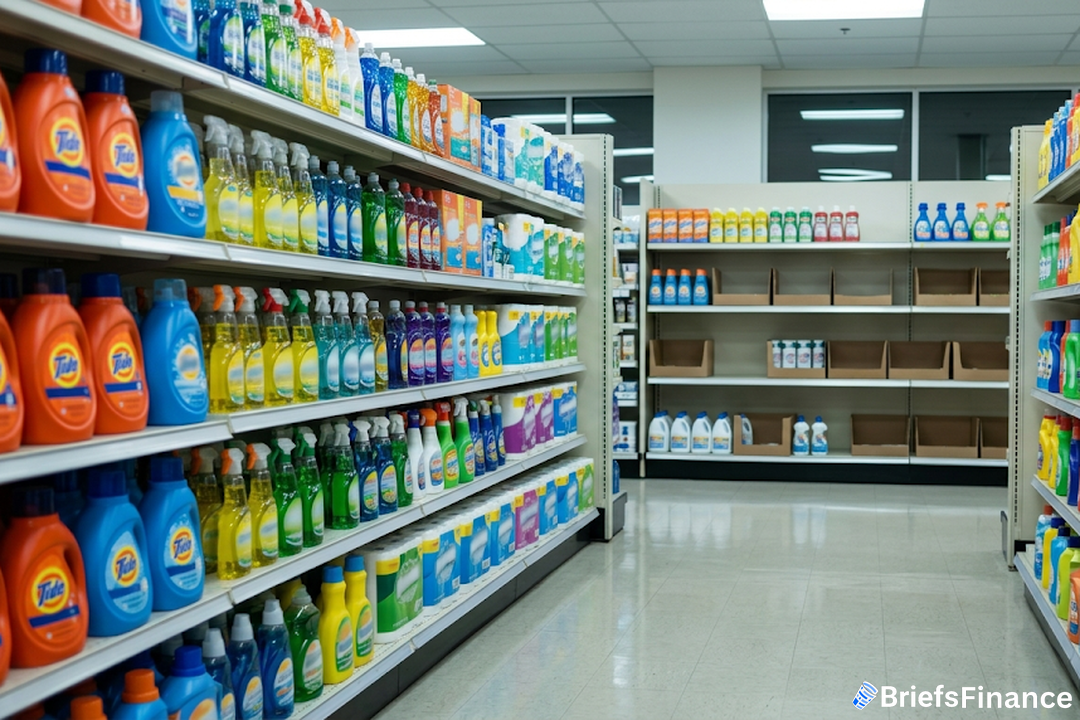
Profit Beat, Revenue Miss
Procter & Gamble reported mixed quarterly results. But the revenue picture was less rosy. Net income attributable to the company dropped to $3.04 billion from $3.62 billion a year earlier. On a reported basis, earnings per share came in at $1.26, down from $1.48 a year earlier.
P&G's stock dropped over 3% during premarket trading.
Why Sales Are Stalling
The core problem is that shoppers are getting more careful with their money. That means the amount of products sold, ignoring price changes, acquisitions, and currency fluctuations, was unchanged.
Some categories are doing better than others. The beauty division saw volume grow 3%, the strongest performer. Fabric and home care managed 1% growth.
Get the market news that matters in a five-minute read with Market Briefs, our free daily newsletter
But the baby, feminine, and family care division, along with grooming, saw volume shrink by 1%. The worst hit was health care, where volume dropped 3%, driven by weaker sales of its oral care products.
Over its entire 2026 fiscal year, P&G achieved volume growth in only a single quarter. Similar to other consumer goods firms, P&G has experienced softening demand as buyers become more price-sensitive, opting for less expensive store brands or using its products more sparingly.
There is also a leadership change. Shailesh Jejurikar, currently CEO, will also become board chair on August 1, according to P&G, while retaining his current role. Jejurikar steps into that role after Moeller, the former chief executive, departed.
What's Ahead for Your Portfolio
P&G's outlook for the next fiscal year is cautious. Analysts had been expecting EPS of $7.04 and revenue expansion of 2.7% for the 2027 fiscal year.
The big reason is costs. P&G currently foresees a $1 billion after-tax hit from increased expenses on raw materials, energy, and transportation. Along with expectations of greater net interest costs, reduced non-operating income, and adverse currency effects, P&G expects a 56-cent (8%) reduction in its fiscal 2027 EPS.
The $1 billion cost hit is squeezing margins, and P&G is not alone. Consumer goods companies across the sector face higher input costs and a more cautious shopper base. Many have raised prices to offset inflation, but that strategy is wearing thin as customers trade down to cheaper alternatives. P&G's flat volume suggests its pricing power has limits, and the cautious guidance reflects a belief that these headwinds will persist through fiscal 2027, limiting earnings growth despite cost-cutting measures.
A P&G spokesperson told investors that "the next year will be a grind, not a breakout."
The bottom line: P&G does not expect a big jump in demand anytime soon. The company is telling investors that the next year will be a grind, not a breakout. For your portfolio, that means a steady dividend payer like P&G might not offer much growth in the near term.
But it also shows how even the biggest consumer brands have to adapt when shoppers tighten their belts. The question is whether P&G can find ways to offset those cost pressures without losing more customers to cheaper alternatives.
Join Market Briefs, our free daily newsletter, for a quick daily rundown of the markets