Free NewsletterPro Login

Netflix Changes Offer To All-Cash Bid For Warner Bros. Discovery

A stylized illustration of a cylindrical cup with blue arrows and lines indicating a swirling or rotational motion inside the cup.
Published Jan 20, 2026
Share:
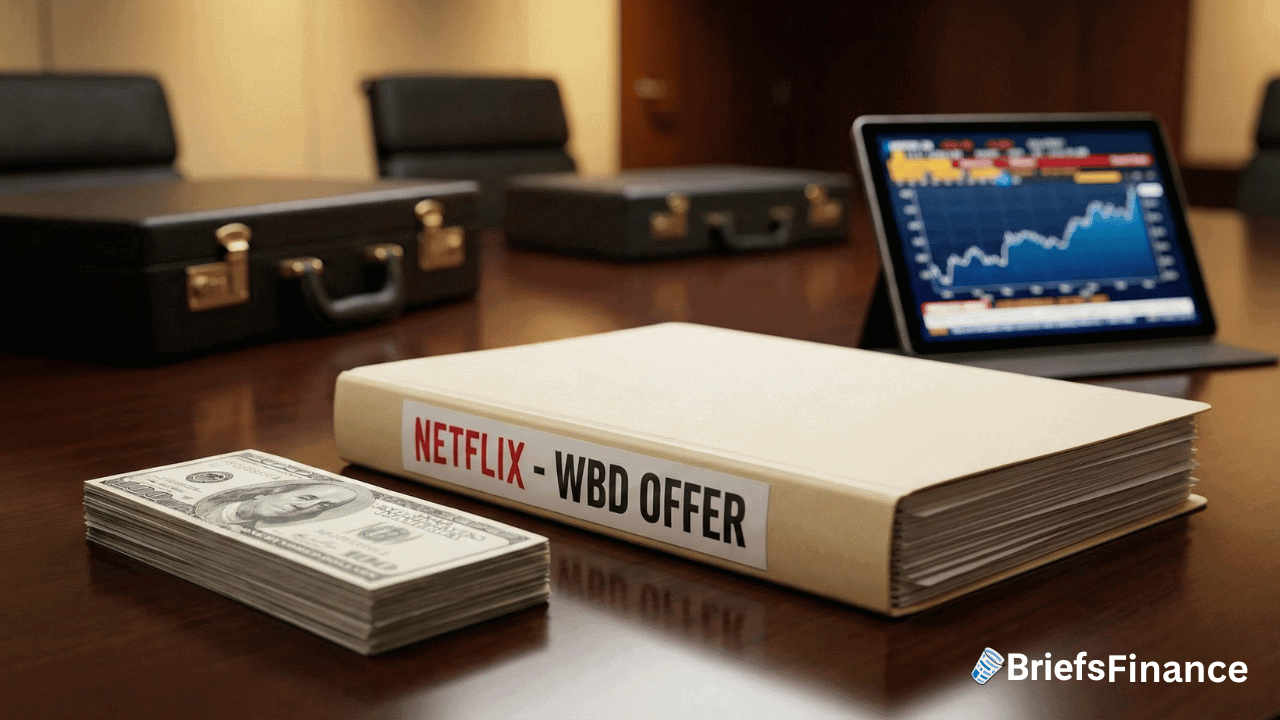
A binder labeled "Netflix - WBD Offer" sits on a table with a stack of cash, two briefcases, and a laptop displaying a stock chart—hinting at an all-cash bid involving Netflix and Warner Bros. Discovery.
Summary:
  • Netflix has revised its offer for Warner Bros. Discovery to an all-cash bid of $27.75 per share.
  • The initial deal, reached in December 2025, was worth $72 billion and included cash and stock.
  • Warner Bros. Discovery's board has unanimously accepted the new offer.

Netflix Changes Offer Structure

Netflix has made a significant change to its proposal for acquiring Warner Bros. Discovery (WBD). According to an SEC filing on Tuesday, the streaming giant adjusted its offer to an all-cash bid of $27.75 per share.

This new offer is a shift from the initial deal made in December 2025, which was a mix of cash and stock valued at $72 billion.

WBD's Response to the Offer

WBD's board has unanimously accepted Netflix's amended offer. Previously, shareholders were set to vote on the deal in the spring or early summer of 2026.

However, the revised all-cash bid could enable shareholders to vote earlier, which may accelerate the approval process.

Pressure from Paramount Skydance

While Netflix aims to finalize its acquisition of WBD, Paramount Skydance is intensifying its efforts to take over the company.

Paramount has initiated a hostile takeover attempt that includes WBD's cable TV networks like CNN and TNT. Last week, Paramount also sued for information to support its pursuit and launched a proxy fight to nominate directors for WBD's board.

Next Steps for WBD and Netflix

On the same day as Netflix's announcement, WBD filed a preliminary proxy statement. This statement seeks shareholder approval for the Netflix deal.

If the deal is approved, WBD's cable TV networks would be spun off into a new publicly traded entity called Discovery Global.

Upcoming Earnings Report

Netflix is scheduled to report its quarterly earnings after the market closes on Tuesday.

Investors are keenly awaiting this report, hoping for further updates regarding the acquisition process and the overall direction of the company.

Disclosure

Get Market Briefs delivered to your inbox every morning for free!

No fluff. No noise. No politics. Just finance news you can read in 5 minutes.

Blogs

May 30, 2026
Financial Literacy Books That Actually Build Wealth
  • The best financial literacy books don't just teach budgeting, they shift how you think about money.
  • Two classics stand out: The Intelligent Investor for valuing investments, and Rich Dad Poor Dad for the owner's mindset.
  • Reading is only step one. The real wealth comes from acting on what you learn.
Read More
May 30, 2026
What Is a Roth Conversion? A Simple Guide
  • A Roth conversion moves money from a traditional retirement account into a Roth account.
  • You pay taxes on the money now, in exchange for tax-free growth and withdrawals later.
  • It can pay off if you expect higher taxes or more income in the future, but the timing and tax hit matter a lot.
Read More
May 30, 2026
Trailing Stop Loss: How to Protect Your Gains
  • A trailing stop loss is an order that automatically sells a stock if it falls a set percentage from its recent high.
  • As the stock rises, the sell point rises with it, locking in gains while capping losses.
  • It's most useful for active strategies like momentum investing, not for long-term buy-and-hold.
Read More
May 30, 2026
5 Types of Wealth: Why Money Is Only One of Them
  • Real wealth is more than a bank balance. It spans your finances, health, mind, purpose, and freedom.
  • Money is powerful, but it amplifies the life you already have rather than fixing a broken one.
  • True financial wealth means your cash flow covers your expenses, so your money works while you live.
Read More
May 30, 2026
How to Invest in Private Equity: A Beginner's Guide
  • Private equity means investing in companies that aren't listed on the stock market.
  • Traditional private equity is built for experienced, high-net-worth investors with large amounts to invest.
  • New rules have opened more accessible paths, like startup crowdfunding and real estate deals, often starting around $100.
Read More
May 30, 2026
What Is a Call Option? A Simple Guide With Examples
  • A call option gives you the right to buy a stock at a set price by a set date.
  • Investors buy calls when they expect a stock to rise, using less money than buying the shares outright.
  • The most you can lose buying a call is the premium, but time works against you, so it's an advanced tool.
Read More
May 30, 2026
EBITDA Formula: How to Calculate It Step by Step
  • EBITDA stands for Earnings Before Interest, Taxes, Depreciation, and Amortization, a measure of a company's core profit.
  • The formula adds those four items back to net income to show what the underlying business earns.
  • Investors use EBITDA to compare companies and to judge how many times earnings a stock is selling for.
Read More
May 30, 2026
What Is a Stock Option? A Plain-English Guide
  • A stock option is a contract giving you the right, but not the obligation, to buy or sell a stock at a set price by a set date.
  • There are two types: calls (the right to buy) and puts (the right to sell).
  • Options are powerful but risky, so they suit investors who already have the basics down.
Read More
May 30, 2026
Put Option: What It Is and How It Works
  • A put option gives you the right to sell a stock at a set price by a set date.
  • Investors use puts to bet a stock will fall, or as insurance to protect shares they own.
  • The most you can lose buying a put is the premium you paid, which makes it a defined-risk tool.
Read More
May 30, 2026
Operating Margin: What It Is and How to Calculate It
  • Operating margin shows how much profit a company keeps from its core business after paying its running costs.
  • The formula is operating income divided by revenue, shown as a percent.
  • A strong, steady operating margin signals a well-run business that controls its costs.
Read More
1 2 3 22
Share via
Copy link









