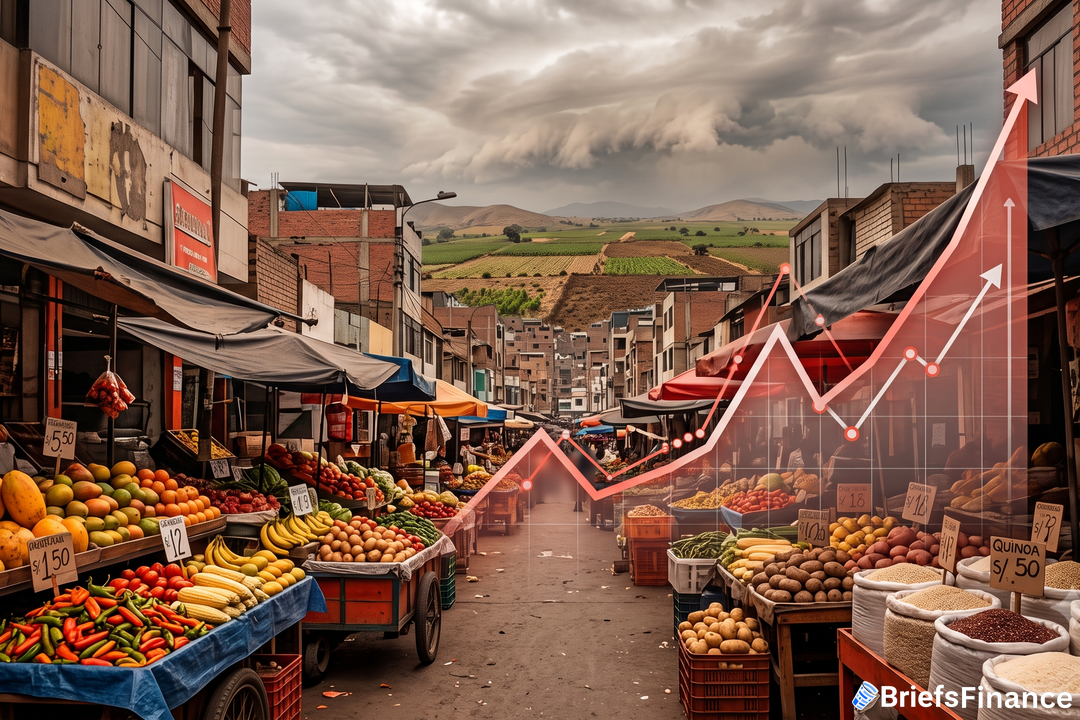
Peru's inflation is not slowing down as expected. The rise came despite a month-over-month price increase of only 0.23%, compared with a 0.16% drop from April to May.
Why Prices Are Still Climbing
The main driver was higher food costs. Additionally, a local shortage of natural gas, higher international oil costs, and adverse weather conditions contributed to the price increases. Poor weather reduced crop yields, making staples more expensive.
The central bank held its benchmark interest rate at 4.25% last month, unchanged from the previous meeting. The data came from INEI, Peru's national statistics agency.
Get your free investing masterclass bonus when you join Market Briefs, our free daily newsletter
Central Bank, Weather, and Political Change
The central bank's policy committee will meet on July 9. Before the data was released, Governor Julio Velarde remarked that he saw "no reason to raise interest rates." At the same time, ENFEN, Peru's El Niño monitoring agency, cautions that the Coastal El Niño may achieve high intensity in two separate windows: through October and from December to March. Intense rainfall and flooding may damage transportation networks and agricultural output.
On July 28, Keiko Fujimori will be sworn in as president of Peru. Fujimori, who is the conservative daughter of former leader Alberto Fujimori, takes office after narrowly winning the presidential runoff. Her five-year term begins after a slim margin of victory, and she becomes the ninth person to hold the presidency in Peru over the last ten years.
Background and Broader Economic Context
Persistent inflation above the central bank's target has put pressure on policymakers. Peru's economy has faced multiple headwinds in recent months, including supply-chain disruptions from poor harvests and rising energy costs linked to global oil price volatility. The natural gas shortage, partly due to maintenance at the Camisea gas field, has further squeezed production costs for businesses and households.
Meanwhile, the threat of Coastal El Niño adds uncertainty to agricultural output - key export crops such as coffee, quinoa, and asparagus could be hit by flooding or drought. The central bank's next decision on interest rates will weigh these supply-side pressures against weakening domestic demand, as consumer confidence remains fragile. Political transition under President-elect Fujimori also introduces potential shifts in fiscal policy, though her administration has signaled continuity in macroeconomic stability.
The combination of weather risks, energy constraints, and political change means inflation may stay elevated for longer than initially forecast, challenging the central bank's ability to bring price growth back within the 1%-3% comfort zone. The new government's approach to managing these overlapping pressures will be closely watched by markets and consumers alike, as any policy misstep could further erode confidence in Peru's economic outlook.
Subscribe to Market Briefs, our free daily newsletter, and claim your bonus investing masterclass