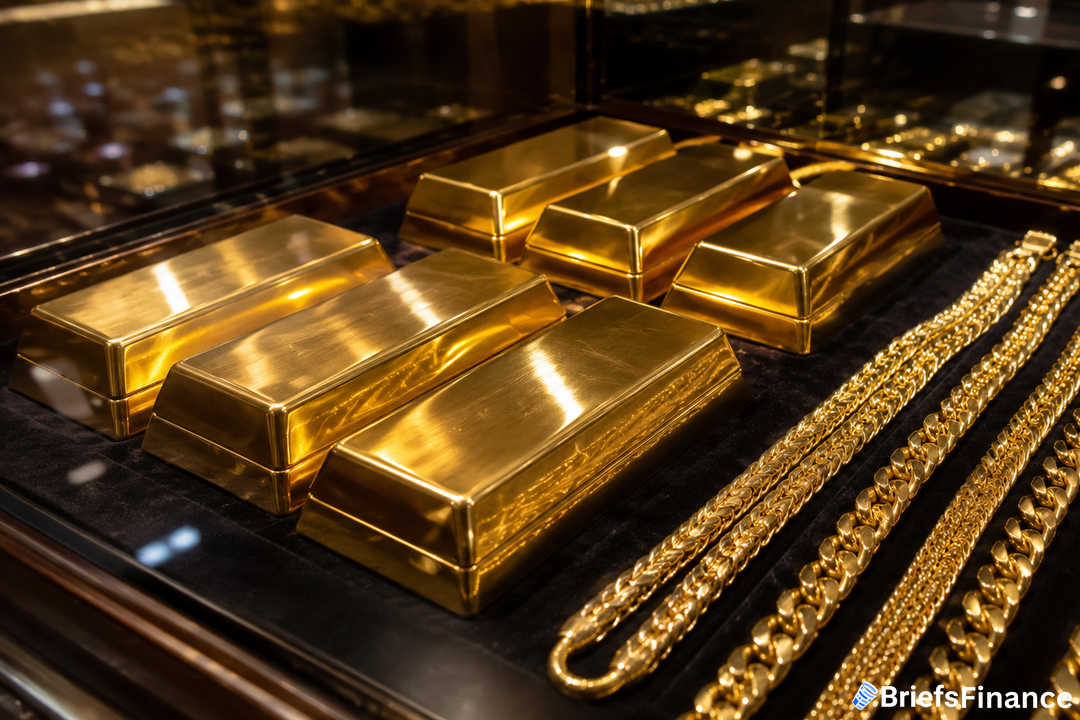
A Gold Rush That Cooled Fast
Laopu Gold had a pretty good run. The Chinese luxury jeweler saw revenue more than triple in the first half of 2025, riding a wave of demand from shoppers who wanted something beautiful that also held its value.
But that wave has lost some power. The number behind the slowdown is simple: gold prices have fallen. After hitting a record high in January 2026, the price of bullion dropped about 24% by the time this article was written.
When gold heads down, some shoppers stop seeing jewelry as a smart place to park their money. They wait instead.
Laopu expects maximum revenue of roughly 20.5 billion yuan, or about US$3.03 billion, for the six months ending June 2026. Adjusted net profit should climb 83% to 85%, hitting as much as 4.36 billion yuan. Strong numbers by most standards. Just less strong than before.
The Strategy Behind the Slump
Laopu is not a typical jeweler. Most of its products sell at fixed prices, and the company leans hard on craftsmanship rather than the weight of the gold. That approach worked beautifully when bullion was climbing and shoppers felt smart buying something that might go up.
Get the market news that matters in a five-minute read with Market Briefs, our free daily newsletter
But falling gold prices change the math. When the metal itself looks like it could lose value, the store of value argument weakens. Consumers pull back. That is exactly what happened here.
The slowdown is also part of a bigger pattern. Other Chinese brands that rode social media hype and speculative purchases - including collectible toy producers such as Labubu and the drink chain Chagee - have also seen their growth cool. Viral moments do not last forever.
Laopu operates nearly 50 boutiques across China. The company said that among luxury brands, it achieved the highest per-store sales and floor efficiency in mainland China for 2025 and the first six months of 2026.
Why does it matter? Even with the slowdown, Laopu is still growing much faster than most Western luxury brands. The question is whether that can hold.
What the Slowdown Means for Investors
Laopu's stock tells a rough story. That is a serious haircut - shares have dropped more than 60% - for a company that still expects revenue to grow more than 60%.
The company said the growth that remains is due to "the continuous expansion of brand influence" and "the improvement in high-value customer consumption." In other words, Laopu says its brand is getting stronger, and its richest customers are still spending. That is not nothing.
But the broader picture deserves attention. Falling gold prices change how people think about jewelry as an investment. When the asset underneath the product stops going up, the product itself gets a harder look. That dynamic affects not just Laopu but any luxury brand that competes for the same shoppers.
The good news is that Laopu's growth still dwarfs most peers. The risk is that a slowdown for a hot stock can feed on itself. If investors lost confidence in other viral Chinese brands after their growth cooled, Laopu may face the same test.
For your portfolio, the lesson is less about this one company and more about the pattern. When growth slows from a 221% surge to about 60% to 66%, the stock often reprices faster than the business actually changes. That can create opportunity or trap, depending on whether the underlying story is still intact.
Laopu says its brand influence is expanding and wealthy customers are stepping up. That is a bet worth watching closely, but not one to rush into blind.
Join Market Briefs, our free daily newsletter, for a quick daily rundown of the markets