Free NewsletterPro Login
S&P 500 6,287 +0.42%
DOW 44,521 -0.18%
NASDAQ 21,103 +0.71%
S&P 500 +12.4%
Briefs Finance Fund +24.8%
JOIN THE FUND →

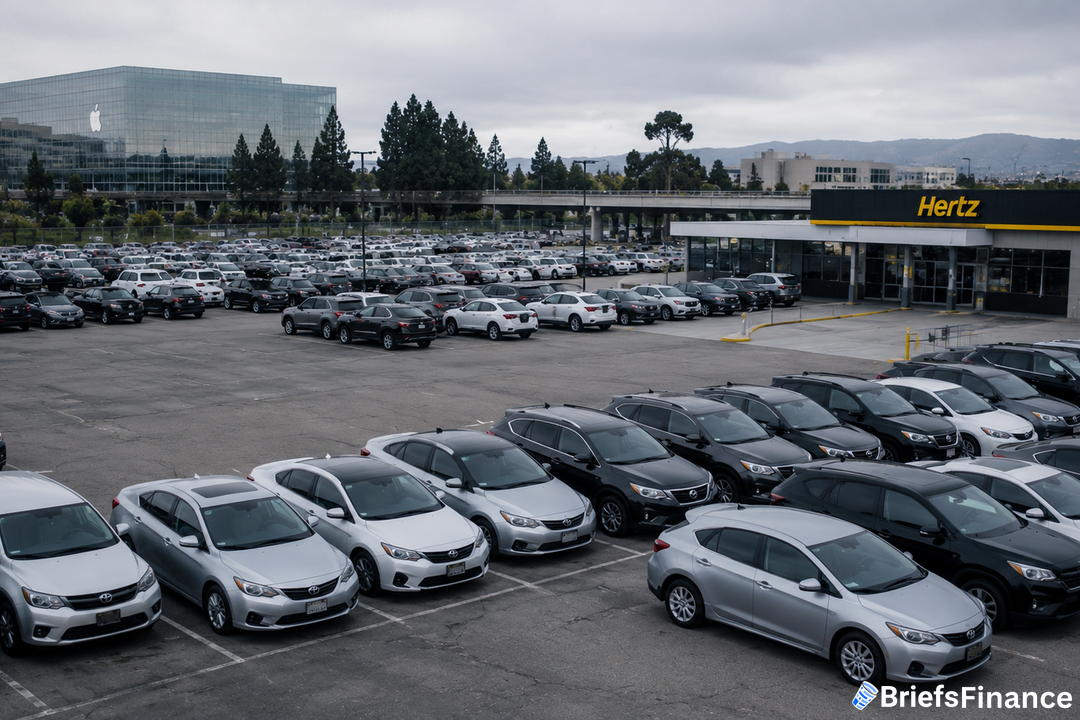
Hertz Stock Plunges 41% on Wednesday, 11% on Thursday as Apple Hikes Prices

Published Jun 28, 2026
[tts_player]
Share:
Summary:
  • Hertz’s stock fell 41% on the first day and another 11% on the second day after the company announced a plan to sell $100 million of shares and $300 million of convertible bonds, while also warning that second-quarter profit would miss analyst estimates.
  • Apple raised prices on nearly every product - from MacBooks to iPads to the Apple Vision Pro - because a surge in demand for memory chips from AI data centers caused an unprecedented jump in component costs.
  • Short sellers made $117.7 million in profit on the first day of Hertz’s decline, and Apple’s stock fell 6.1% on the day of its price increases.

Hertz shares had gained more than 50% from the start of 2026 through mid-April. Then the rental-car company announced a funding plan so complicated that even Wall Street analysts wondered why.

A company that seemed to be on a hot streak suddenly needed cash so badly that it turned to a complex mix of share sales and convertible bonds. Meanwhile, Apple faced the opposite problem. Demand for its products remained strong, but a shortage of memory chips forced it to raise prices across nearly every device.

Hertz's Funding Plan Sparks Selloff

Hertz said it would sell $100 million of shares and offer $300 million of convertible payment-in-kind notes. Buyers of the notes will also receive shares, allowing them to offset risk in the struggling company.

"Why are they doing something so complicated? They need funds and this is the only way they can pull it off through the debt markets," said SLC Management's Dec Mullarkey. "Its complicated structure is spooking investors."

The rental-car industry is tough. Companies carry a lot of debt because they buy huge fleets of vehicles. When used-car prices soften, their profits take a hit. Hertz warned that "current unexpected softness in the used car market" will raise its depreciation costs, and that its adjusted corporate EBITDA for the second quarter is expected to fall short of analysts' average forecasts.

Gabelli Funds portfolio manager Brian Sponheimer commented, "For a highly leveraged company in a difficult industry to begin with, the market is concerned about their ability to self fund."

Get your free investing masterclass bonus when you join Market Briefs, our free daily newsletter

S3's Ihor Dusaniwsky said, "The decline made the Hertz shorts' year."

Apple's Price Hikes Hit Every Product Line

Apple didn't just raise a few prices. It increased costs on nearly every Mac, iPad, accessory, and even the Apple Vision Pro. The starting price for the MacBook Neo jumped from $599 to $699.

The 16-inch MacBook Pro now starts at $2,999, up from $2,499. A fully loaded version costs $9,999.

The iPad lineup got hit too. The base iPad went from $349 to $449. The iPad mini rose from $499 to $599.

Even the HomePod mini climbed from $99 to $129. The Apple TV went from $129 to $199.

Why? A massive shortage of memory and storage chips. AI data centers are expanding fast and gobbling up chips. An Apple spokesperson said, "The rapid expansion of AI data centers has created an extraordinary surge in demand for memory and storage" and added that the company had "never seen a component price increase this much, this quickly."

Apple said, "We know this is not welcome news, and we are working tirelessly to find solutions." Apple CEO Tim Cook noted that the shortages are affecting supply, leading to extended constraints and shipment delays on many Mac models. Cook added that the constraints will likely last "several months."

Apple's stock fell 6.1% on the day of the announcement, closing at $275.15.

What to Watch

Two big questions remain. Will Hertz's stock keep falling, or will its funding plan eventually stabilize the company? And will Apple raise iPhone prices this fall?

Bloomberg Intelligence expects a $100 increase on Pro models, saying that "a $100 boost can offset 78% of higher expenses." Apple is also expected to release a new foldable smartphone that could cost over $2,000. Investors should pay close attention to how both companies navigate these pressures.

Subscribe to Market Briefs, our free daily newsletter, and claim your bonus investing masterclass

Disclosure

Recent News

1 2 3 28

Get Market Briefs delivered to your inbox every morning for free!

No fluff. No noise. No politics. Just finance news you can read in 5 minutes.

Blogs

June 25, 2026
How Stocks Work: A Simple Guide for Beginners
  • A stock is a slice of ownership in a company - buy one, and you own a piece of the business.
  • You make money two ways: the share price rising over time, and dividends paid to shareholders.
  • The simplest path for most beginners is buying into the whole market through a low-cost index fund.
Read More
June 25, 2026
Stop Loss vs Stop Limit: What's the Difference?
  • A stop loss order sells your stock once it hits a trigger price, prioritizing getting you out.
  • A stop limit order only sells within a price range you set, prioritizing price over a guaranteed exit.
  • The trade-off: a stop loss almost always executes; a stop limit might not if the price moves too fast.
Read More
June 25, 2026
Energy Stocks: A Simple Guide for Investors
  • Energy stocks are companies that produce and supply the power the world runs on, from oil and gas to newer sources.
  • They make up one of the 11 sectors of the market and tend to move with energy prices and big-picture shifts.
  • Like any sector, the key is diversification and understanding the forces driving demand.
Read More
June 18, 2026
What Is a Stop Loss Order? A Simple Guide
  • A stop loss order automatically sells a stock once it falls to a price you set.
  • It's a tool to cap losses or lock in gains without watching the market all day.
  • It works best for active strategies, and can backfire if used carelessly on long-term holdings.
Read More
June 18, 2026
Best S&P 500 Index Fund: How to Choose One
  • The best S&P 500 index fund for most investors is simply the cheapest, most established one that tracks the index well.
  • Funds like VOO, IVV, and SPY all hold the same 500 companies, so the biggest difference is the fee.
  • Pick one, automate your buys, and let time do the heavy lifting.
Read More
June 17, 2026
What Are Penny Stocks? Risks and Rewards Explained
  • Penny stocks are very low-priced shares of very small companies, often trading for just a few dollars or less.
  • They promise huge gains but carry huge risks: low liquidity, high failure rates, and wild price swings.
  • Most investors are better served by quality companies and funds than by chasing cheap shares.
Read More
June 17, 2026
Best Stocks for Beginners With Little Money
  • The best stocks for beginners with little money usually aren't individual stocks at all - they're low-cost index funds.
  • You can start with $100 or less and use small, regular investments to build wealth over time.
  • Focus on diversification and consistency, not on picking the next big winner.
Read More
June 16, 2026
Tech Stocks: A Simple Guide for New Investors
  • Tech stocks are companies in the information technology and related sectors, from software to chips to the internet giants.
  • They've driven much of the market's growth, but they can be volatile and richly valued.
  • The smart approach is to understand what you own and not let one sector run your whole portfolio.
Read More
June 16, 2026
What Is a Joint Stock Company? A Simple Guide
  • A joint stock company is a business owned by many people, each holding shares of stock that represent a slice of ownership.
  • It's the basic idea behind every public company you can buy on the stock market today.
  • Owning a share makes you a part-owner, entitled to a piece of the profits and growth.
Read More
June 16, 2026
Capital Gains Tax in California: A Simple Guide
  • Capital gains tax is what you owe when you sell an investment for more than you paid for it.
  • How long you held it matters: long-term gains are taxed more gently than short-term gains at the federal level.
  • Smart investors lower the bill with tools like tax-loss harvesting and holding for the long run.
Read More
1 2 3 23
Share via
Copy link










