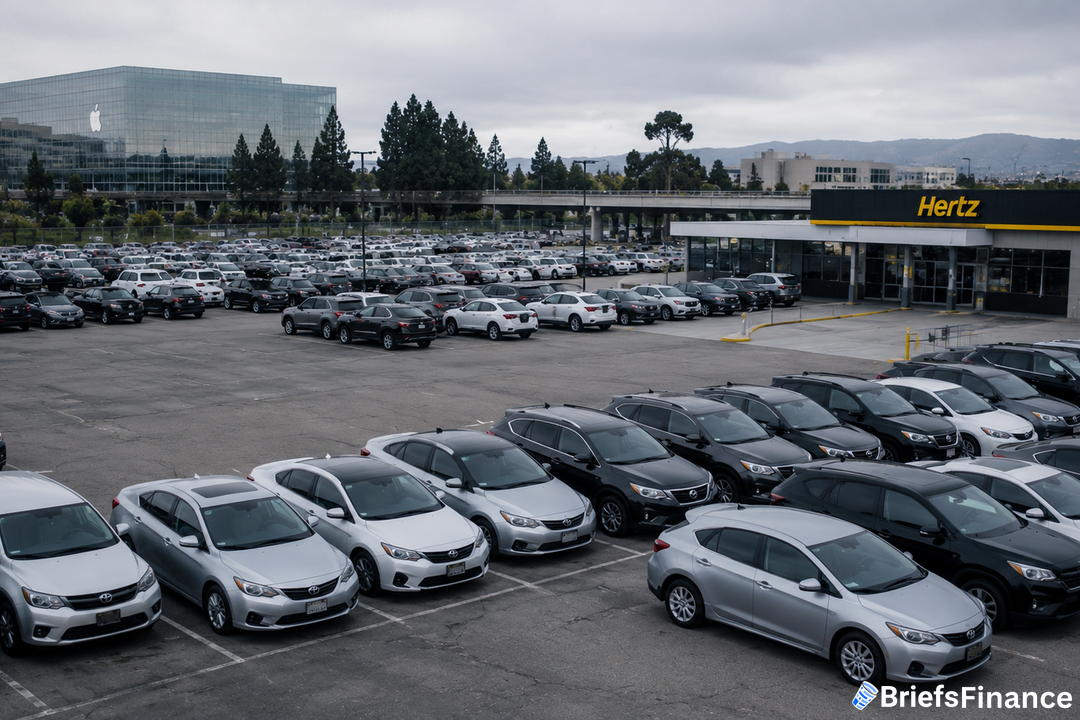
Hertz shares had gained more than 50% from the start of 2026 through mid-April. Then the rental-car company announced a funding plan so complicated that even Wall Street analysts wondered why.
A company that seemed to be on a hot streak suddenly needed cash so badly that it turned to a complex mix of share sales and convertible bonds. Meanwhile, Apple faced the opposite problem. Demand for its products remained strong, but a shortage of memory chips forced it to raise prices across nearly every device.
Hertz's Funding Plan Sparks Selloff
Hertz said it would sell $100 million of shares and offer $300 million of convertible payment-in-kind notes. Buyers of the notes will also receive shares, allowing them to offset risk in the struggling company.
"Why are they doing something so complicated? They need funds and this is the only way they can pull it off through the debt markets," said SLC Management's Dec Mullarkey. "Its complicated structure is spooking investors."
The rental-car industry is tough. Companies carry a lot of debt because they buy huge fleets of vehicles. When used-car prices soften, their profits take a hit. Hertz warned that "current unexpected softness in the used car market" will raise its depreciation costs, and that its adjusted corporate EBITDA for the second quarter is expected to fall short of analysts' average forecasts.
Gabelli Funds portfolio manager Brian Sponheimer commented, "For a highly leveraged company in a difficult industry to begin with, the market is concerned about their ability to self fund."
Get your free investing masterclass bonus when you join Market Briefs, our free daily newsletter
S3's Ihor Dusaniwsky said, "The decline made the Hertz shorts' year."
Apple's Price Hikes Hit Every Product Line
Apple didn't just raise a few prices. It increased costs on nearly every Mac, iPad, accessory, and even the Apple Vision Pro. The starting price for the MacBook Neo jumped from $599 to $699.
The 16-inch MacBook Pro now starts at $2,999, up from $2,499. A fully loaded version costs $9,999.
The iPad lineup got hit too. The base iPad went from $349 to $449. The iPad mini rose from $499 to $599.
Even the HomePod mini climbed from $99 to $129. The Apple TV went from $129 to $199.
Why? A massive shortage of memory and storage chips. AI data centers are expanding fast and gobbling up chips. An Apple spokesperson said, "The rapid expansion of AI data centers has created an extraordinary surge in demand for memory and storage" and added that the company had "never seen a component price increase this much, this quickly."
Apple said, "We know this is not welcome news, and we are working tirelessly to find solutions." Apple CEO Tim Cook noted that the shortages are affecting supply, leading to extended constraints and shipment delays on many Mac models. Cook added that the constraints will likely last "several months."
Apple's stock fell 6.1% on the day of the announcement, closing at $275.15.
What to Watch
Two big questions remain. Will Hertz's stock keep falling, or will its funding plan eventually stabilize the company? And will Apple raise iPhone prices this fall?
Bloomberg Intelligence expects a $100 increase on Pro models, saying that "a $100 boost can offset 78% of higher expenses." Apple is also expected to release a new foldable smartphone that could cost over $2,000. Investors should pay close attention to how both companies navigate these pressures.
Subscribe to Market Briefs, our free daily newsletter, and claim your bonus investing masterclass