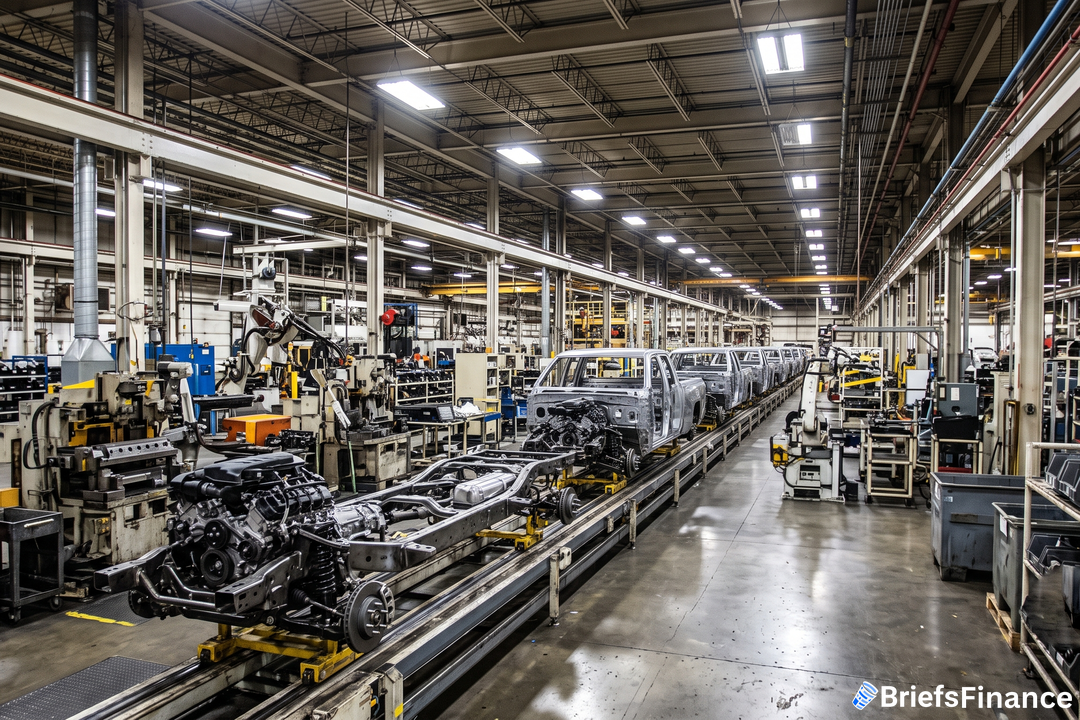
Ford sold fewer cars and trucks last quarter. Yet its piece of the U.S. market got a little bigger. The company's actual decline was slightly smaller than what analysts had expected.
The Quarterly Sales Picture
Ford reported total U.S. sales of 549,200 vehicles for the three months ending June 2026, a 10.3% drop from the same period a year earlier. For the first half of the year, the automaker sold roughly 1 million vehicles, down 9.6% from 1.1 million during the first half of last year. Despite falling volume, Ford's estimated retail market share in the U.S. rose to 12.3% at the end of Q2, up 0.2 percentage points from a year earlier.
That small gain came even as independent forecaster Cox Automotive had predicted a larger 11.5% decline for the quarter.
Get your free investing masterclass bonus when you join Market Briefs, our free daily newsletter
Why Sales Dropped
Two main reasons pushed Ford's sales lower. First, the company's top aluminum supplier suffered two fires late last year, which disrupted production of the F-Series pickup trucks. Sales of the F-Series, including the F-150, fell 11% during the quarter. Ford said in a press release, "Although customer demand remains high, first-half F-Series sales reflect a retiming of commercial production following last year's aluminum supply shortages." The company anticipates that aluminum availability will improve significantly later this year.
Second, consumer demand for all-electric cars and trucks dropped sharply. Ford's all-electric vehicle sales in the second quarter of 2026 fell 40.7% compared to the prior year's quarter. That decline hit like a one-two punch - first the aluminum shortage, then the EV slowdown.
Broader Context
Ford's Q2 performance highlights a turbulent period for the automaker, yet its slight market-share gain suggests it fared better than some rivals amid widespread headwinds. The aluminum fires created a production bottleneck for the highly profitable F-Series, while the broader EV sector has cooled as higher interest rates and charging concerns temper consumer enthusiasm. Ford continues to invest in its electric-vehicle lineup, but near-term demand remains under pressure.
This small increase indicates that while Ford sold fewer vehicles, its competitors may have suffered even larger losses. The company's ability to maintain share during a period of supply constraints suggests underlying brand strength.
What to Watch
In the latter half of 2026, Ford predicts a fuller restoration of supply, which should enable F-Series output to return to normal levels. The company also pointed out that the F-Series remained the best-selling truck in the United States despite the quarterly drop.
Subscribe to Market Briefs, our free daily newsletter, and claim your bonus investing masterclass