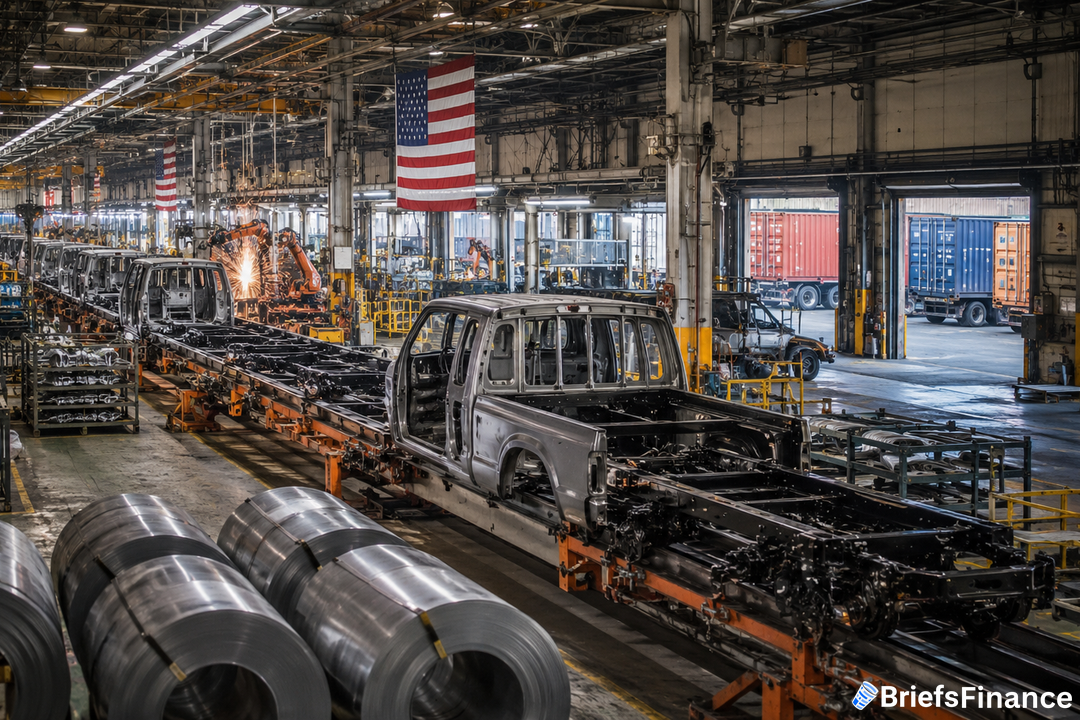
Ford builds more vehicles in the United States than any other automaker. Yet its CEO says the company faces a competitive disadvantage against rivals that import heavily from lower-cost countries. He wants the upcoming USMCA trade deal rewrite to fix that.
Farley's Pitch
Jim Farley, Ford's chief executive, argues that the revised USMCA should reward automakers that build most of their vehicles inside the United States. It should also add penalties for companies that import many vehicles from places like Japan and South Korea.
"It's imperative that any new agreement makes it easier, not harder, to compete with U.S. makers who import from Japan, South Korea and global competitors that import from those locations," Farley said in a CNBC interview on July 2, 2026. "That's the key for us."
Ford exported 311,000 vehicles to more than 60 countries last year, while importing only 378,000. That import share of 17% is far lower than many competitors. Farley also highlighted Ford's U.S. workforce: "Ford's a leader of U.S. auto production with the most U.S.-built vehicles but, more importantly, we import very few, and we export the most, and we have the most UAW workers here."
The Import Gap
General Motors, the No. 1 seller in the U.S., imported 1.17 million vehicles in 2025 - 41% of its U.S. sales. Toyota, the No. 2 seller, imported more than 1.19 million vehicles, or 47% of its sales. Hyundai, the largest importer from South Korea, plans to produce 80% of its U.S. sales domestically by 2030.
Get your free investing masterclass bonus when you join Market Briefs, our free daily newsletter
The auto industry accounts for about 18% of total U.S. trade with Canada and Mexico.
The Broader Context
The USMCA, which replaced NAFTA in 2020, was designed to modernize North American trade. Its built-in review process allows for renegotiation every six years, but the Trump administration's decision to shift to annual reviews has injected new uncertainty. With the auto industry deeply integrated across borders, any changes to rules of origin or tariff preferences could force automakers to reconfigure supply chains, potentially raising costs and affecting vehicle prices across the region.
Uncertainty Ahead
Automakers, dealers and suppliers worry that reopening the deal will create uncertainty, which might reduce investment and cost jobs. A coalition of American industry organizations representing the majority of car manufacturers, dealerships, and parts suppliers released a statement calling for a swift extension agreement among the three nations.
"We urge the leaders of the U.S., Canada, and Mexico to swiftly reach consensus on an extension of USMCA that preserves the existing trilateral partnership," the group said. "Returns to preferential treatment for qualifying goods, and continues the stability and predictability that has helped the industry thrive for the past six years."
The stakes are high: the annual review process creates a rolling threat of renegotiation, and any major shift in rules could disrupt the cross-border supply chains that have grown under the current framework. Even small changes in tariff preferences or content requirements can ripple through factory planning, employment levels, and vehicle pricing across North America.
What to Watch
The USMCA talks officially reopened on July 2, 2026. How the three nations balance Farley's demands with the broader industry's call for stability will determine whether the deal survives to 2036. The outcome could reshape the competitive landscape for every major automaker selling in the United States.
Subscribe to Market Briefs, our free daily newsletter, and claim your bonus investing masterclass