Free NewsletterPro Login

Financial Stocks Drop as AI Disruption Fears Grow

A stylized illustration of a cylindrical cup with blue arrows and lines indicating a swirling or rotational motion inside the cup.
Published Feb 10, 2026
Share:
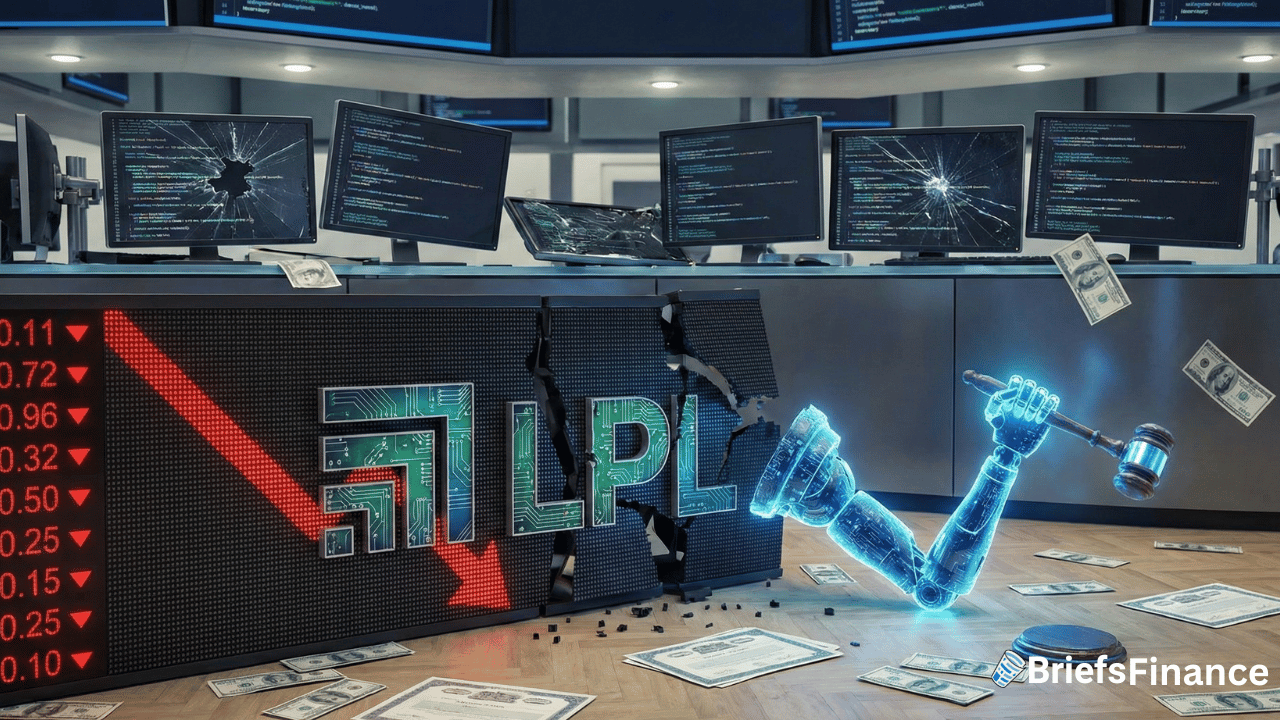
A digital gavel shatters a stock market display with the LPL logo as computer monitors glitch and paper money falls, symbolizing AI disruption and turmoil in financial stocks.
Summary:

  • LPL Financial shares closed 8.31% lower after falling 11% during the day.
  • Charles Schwab's stock price decreased by 7.42%, while Raymond James Financial lost 8.75%.
  • Morgan Stanley's shares fell by 2.4% as the market reacted to AI advancements.

Financial Services Face AI Challenges

Shares of financial services firms took a hit on Tuesday, following concerns about artificial intelligence disrupting their industry.

LPL Financial saw its stock close down 8.31% after it had plummeted 11% in midday trading. Other firms were also affected, with Charles Schwab's stock falling 7.42% and Raymond James Financial dropping 8.75%. Morgan Stanley's shares decreased by 2.4% as investors reacted to these developments.

Launch of AI-Powered Tax Tool

The drop in financial stocks came after Altruist introduced a new AI-powered tax planning tool named Hazel. This tool promises to create personalized tax strategies for clients in just minutes.

It analyzes various financial documents, including 1040s, paystubs, and account statements, to develop these strategies. Such advancements raise fears that AI could replace some services currently offered by financial advisors, potentially impacting their profitability.

Broader Market Impact

This isn't the first time AI advancements have led to stock declines in the financial sector. Earlier this year, software stocks faced similar challenges after the introduction of new AI models that could perform tasks typically done by humans.

The iShares Expanded Tech-Software ETF (IGV) has already declined by 19% this year, with companies like ServiceNow and LegalZoom experiencing significant losses.

ETF Performance Indicates Market Sentiment

On Tuesday, the iShares U.S. Broker-Dealers and Securities ETF also reflected negative sentiment, falling by 3.13%.

This suggests that the fears surrounding AI are not limited to individual stocks but are part of a larger trend affecting the financial services market as a whole.

What This Means for Investors

As AI technology continues to evolve, investors may need to keep a close eye on how it impacts the financial sector.

The launch of tools like Hazel could change the landscape of financial advising, which may lead to further volatility in stock prices. Investors should consider these trends when making decisions in the financial market.

Disclosure

Get Market Briefs delivered to your inbox every morning for free!

No fluff. No noise. No politics. Just finance news you can read in 5 minutes.

Blogs

May 30, 2026
Financial Literacy Books That Actually Build Wealth
  • The best financial literacy books don't just teach budgeting, they shift how you think about money.
  • Two classics stand out: The Intelligent Investor for valuing investments, and Rich Dad Poor Dad for the owner's mindset.
  • Reading is only step one. The real wealth comes from acting on what you learn.
Read More
May 30, 2026
What Is a Roth Conversion? A Simple Guide
  • A Roth conversion moves money from a traditional retirement account into a Roth account.
  • You pay taxes on the money now, in exchange for tax-free growth and withdrawals later.
  • It can pay off if you expect higher taxes or more income in the future, but the timing and tax hit matter a lot.
Read More
May 30, 2026
Trailing Stop Loss: How to Protect Your Gains
  • A trailing stop loss is an order that automatically sells a stock if it falls a set percentage from its recent high.
  • As the stock rises, the sell point rises with it, locking in gains while capping losses.
  • It's most useful for active strategies like momentum investing, not for long-term buy-and-hold.
Read More
May 30, 2026
5 Types of Wealth: Why Money Is Only One of Them
  • Real wealth is more than a bank balance. It spans your finances, health, mind, purpose, and freedom.
  • Money is powerful, but it amplifies the life you already have rather than fixing a broken one.
  • True financial wealth means your cash flow covers your expenses, so your money works while you live.
Read More
May 30, 2026
How to Invest in Private Equity: A Beginner's Guide
  • Private equity means investing in companies that aren't listed on the stock market.
  • Traditional private equity is built for experienced, high-net-worth investors with large amounts to invest.
  • New rules have opened more accessible paths, like startup crowdfunding and real estate deals, often starting around $100.
Read More
May 30, 2026
What Is a Call Option? A Simple Guide With Examples
  • A call option gives you the right to buy a stock at a set price by a set date.
  • Investors buy calls when they expect a stock to rise, using less money than buying the shares outright.
  • The most you can lose buying a call is the premium, but time works against you, so it's an advanced tool.
Read More
May 30, 2026
EBITDA Formula: How to Calculate It Step by Step
  • EBITDA stands for Earnings Before Interest, Taxes, Depreciation, and Amortization, a measure of a company's core profit.
  • The formula adds those four items back to net income to show what the underlying business earns.
  • Investors use EBITDA to compare companies and to judge how many times earnings a stock is selling for.
Read More
May 30, 2026
What Is a Stock Option? A Plain-English Guide
  • A stock option is a contract giving you the right, but not the obligation, to buy or sell a stock at a set price by a set date.
  • There are two types: calls (the right to buy) and puts (the right to sell).
  • Options are powerful but risky, so they suit investors who already have the basics down.
Read More
May 30, 2026
Put Option: What It Is and How It Works
  • A put option gives you the right to sell a stock at a set price by a set date.
  • Investors use puts to bet a stock will fall, or as insurance to protect shares they own.
  • The most you can lose buying a put is the premium you paid, which makes it a defined-risk tool.
Read More
May 30, 2026
Operating Margin: What It Is and How to Calculate It
  • Operating margin shows how much profit a company keeps from its core business after paying its running costs.
  • The formula is operating income divided by revenue, shown as a percent.
  • A strong, steady operating margin signals a well-run business that controls its costs.
Read More
1 2 3 22
Share via
Copy link









