The Old Guard of Logistics Meets the New
For 12 years, Keller Rinaudo and his team at Zipline worked on drone delivery. As Rinaudo said, "This thing that we were working on for 12 years that everyone thought was totally weird and was never going to work is now becoming totally normal."
To keep up with that pace, Zipline just brought in three executives who know what scaling looks like. Sendil Palani spent about 17 years at Tesla, most recently as a vice president of finance. Kevin Vosen spent seven years at Waymo, the self-driving car company owned by Alphabet, as its chief legal officer.
Allen Penn was previously a vice president at Uber Eats. All three joined Zipline this year to lead the company's push into new U.S. markets.
Rinaudo puts it bluntly: "It's at a crazy inflection point."
Zipline's growth has been staggering. The company, founded in 2014, has completed over 2.5 million commercial deliveries, with one million of those occurring in just the last twelve months. About seven in ten of its daily deliveries now take place within the United States, and its South San Francisco factory produces 24,000 new drones each year. This is a major change from when it started out, shipping medical supplies and relief packages to remote health centers and agricultural areas in Rwanda and Ghana.
Get the market news that matters in a five-minute read with Market Briefs, our free daily newsletter
What a Grown-Up Drone Market Looks Like
The broader industry is growing fast. According to analysts at PwC, the U.S. drone market is expected to expand by 65% annually between 2024 and 2034, with delivery numbers climbing from about 13 million this year to over 800 million in 2034.
Palani described Zipline as a similarly mission-focused company with operations spanning precision manufacturing and charging infrastructure maintenance. His predecessor as Zipline CFO, Deepak Ahuja, also came from Tesla and personally recommended Palani for the role.
Zipline already has big-name partners. Walmart uses its drones. So do Little Caesars and Chipotle.
Cleveland Clinic is working with Zipline on a healthcare home delivery service in a suburb of Cleveland. The quickest order-to-delivery time recorded so far is roughly five minutes for certain orders in Dallas.
Competitors include Alphabet's drone unit Wing, startups such as Flytrex and Matternet, and firms building cargo drones for the military.
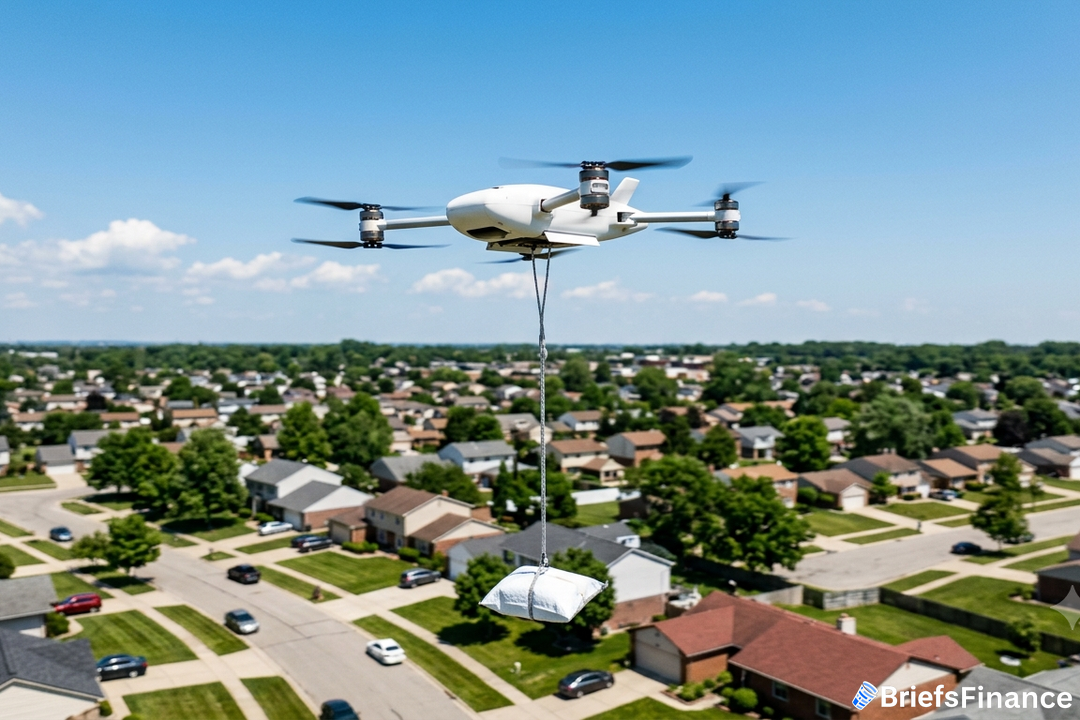
The shift from gas-powered trucks to electric drones represents a fundamental change in last-mile logistics. With each drone carrying up to 8 pounds, the company argues that sending a two-ton vehicle for a small package is wasteful. Zipline's autonomous system eliminates the need for a human driver, reducing labor costs and carbon emissions.
Your Next Package Could Come from the Sky
Zipline intends to begin service shortly in Austin, Houston, and Cleveland, and will expand to additional cities later. Rinaudo says the company is planning for "many tens of metros across the U.S. and some new, large international markets" in 2027.
The bottom line: drone delivery is becoming something ordinary. A machine that carries up to 8 pounds can now get a pizza or a prescription to your door.
"It doesn't make sense to have a 3,000-pound gas-powered, combustion engine vehicle and a person deliver something to your house that weighs five pounds," Rinaudo says.
Join Market Briefs, our free daily newsletter, for a quick daily rundown of the markets