Free NewsletterPro Login
S&P 500 6,287 +0.42%
DOW 44,521 -0.18%
NASDAQ 21,103 +0.71%
S&P 500 +12.4%
Briefs Finance Fund +24.8%
JOIN THE FUND →

Apple in Discussions With Company That Compresses AI Models onto a Single iPhone

Published Jul 14, 2026
[tts_player]
Share:
Summary:
  • Apple is negotiating a potential partnership with PrismML, a startup that compresses large AI models to run entirely on an iPhone.
  • The company claims it reduced a 54‑gigabyte AI model to under 4 gigabytes, using 10-15 times less memory and running 6-8 times faster.
  • The talks come as Apple seeks to improve Siri without relying on the cloud, while facing rising memory costs.

Why Apple Is Looking at This Startup

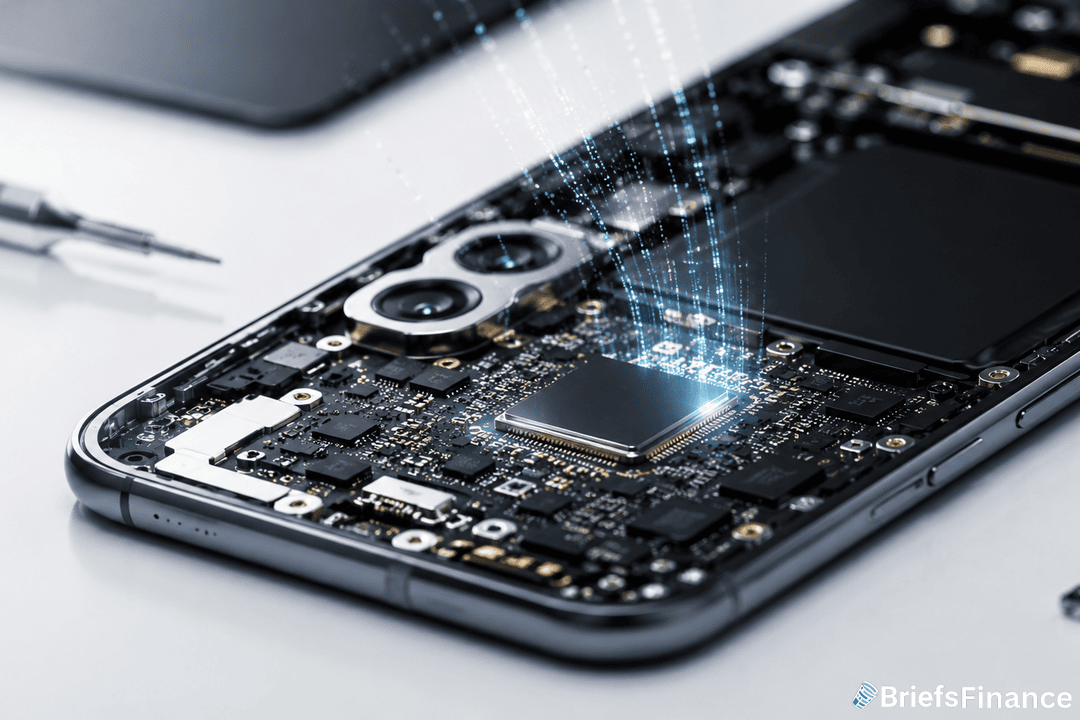
Your phone's assistant wants to be smarter, but there is a problem. The most powerful AI models are too big to fit on a device the size of an iPhone. They live in the cloud, which means every time you ask Siri something, your request leaves your phone and travels to a data center. That takes time, uses energy, and raises questions about privacy.

Apple has been trying to fix that. The company wants Siri to be faster and keep your data on your device. But the models that give AI its brains are enormous. Think of them as huge files that need a lot of storage and a lot of memory to run.

That is where PrismML comes in. The startup says it can squeeze those massive models down until they fit onto a phone. Babak Hassibi, PrismML's CEO, told CNBC, "They're really evaluating our technology right now."

How small can they go? The startup took a model from Alibaba called Qwen that had 27 billion parameters, compressed it from 54 gigabytes to less than 4 gigabytes. That is roughly the difference between a full-length movie and a single song.

The technology emerged from the California Institute of Technology, which holds the underlying patents. The startup is backed by Khosla Ventures and raised $16.25 million in seed funding in March.

Get the market news that matters in a five-minute read with Market Briefs, our free daily newsletter

The Financial Pressure Behind the Talks

Apple is not just looking for better AI. It is also trying to control costs.

For fiscal 2027, Morgan Stanley projects that Apple's per-bit DRAM cost might increase by about 190% compared to the previous year, with NAND costs up about 180%. Memory is a big part of what makes a phone expensive. The analysts anticipate that Apple will increase the base price of equivalent iPhone 18 devices.

Now add the AI problem. Running smart models on a phone requires more memory, not less. Still, doing more on the device means Apple can lean less on cloud services. That saves money on servers and data transfers. Horace Dediu, founder of Asymco, described the challenge this way: "They're trying to figure out how big a model and how clever a model they can fit on the device."

What the Testing Phase Means

PrismML's technology is not a done deal yet. Apple and other companies are now running their own tests. They are checking whether the compressed models actually deliver the speed, energy savings, and accuracy the startup claims.

Tarun Pathak, who serves as research director at Counterpoint Research, offered a blunt assessment: "The ultimate test will be millions of queries, thousands of device combinations and robust testing at scale." He added that a blend of cloud and on-device AI can provide a more complete, efficient and privacy-centric experience.

PrismML plans to next compress Google's open-source Gemma model, and eventually tackle much larger models that today generally require datacenter hardware. That could open the door for phones that do not need to phone home at all for smart answers.

The bottom line: If the tests pass, Apple could ship an iPhone that runs serious AI without the cloud. That means faster responses, better privacy, and fewer server costs. But those memory cost increases will still hit, so phone prices could rise either way. Carolina Milanesi, president and principal analyst for Creative Strategies, encapsulated the reasoning: "The more you can do on device, the better it is."

For investors, this is worth watching. If Apple pulls it off, the next iPhone could feel noticeably smarter. If not, the wait continues. Either way, the pressure to fit more brain into a pocket-sized computer is only getting stronger.

Join Market Briefs, our free daily newsletter, for a quick daily rundown of the markets
Disclosure

Recent News

1 2 3 35

Get Market Briefs delivered to your inbox every morning for free!

No fluff. No noise. No politics. Just finance news you can read in 5 minutes.

Blogs

June 29, 2026
Portfolio Diversification: Why Putting All Your Eggs in One Basket Destroys Wealth
  • Real diversification means spreading investments across all 11 economic sectors plus bonds, alternatives, and cash so no single bet can sink the portfolio.
  • Different sectors perform at different times, so a diversified portfolio captures upswings while smoothing the brutal drawdowns that wipe out concentrated bets.
  • Total market index funds offer the simplest path to diversification, and annual rebalancing is what keeps the structure working over time.
Read More
June 29, 2026
Non Taxable Income: What It Is and Why It Matters
  • Non taxable income is money you receive that you don't owe income tax on.
  • The tax code treats workers, investors, and business owners very differently, and investors often come out ahead.
  • Learning how income is taxed is a quiet superpower for keeping more of what you earn.
Read More
June 29, 2026
Semiconductor Stocks: A Simple Guide for Investors
  • Semiconductor stocks are companies that design and make computer chips, the brains inside nearly every modern device.
  • The AI boom has turned chips into one of the market's most important and most watched groups.
  • They offer big growth potential, but come with high valuations and a notoriously cyclical history.
Read More
June 25, 2026
How Stocks Work: A Simple Guide for Beginners
  • A stock is a slice of ownership in a company - buy one, and you own a piece of the business.
  • You make money two ways: the share price rising over time, and dividends paid to shareholders.
  • The simplest path for most beginners is buying into the whole market through a low-cost index fund.
Read More
June 25, 2026
Stop Loss vs Stop Limit: What's the Difference?
  • A stop loss order sells your stock once it hits a trigger price, prioritizing getting you out.
  • A stop limit order only sells within a price range you set, prioritizing price over a guaranteed exit.
  • The trade-off: a stop loss almost always executes; a stop limit might not if the price moves too fast.
Read More
June 25, 2026
Energy Stocks: A Simple Guide for Investors
  • Energy stocks are companies that produce and supply the power the world runs on, from oil and gas to newer sources.
  • They make up one of the 11 sectors of the market and tend to move with energy prices and big-picture shifts.
  • Like any sector, the key is diversification and understanding the forces driving demand.
Read More
June 18, 2026
What Is a Stop Loss Order? A Simple Guide
  • A stop loss order automatically sells a stock once it falls to a price you set.
  • It's a tool to cap losses or lock in gains without watching the market all day.
  • It works best for active strategies, and can backfire if used carelessly on long-term holdings.
Read More
June 18, 2026
Best S&P 500 Index Fund: How to Choose One
  • The best S&P 500 index fund for most investors is simply the cheapest, most established one that tracks the index well.
  • Funds like VOO, IVV, and SPY all hold the same 500 companies, so the biggest difference is the fee.
  • Pick one, automate your buys, and let time do the heavy lifting.
Read More
June 17, 2026
What Are Penny Stocks? Risks and Rewards Explained
  • Penny stocks are very low-priced shares of very small companies, often trading for just a few dollars or less.
  • They promise huge gains but carry huge risks: low liquidity, high failure rates, and wild price swings.
  • Most investors are better served by quality companies and funds than by chasing cheap shares.
Read More
June 17, 2026
Best Stocks for Beginners With Little Money
  • The best stocks for beginners with little money usually aren't individual stocks at all - they're low-cost index funds.
  • You can start with $100 or less and use small, regular investments to build wealth over time.
  • Focus on diversification and consistency, not on picking the next big winner.
Read More
1 2 3 24
Share via
Copy link











