Free NewsletterPro Login

Warning: Undefined variable $stocks in /var/www/briefs.co/htdocs/wp-content/plugins/oxygen/component-framework/components/classes/code-block.class.php(133) : eval()'d code on line 448

Warning: foreach() argument must be of type array|object, null given in /var/www/briefs.co/htdocs/wp-content/plugins/oxygen/component-framework/components/classes/code-block.class.php(133) : eval()'d code on line 448

Warning: Undefined variable $funds in /var/www/briefs.co/htdocs/wp-content/plugins/oxygen/component-framework/components/classes/code-block.class.php(133) : eval()'d code on line 472

Warning: foreach() argument must be of type array|object, null given in /var/www/briefs.co/htdocs/wp-content/plugins/oxygen/component-framework/components/classes/code-block.class.php(133) : eval()'d code on line 472
/* the link was here */

Costlier Construction Supplies Hit Smaller Homebuilders Hardest

Published Aug 24, 2026
[tts_player]
Share:
Summary:
  • Material costs rose 6.7% in the year ending July 2026, according to the NAHB/Wells Fargo Housing Market Index.
  • 72.9% of builders said the cost of materials needed to build an identical house rose by as much as 15%.
  • Builders with no more than five new-home starts saw material costs climb 9.1%, compared with 1.8% for companies with 100-plus starts.

Higher Costs Spread Across the Industry

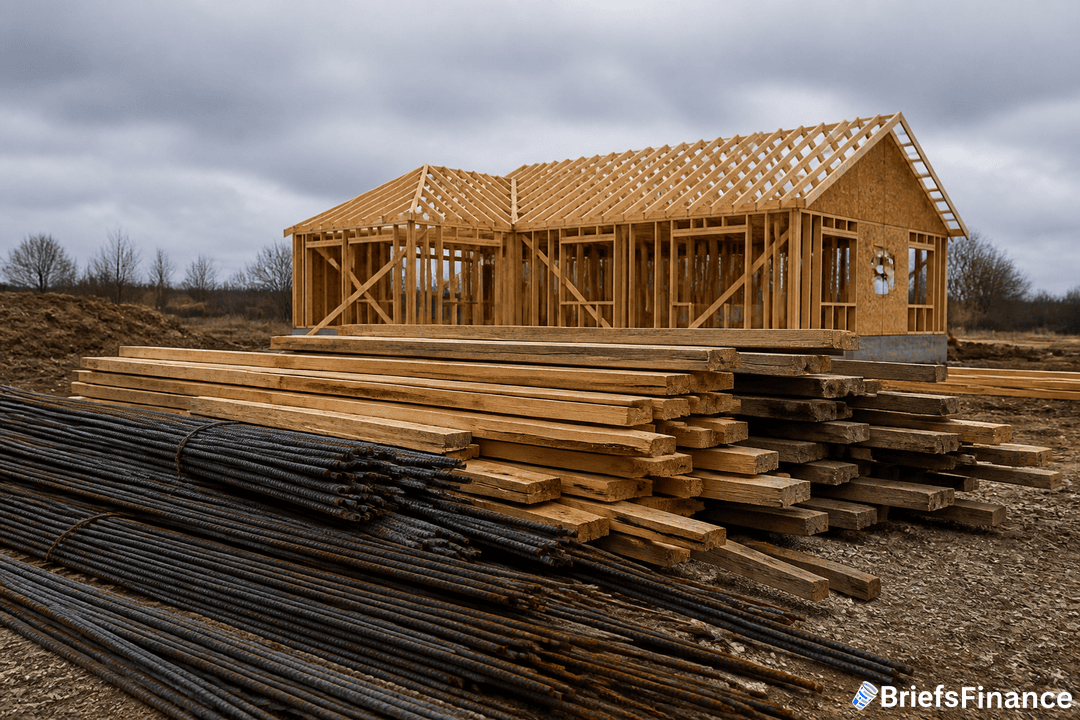
A newly built house costs more than it did a year ago, and only a small share of builders avoided any increase. According to the July 2026 NAHB/Wells Fargo Housing Market Index, material costs rose 6.7% compared with the same period in 2025. That matched the 6.7% increase in the Producer Price Index tracking materials for newly built homes, including energy costs.

Builders were asked how much more they paid to construct the identical house this year versus last year. 72.9% said the cost of materials required to build the same house had risen by 15% or less. That means the price squeeze was widespread, not limited to one region or type of builder.

Cost Increases Are Not Uniform

The degree of pain varied considerably. The largest share of builders, 28.4%, saw costs rise between 5% and 9.99%. Another 22.4% reported an increase under 5%, while 22.1% experienced a jump of 10% to 14.99%.

With material costs climbing, build your wealth steadily by grabbing the free Always Be Buying E-Book for simple investing tips.

Meaningful. Even when energy is excluded, the Producer Price Index for residential construction goods rose 5.0%. The median annual increase was 6.7%, which lines up with the broader index. The spread across categories shows that some companies managed to contain yawning while others faced much steeper bills.

Leverage in Purchasing Power

The size of a construction firm was a major factor in the cost climb. For builders who began no more than five homes in 2025, the median material-cost increase was 9.1%; for firms with at least 100 starts, it was 1.8%. That stark gap reflected purchasing power.

Larger firms can often lock in supplier contracts, buy in bulk, and carry larger inventories. Smaller operations do not have that type of market leverage. They tend to pay the prevailing price each time they purchase lumber, concrete, and electrical supplies. As those prevailing prices climb, the smaller builder feels the pressure more quickly.

Why Higher Input Costs Matter

For investors, the difference between 1.8% and 9.1% is important. Public homebuilders may be able to shield their margins from a modest cost increase. But smaller private contractors, who make up a substantial part of the housing market, cannot easily do so. Those higher costs may push up home prices or reduce builder profit margins.

For context, the survey asks builders to compare the cost of building the same house year over year. The July 2026 reading therefore reflects conditions across the industry, not just one segment.

For anyone buying a new home, the situation is straightforward. When the underlying materials become more expensive, someone in the chain eventually pays. Builders generally cannot absorb higher cost in quiet for long. As long as material prices continue moving upward, prospective buyers should expect the effects to show up in their prices.

In short, rising construction costs are real, widespread, and hitting smaller builders especially hard. Keep an eye on material prices, because they are a clear signal for margin and pricing trends in the housing market.

When builders feel the pinch, remember consistent investing is key, so download the free Always Be Buying E-Book today.

Disclosure

Recent News

1 2 3 61

Get Market Briefs delivered to your inbox every morning for free!

No fluff. No noise. No politics. Just finance news you can read in 5 minutes.

Blogs

August 23, 2026
How to Get the Most From Your Guideline 401k
  • Guideline is a company that provides low-cost 401k plans, popular with small businesses and their employees.
  • A "Guideline 401k" follows the same core rules as any 401k: tax-advantaged growth, contribution limits, and often an employer match.
  • The biggest results come from capturing the full match, choosing low-cost funds, and picking Roth or traditional to fit your situation.
Read More
August 23, 2026
Principal 401k: What to Know About Your Plan
  • Principal is one of many companies that manage workplace 401k plans, so a "Principal 401k" is simply a 401k where Principal is the provider.
  • The rules of a 401k are the same no matter who runs it: pre-tax or Roth contributions, tax-advantaged growth, and often an employer match.
  • The biggest wins come from grabbing the full match, picking low-cost funds, and knowing whether Roth or traditional fits you.
Read More
August 23, 2026
What a Tariff Dividend Means for Your Money
  • A "tariff dividend" is the idea of taking money the government collects from tariffs and paying some of it back to citizens.
  • To judge the idea, you first need to know what a tariff is: a tax on imported goods, usually paid by the companies bringing them in.
  • Tariffs ripple through prices, businesses, and your investments, so the smart move is understanding those ripples, not just the headline.
Read More
August 23, 2026
No Tax on Overtime: How Overtime Pay Is Taxed
  • "No tax on overtime" refers to a tax break that lets certain workers deduct some overtime pay, lowering the income they get taxed on.
  • A deduction does not mean overtime is truly tax-free. It means part of that pay is subtracted before your tax is figured.
  • The bigger money lesson: how you earn money changes how it is taxed, and investors often get the friendliest treatment of all.
Read More
August 23, 2026
Reading the Silver Price Forecast for 2026
  • Nobody can honestly promise a specific silver price for 2026. Any exact number is a guess, so treat forecasts as opinions, not facts.
  • Silver is unusual because it is both a precious metal and an industrial metal, so its price answers to two very different forces.
  • Instead of chasing a forecast, learn the drivers - inflation, interest rates, recession fear, and industrial demand - so you can judge any prediction yourself.
Read More
August 23, 2026
What to Do When Reddit Stocks Go Viral
  • "Reddit stocks" usually means stocks getting hyped in online communities, where crowds can send a price soaring or crashing fast.
  • These tips can be entertaining and sometimes useful, but they are opinions, not research, and often come loaded with hype.
  • The safe move is to treat every online tip as a starting point, then do your own homework before risking a dollar.
Read More
August 23, 2026
Why Is Bitcoin Dropping Right Now?
  • Bitcoin drops for a mix of reasons: interest rates, big-picture money policy, regulation news, and simple shifts in how much risk investors want to take.
  • Bitcoin has a fixed supply and no earnings, so its price runs almost entirely on supply, demand, and sentiment.
  • Sharp drops are normal for bitcoin. Understanding the drivers matters more than reacting to any single day.
Read More
August 23, 2026
The Fidelity 500 Index Fund, Made Simple for Beginners
  • The Fidelity 500 Index Fund is a low-cost fund that tracks the S&P 500, an index of 500 large U.S. companies.
  • Buying it means owning a tiny slice of 500 businesses at once, which spreads your risk in a single purchase.
  • Index funds like this win over time mostly by keeping fees low and letting compounding do the work.
Read More
August 23, 2026
USA Penny Stocks: Risks and Rewards Explained
  • USA penny stocks are very low-priced shares of very small companies, often trading under $5 and sometimes under $1.
  • They dangle the dream of huge, fast gains, but carry brutal risks: low liquidity, wild swings, and high failure rates.
  • Most investors build wealth faster with quality companies and funds than by chasing cheap shares.
Read More
August 23, 2026
Finding Cheap Stocks to Buy Now Without Getting Burned
  • A low share price does not mean a stock is cheap. Real value compares the price to what the business is actually worth.
  • The best cheap stocks to buy now are quality companies trading below their true value, not the tiniest, riskiest shares on the market.
  • For most beginners, a low-cost index fund is the simplest "cheap" way to own great companies at once.
Read More
1 2 3 25
Share via
Copy link