Free NewsletterPro Login

Warning: Undefined variable $stocks in /var/www/briefs.co/htdocs/wp-content/plugins/oxygen/component-framework/components/classes/code-block.class.php(133) : eval()'d code on line 448

Warning: foreach() argument must be of type array|object, null given in /var/www/briefs.co/htdocs/wp-content/plugins/oxygen/component-framework/components/classes/code-block.class.php(133) : eval()'d code on line 448

Warning: Undefined variable $funds in /var/www/briefs.co/htdocs/wp-content/plugins/oxygen/component-framework/components/classes/code-block.class.php(133) : eval()'d code on line 472

Warning: foreach() argument must be of type array|object, null given in /var/www/briefs.co/htdocs/wp-content/plugins/oxygen/component-framework/components/classes/code-block.class.php(133) : eval()'d code on line 472
/* the link was here */

Treasury May Tap $950B Reserve to Boost Debt Purchases

Published Aug 24, 2026
[tts_player]
Share:
Summary:
  • The Treasury may use its $950 billion checking account to fund an expanded bond buyback program.
  • The minimum buyback amount was raised from $2 billion to $4 billion per operation.
  • Treasury Secretary Scott Bessent aims to keep the market in equilibrium by focusing on fundamentals.

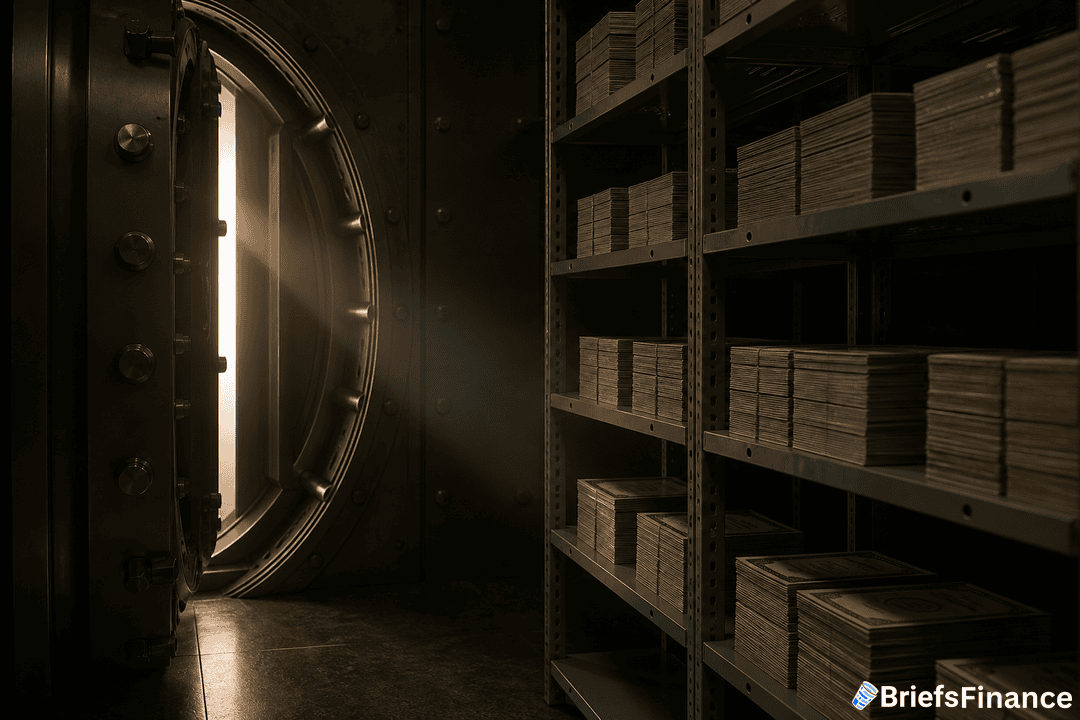
The Treasury keeps a cash account at the Federal Reserve. It holds about $950 billion. And right now, the government is deciding whether to dip into it.

Word from two senior Treasury officials is that the department may draw on that account to help pay for a bigger bond buyback program. The move could change how the market reads the government's latest financial maneuvers.

What the Treasury Is Planning

Last week, the Treasury doubled the size of its buyback for long-dated off-the-run securities, which are older bonds that are no longer the most recently issued. The minimum purchase amount increased to $4 billion per operation, up from $2 billion.

Treasury Secretary Scott Bessent told CNBC the buybacks could get even bigger than that new $4 billion floor. He called the operation a "Treasury Twist," a nod to the idea of selling short-term bonds to fund purchases of longer-term ones.

The first operation under the new plan is scheduled for Sept. 9. The announcement came nearly three weeks before that, and the Treasury also laid out its full-quarter plan on Aug. 19. Officials say no official auction schedules were changed.

When the Treasury dips into its checking account for buybacks, grab the free Always Be Buying E-Book to build wealth steadily.

The Checking Account Solution

Here is where the General Account comes in. The Treasury General Account, known as the TGA, is essentially the government's checking account at the Federal Reserve, funded by tax receipts.

The previous administration's target was $550 billion to $600 billion. That extra cushion gives the Treasury options it didn't have before.

Using the TGA could shift market skepticism about the buyback plan. After the initial rally, bonds reversed and yields rose because traders doubted the plan would work and questioned whether the Treasury had the resources to pull it off.

The catch: the TGA would be used only for the off-the-run securities purchases, not for anything else. And officials declined to say how much might be used or when an announcement would come.

What It Means for Your Portfolio

If the Treasury does tap the account, it could help calm the bond market. Even a small draw, or just the acknowledgment that the money is available, could influence bond yields. And using the TGA would ease any worry that the Federal Reserve might be asked to help, since this account is not part of the Fed's monetary toolkit.

There is a trade-off. Reducing the TGA leaves less cash on hand for a debt ceiling impasse, though officials do not expect the next limit to be hit until winter or early spring. If the Treasury wants to keep the account near $1 trillion, it would need to sell additional bonds to refill it later.

Bessent said the goal is to get the market to "focus on the fundamentals and not trade the headlines during … a quiet period in a thin market. So we are trying to keep the market in equilibrium."

Officials say it's too early to judge how the market will react, since the first auction hasn't happened yet. The Treasury also sees the deficit improving as new tariffs replace the court-ordered refunds, bringing back tariff revenue. Top officials plan to meet soon to develop measures to improve the fiscal situation.

For everyday investors, the bottom line is about stability. When the Treasury can back its plans with real money, the bond market tends to calm down. A calmer bond market means less turbulence for your portfolio, especially if you hold bond funds or rely on fixed-income investments for income.

If the government uses its cash pile for bond buybacks, let the Always Be Buying E-Book guide your investing habit.

Disclosure

Recent News

1 2 3 60

Get Market Briefs delivered to your inbox every morning for free!

No fluff. No noise. No politics. Just finance news you can read in 5 minutes.

Blogs

August 23, 2026
How to Get the Most From Your Guideline 401k
  • Guideline is a company that provides low-cost 401k plans, popular with small businesses and their employees.
  • A "Guideline 401k" follows the same core rules as any 401k: tax-advantaged growth, contribution limits, and often an employer match.
  • The biggest results come from capturing the full match, choosing low-cost funds, and picking Roth or traditional to fit your situation.
Read More
August 23, 2026
Principal 401k: What to Know About Your Plan
  • Principal is one of many companies that manage workplace 401k plans, so a "Principal 401k" is simply a 401k where Principal is the provider.
  • The rules of a 401k are the same no matter who runs it: pre-tax or Roth contributions, tax-advantaged growth, and often an employer match.
  • The biggest wins come from grabbing the full match, picking low-cost funds, and knowing whether Roth or traditional fits you.
Read More
August 23, 2026
What a Tariff Dividend Means for Your Money
  • A "tariff dividend" is the idea of taking money the government collects from tariffs and paying some of it back to citizens.
  • To judge the idea, you first need to know what a tariff is: a tax on imported goods, usually paid by the companies bringing them in.
  • Tariffs ripple through prices, businesses, and your investments, so the smart move is understanding those ripples, not just the headline.
Read More
August 23, 2026
No Tax on Overtime: How Overtime Pay Is Taxed
  • "No tax on overtime" refers to a tax break that lets certain workers deduct some overtime pay, lowering the income they get taxed on.
  • A deduction does not mean overtime is truly tax-free. It means part of that pay is subtracted before your tax is figured.
  • The bigger money lesson: how you earn money changes how it is taxed, and investors often get the friendliest treatment of all.
Read More
August 23, 2026
Reading the Silver Price Forecast for 2026
  • Nobody can honestly promise a specific silver price for 2026. Any exact number is a guess, so treat forecasts as opinions, not facts.
  • Silver is unusual because it is both a precious metal and an industrial metal, so its price answers to two very different forces.
  • Instead of chasing a forecast, learn the drivers - inflation, interest rates, recession fear, and industrial demand - so you can judge any prediction yourself.
Read More
August 23, 2026
What to Do When Reddit Stocks Go Viral
  • "Reddit stocks" usually means stocks getting hyped in online communities, where crowds can send a price soaring or crashing fast.
  • These tips can be entertaining and sometimes useful, but they are opinions, not research, and often come loaded with hype.
  • The safe move is to treat every online tip as a starting point, then do your own homework before risking a dollar.
Read More
August 23, 2026
Why Is Bitcoin Dropping Right Now?
  • Bitcoin drops for a mix of reasons: interest rates, big-picture money policy, regulation news, and simple shifts in how much risk investors want to take.
  • Bitcoin has a fixed supply and no earnings, so its price runs almost entirely on supply, demand, and sentiment.
  • Sharp drops are normal for bitcoin. Understanding the drivers matters more than reacting to any single day.
Read More
August 23, 2026
The Fidelity 500 Index Fund, Made Simple for Beginners
  • The Fidelity 500 Index Fund is a low-cost fund that tracks the S&P 500, an index of 500 large U.S. companies.
  • Buying it means owning a tiny slice of 500 businesses at once, which spreads your risk in a single purchase.
  • Index funds like this win over time mostly by keeping fees low and letting compounding do the work.
Read More
August 23, 2026
USA Penny Stocks: Risks and Rewards Explained
  • USA penny stocks are very low-priced shares of very small companies, often trading under $5 and sometimes under $1.
  • They dangle the dream of huge, fast gains, but carry brutal risks: low liquidity, wild swings, and high failure rates.
  • Most investors build wealth faster with quality companies and funds than by chasing cheap shares.
Read More
August 23, 2026
Finding Cheap Stocks to Buy Now Without Getting Burned
  • A low share price does not mean a stock is cheap. Real value compares the price to what the business is actually worth.
  • The best cheap stocks to buy now are quality companies trading below their true value, not the tiniest, riskiest shares on the market.
  • For most beginners, a low-cost index fund is the simplest "cheap" way to own great companies at once.
Read More
1 2 3 25
Share via
Copy link