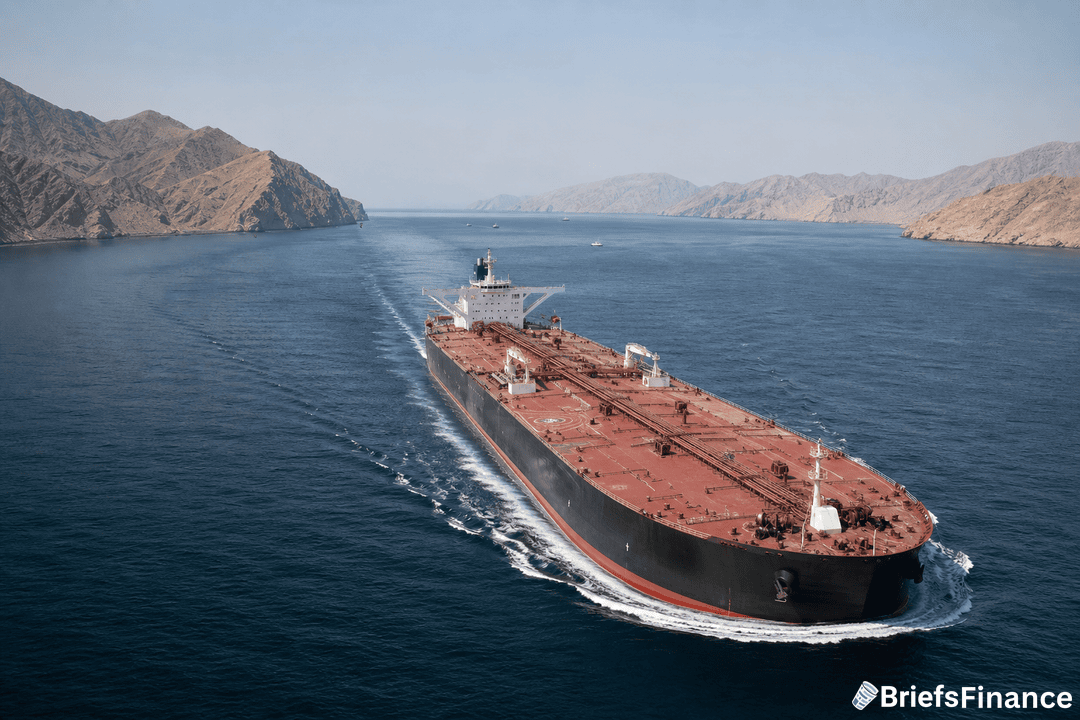
The $20 Million Ride
Shipping a supertanker of oil through the Strait of Hormuz now costs about $20 million. That is the figure TotalEnergies CEO Patrick Pouyanne put on the trip in a report dated August 24, 2026.
His company buys crude for $50 to $60 a barrel inside the Persian Gulf. Producers there are eager to sell after six months of conflict, so they are willing to pay.
The extra freight charge works out to roughly $10 per barrel, he said. That is the price of doing business in a war zone, and it is a sign of just how tense the region has become.
Why the Waterway Stays Busy
TotalEnergies is one of the biggest oil traders, and producers have kept moving barrels through Hormuz in recent weeks. They are not alone.
More producers are using the waterway, which handled about a fifth of world oil flows before the Iran war. Those shipments have done a lot of heavy lifting.
Markets move every day, and most of it never reaches you in time. Get the free Market Briefs daily newsletter and stay ahead of it.
They have kept global prices from crossing $100 a barrel. Brent futures are trading above $90 right now, so the buffer is thinner than it looks.
Take Hormuz out of the mix and the math gets ugly fast. That is why shipowners and middlemen are cashing in on the chaos.
Some cargoes head straight to refineries, while many are passed to other vessels at a staging point near the Gulf of Oman, and only later delivered. That little dance adds time and cost, but it keeps the oil moving.
It also means the people who control the ships are making a killing. They are the quiet winners of a conflict that has turned the world's oil upside down.
The stakes are enormous. Before the conflict, the strait moved roughly 20 million barrels a day, equivalent to about a fifth of global consumption. Disruptions there have historically sent prices spiking, and the current premium on freight reflects the risk that a single attack could close the waterway.
Pouyanne's estimate of $20 million per supertanker is a direct measure of that risk, and it is a cost that ultimately gets baked into every barrel delivered to refineries. The fact that producers are still willing to pay such rates shows how desperate they are to keep revenue flowing, even as insurance and security costs climb. Meanwhile, the rerouting of cargoes through the Gulf of Oman staging point adds days to each voyage, tying up tanker capacity and pushing rates even higher.
These dynamics are why the market remains on edge, with traders watching every movement in the region.
What This Means for Your Wallet
Pouyanne sees crude markets as bearish partly because of those Hormuz flows. More supply on the water means less pressure on the price of raw oil.
Refined fuels are a different story. Gasoline and diesel prices have rallied since Ukrainian attacks hit Russian refineries, and because crude is the dominant cargo moving through Hormuz.
So while the price of oil itself looks calm, the product you put in your tank is another conversation. The crude barrel and the fuel pump are drifting apart.
For most people, the message is simple: the oil keeps moving, and that is why the pump price has not broken down completely.
Still, the system that keeps it running is fragile. The cost of keeping the oil moving goes up and up, and in the end the bill comes back to you.
The money story behind the headlines is usually the part that matters. Join Market Briefs free and get it every morning.