Free NewsletterPro Login
S&P 500 6,287 +0.42%
DOW 44,521 -0.18%
NASDAQ 21,103 +0.71%

Warning: Undefined variable $funds in /var/www/briefs.co/htdocs/wp-content/plugins/oxygen/component-framework/components/classes/code-block.class.php(133) : eval()'d code on line 491

Warning: foreach() argument must be of type array|object, null given in /var/www/briefs.co/htdocs/wp-content/plugins/oxygen/component-framework/components/classes/code-block.class.php(133) : eval()'d code on line 491
/* the link was here */

Severe Weather Damages U.S. Crops, Driving Grain Prices Upward

Published Aug 23, 2026
[tts_player]
Share:
Summary:
  • The Pro Farmer Crop Tour estimates Iowa's corn yield at 194 bushels per acre, down from last year and below the USDA's forecast.
  • China has agreed to buy 25 million tons of U.S. soybeans annually, but actual purchases as of mid-August were only about 5.7 million tons.
  • Chicago corn futures exceeded $5 a bushel this week, the first time since early 2025, driven by weather-related crop damage.

The corn in the ground right now is not looking great, and the prices at the grain exchange already know it.

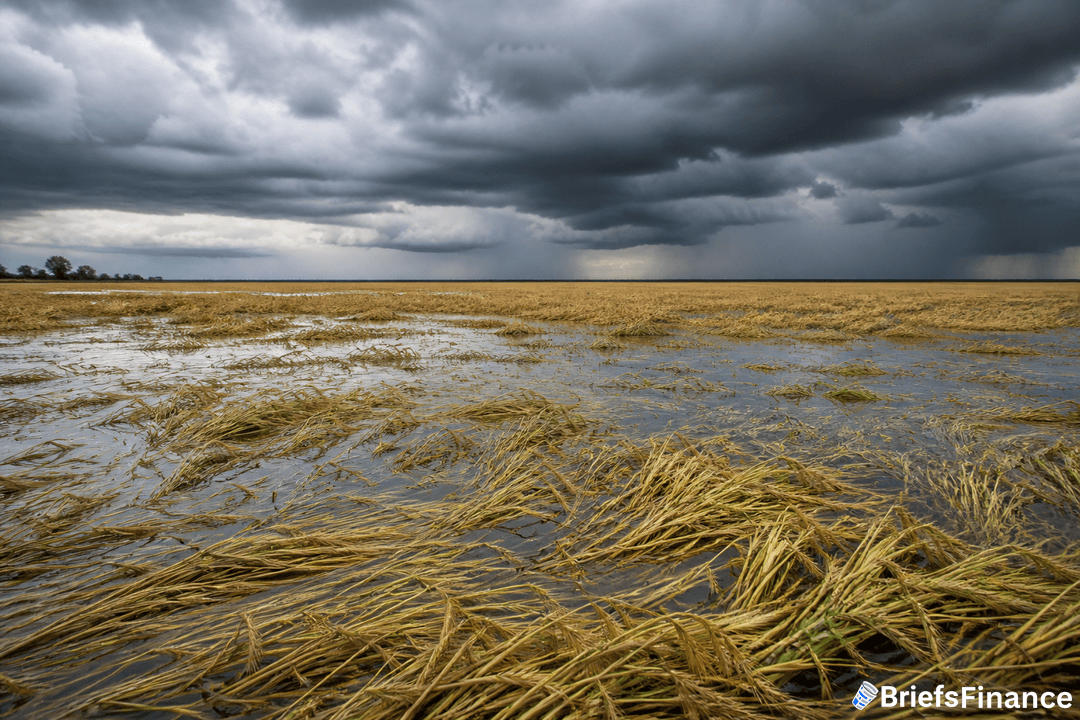
Flooding across Indiana and Ohio is threatening soybean plants, a record tornado season in Illinois stressed crops, and heat waves limited yields. All of this is happening as the U.S. harvest was already expected to come up short of last year's bumper crop.

What the Crop Tour Found

The Pro Farmer Crop Tour, which has been scouting fields for 34 years, wrapped up its annual survey of Midwest farmland this week. The findings were not encouraging.

The tour estimates Iowa's corn yield at 194 bushels per acre. That is down from 198.4 bushels last year and well below the USDA's official forecast of 216 bushels per acre. Nationally, the tour's corn yield estimate sits 4.2% below what the USDA projected in its August report.

"Overall, corn yields were disappointing for everyone in the Midwest," said Maxence Devillers, a crop scout and grains analyst at Argus.

Chip Flory, who leads the tour's western leg and hosts the AgriTalk radio program, saw the same pattern in the fields. "In corn, lower ear populations, shorter kernel depth and inconsistent field performance limited upside in several areas," he said. "Soybeans showed pockets of strong potential but remain more dependent on late-season weather and plant health."

Bad weather shrinks crops and pushes prices up, so try the free Always Be Buying E-Book to invest steadily

The problems are not just in the U.S. Europe is looking at its most meager corn harvest in 19 years, and ongoing attacks between Russia and Ukraine keep threatening wheat shipments from the Black Sea. Global grain supplies are tightening from multiple directions at once.

China Steps Back Into the Market

Here is where the story gets complicated. The White House says China has agreed to buy 25 million tons of U.S. soybeans annually, plus $17 billion in additional agricultural purchases. But federal export data reveals that by mid-August, China had purchased only about 5.7 million tons of U.S. soybeans.

That gap is starting to close. The USDA announced a sale of 712,000 tons to China on Friday, the largest single-day amount this year. The buying is ramping up ahead of a planned September meeting between President Donald Trump and Chinese President Xi Jinping.

Lee Brooke, president-elect of the Iowa Soybean Association, is not convinced China is back for good. "They're not looking for us first, they're going to other places to buy their needs," he said.

He is not wrong to be cautious. China has increasingly turned to South America for soybean purchases while U.S. tariffs were in place. Winning back a customer takes more than one big order.

The weather damage is pushing prices up, though. This week, Chicago corn futures crossed above the $5 per bushel level, a threshold not breached since early 2025. That is good news for farmers who have crops worth selling, even if it is bad news for anyone buying groceries.

What Higher Prices Mean for You

Indiana farmer Kip Tom, a special adviser to USDA Secretary Brooke Rollins, said some growers in his area saw eight to 18 inches of rain. "We had people with anywhere from eight to 18 inches of rain," he said. "There's a lot to learn about the losses and yield impacts."

Pro Farmer data analyst Carolan put it more bluntly. "We got saturated at a critical time," she said. "It's been stress on top of stress."

Not every farmer is hurting. Nick Goslar, who farms in western Iowa, expects his yields to land right around last year's levels, which he called "good enough." Brian Nilson, who farms 600 acres, is in a similar spot. "To get good prices in farming, somebody has to have problems," he said. "I've got a good crop, and with how things look elsewhere, maybe we have a shot at decent prices."

Deere & Co., the equipment maker that watches farm conditions closely, said things are stabilizing but does not expect a more pronounced recovery until 2027.

The bottom line: When crops shrink, prices rise. That means higher costs for food down the road, but it also means the farmers who managed to dodge the worst weather are finally getting paid for it. For your portfolio, the takeaway is simpler. The weather is always the wild card in agriculture, and this year it is playing a bigger hand than usual.

When harvests suffer and grocery bills rise, get the free Always Be Buying E-Book for a wealth-building system

Disclosure

Recent News

1 2 3 59

Get Market Briefs delivered to your inbox every morning for free!

No fluff. No noise. No politics. Just finance news you can read in 5 minutes.

Blogs

June 29, 2026
Portfolio Diversification: Why Putting All Your Eggs in One Basket Destroys Wealth
  • Real diversification means spreading investments across all 11 economic sectors plus bonds, alternatives, and cash so no single bet can sink the portfolio.
  • Different sectors perform at different times, so a diversified portfolio captures upswings while smoothing the brutal drawdowns that wipe out concentrated bets.
  • Total market index funds offer the simplest path to diversification, and annual rebalancing is what keeps the structure working over time.
Read More
June 29, 2026
Non Taxable Income: What It Is and Why It Matters
  • Non taxable income is money you receive that you don't owe income tax on.
  • The tax code treats workers, investors, and business owners very differently, and investors often come out ahead.
  • Learning how income is taxed is a quiet superpower for keeping more of what you earn.
Read More
June 29, 2026
Semiconductor Stocks: A Simple Guide for Investors
  • Semiconductor stocks are companies that design and make computer chips, the brains inside nearly every modern device.
  • The AI boom has turned chips into one of the market's most important and most watched groups.
  • They offer big growth potential, but come with high valuations and a notoriously cyclical history.
Read More
June 25, 2026
How Stocks Work: A Simple Guide for Beginners
  • A stock is a slice of ownership in a company - buy one, and you own a piece of the business.
  • You make money two ways: the share price rising over time, and dividends paid to shareholders.
  • The simplest path for most beginners is buying into the whole market through a low-cost index fund.
Read More
June 25, 2026
Stop Loss vs Stop Limit: What's the Difference?
  • A stop loss order sells your stock once it hits a trigger price, prioritizing getting you out.
  • A stop limit order only sells within a price range you set, prioritizing price over a guaranteed exit.
  • The trade-off: a stop loss almost always executes; a stop limit might not if the price moves too fast.
Read More
June 25, 2026
Energy Stocks: A Simple Guide for Investors
  • Energy stocks are companies that produce and supply the power the world runs on, from oil and gas to newer sources.
  • They make up one of the 11 sectors of the market and tend to move with energy prices and big-picture shifts.
  • Like any sector, the key is diversification and understanding the forces driving demand.
Read More
June 18, 2026
What Is a Stop Loss Order? A Simple Guide
  • A stop loss order automatically sells a stock once it falls to a price you set.
  • It's a tool to cap losses or lock in gains without watching the market all day.
  • It works best for active strategies, and can backfire if used carelessly on long-term holdings.
Read More
June 18, 2026
Best S&P 500 Index Fund: How to Choose One
  • The best S&P 500 index fund for most investors is simply the cheapest, most established one that tracks the index well.
  • Funds like VOO, IVV, and SPY all hold the same 500 companies, so the biggest difference is the fee.
  • Pick one, automate your buys, and let time do the heavy lifting.
Read More
June 17, 2026
What Are Penny Stocks? Risks and Rewards Explained
  • Penny stocks are very low-priced shares of very small companies, often trading for just a few dollars or less.
  • They promise huge gains but carry huge risks: low liquidity, high failure rates, and wild price swings.
  • Most investors are better served by quality companies and funds than by chasing cheap shares.
Read More
June 17, 2026
Best Stocks for Beginners With Little Money
  • The best stocks for beginners with little money usually aren't individual stocks at all - they're low-cost index funds.
  • You can start with $100 or less and use small, regular investments to build wealth over time.
  • Focus on diversification and consistency, not on picking the next big winner.
Read More
1 2 3 24
Share via
Copy link