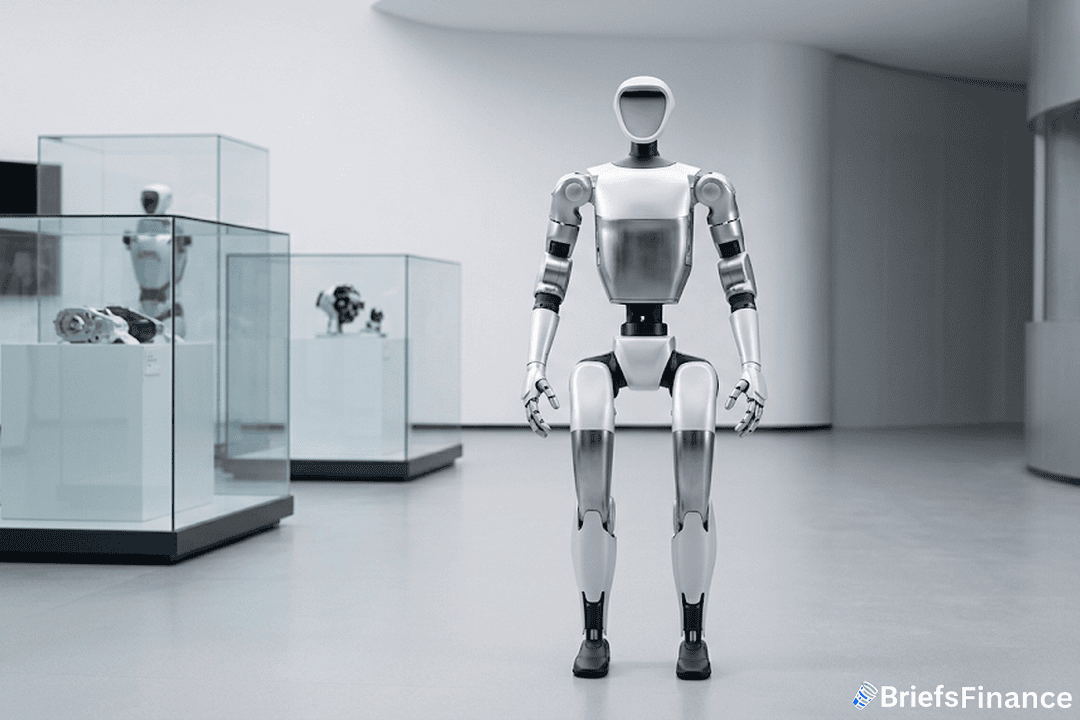
If you have seen the viral videos of Unitree's robots dancing at a Chinese Spring Festival gala, you already know the company behind them. That robot maker just pulled off one of the most lopsided stock sales in recent memory.
Unitree Robotics sold shares to the public for the first time on Shanghai's STAR Market, and retail investors could not get enough. They placed 9.8 million orders, which made the retail portion of the IPO 5,526 times subscribed, according to an exchange filing on Monday.
Oversubscribed means buyers wanted far more shares than the company had to offer. In this case, the demand was so heavy that the retail allotment was effectively a lottery. The overwhelming interest also makes this mainland China's first IPO for a humanoid robot maker, a sign of how hot the robotics trade has become.
A Big Raise for a Robot Pioneer
The company, legally known as Yushu Technology and based in Hangzhou, issued 40.4 million shares at 150.8 yuan each. That raised about 6.1 billion yuan, which works out to roughly $904 million.
The shares are expected to start trading on the STAR Market later this month. That is when the real test begins, because the hype around an IPO does not always carry over to the first day of trading.
Get the free Always Be Buying eBook and learn the simple system for building wealth on any income
The STAR Market is Shanghai's answer to Nasdaq, created for tech companies that want to raise money from public investors. For a robotics firm, listing there puts it in the same arena as some of China's most ambitious tech names.
Who Got a Piece of the Deal
Not all of the shares went to everyday buyers. About 20% of the offering was reserved for strategic investors, and the list reads like a who's who of Chinese tech and state power.
AI startup DeepSeek took a 2.31% stake, and its shares come with a three-year lockup period, meaning it cannot sell them right away. The deal is more than just an investment. The partnership lets Unitree use DeepSeek's AI to build what the company calls embodied-intelligence models, which is a fancy way of saying robots that can think and act on their own.
The other strategic investors include a Tencent-affiliated investment vehicle and the investment arms of state-owned giants like China National Petroleum Corp., China Southern Power Grid Co., and China Telecom Corp. That mix of private tech money and state backing gives Unitree both capital and connections.
Other robotics companies are watching closely. Leju Robotics and Deep Robotics are also eyeing IPOs, and Shanghai AgiBot Innovation Technology has already taken steps toward a Hong Kong listing, according to a July report from Securities Daily.
What It Means for Your Portfolio
For most investors outside China, you cannot just log in and buy Unitree shares. But this IPO still matters for anyone paying attention to where the robotics market is heading.
The sheer size of the retail demand tells you something about public appetite for robot stocks. When a company with no public trading history gets 5,526 times more orders than it can fill, that is not a quiet signal. That is a crowd of people betting that humanoid robots are the next big thing.
The risk is that this kind of frenzy can push valuations ahead of reality. A 61 billion yuan valuation is a lot for a company that is still scaling up production. The strategic investors with long lockup periods are betting on the long game, while the retail buyers who got shares are hoping for a quick pop when trading starts.
Either way, the robotics race is no longer just a lab experiment. It is a public market event with real money behind it. The question now is whether the robots can live up to the hype their debut just created.
Download the free Always Be Buying eBook and start putting your money to work today