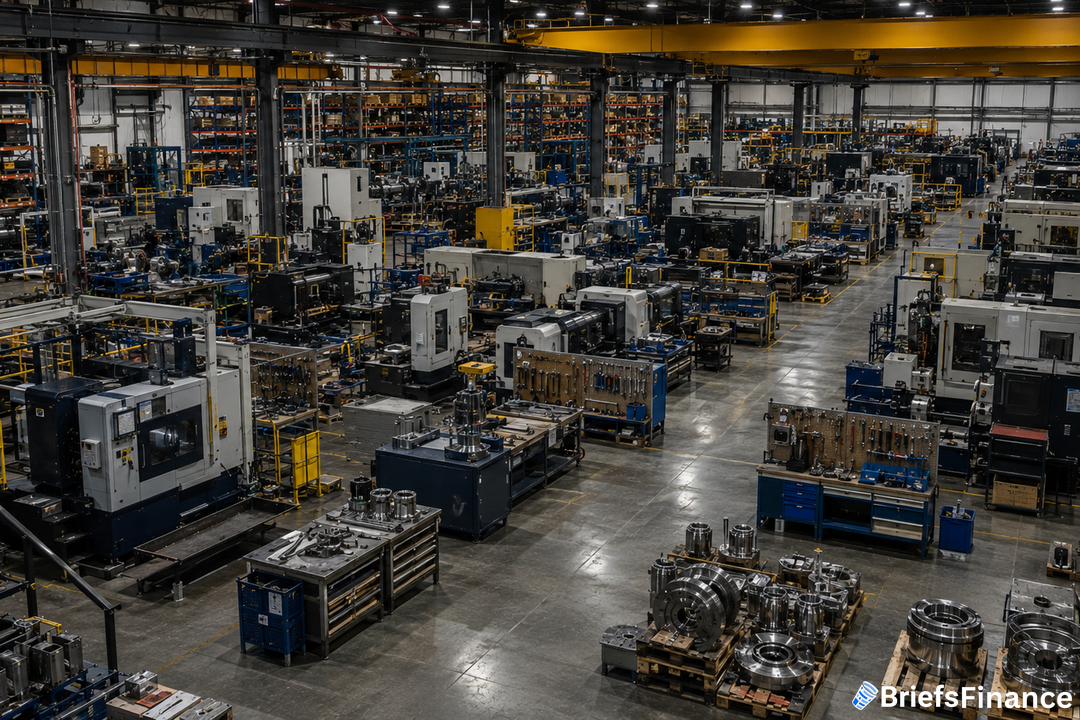
Both supply and demand saw improvement in June, the National Bureau of Statistics reported, with production and new orders sub-indexes rising to 51.4 and 51.2 respectively. New export orders recovered to 50.1 in June, indicating a rebound in overseas demand as reduced tensions in the Middle East eased concerns about a major energy and growth crisis.
Capital Economics' head of China economics, Julian Evans-Pritchard, said, "External demand and AI-related tech demand were the main engines of China's growth momentum in June," and added that "real estate services were still struggling."
Exports remained strong as American purchasers placed orders faster following the May meeting between President Donald Trump and Chinese leader Xi Jinping, which helped stabilize relations. The advance purchases also occurred before a 10% tariff under Section 122 expired in July. Washington has not yet imposed the extra duties that could arise from its Section 301 investigations into countries accused of overcapacity and forced labor.
Get your free investing masterclass bonus when you join Market Briefs, our free daily newsletter
Bank of America Global Research increased its forecast for China's export growth to 15% this year, pointing to strong AI-related investment and worldwide demand for green energy gear and electric cars. Bank of America Global Research's China economist Helen Qiao said, "The hope of rebalancing is dashed," and she pointed to the combination of stronger exports and weaker domestic demand. She further noted that the mix of robust supply and sluggish demand is likely to keep inflation under downward pressure in the latter half of the year once the impact of rising energy prices fades.
The non-manufacturing gauge, which covers construction and services, moved up to 50.2 from 50.1 in May, based on statistics agency data. The construction business activity index kept contracting in June, rising just 0.2 percentage points to 49.0 from the previous month.
According to a poll of 1,321 companies conducted by China Beige Book, a private research organization, the world's second-largest economy exhibited recovery signals in June after a two-month period of tepid expansion, with manufacturing and retail sales bouncing back. Saturday's data showed that industrial profits in upstream industries, alongside AI and renewable energy sectors, recorded strong gains, while downstream manufacturers still faced weak domestic demand.
The private RatingDog manufacturing PMI, which generally follows smaller companies that rely heavily on exports, is anticipated to dip to 51.6 from 51.8 in May, with its figures due out on Wednesday. This gauge has historically been higher than the official PMI, partly due to China's export strength.
Chinese authorities have refrained from major stimulus to boost demand this year, and most economists do not expect near-term measures like policy rate cuts. Goldman Sachs expects that growing fiscal strains will prompt stepped-up support through accelerated government borrowing in the months ahead, while it stays prepared to loosen further if Q3 GDP underperforms.
Subscribe to Market Briefs, our free daily newsletter, and claim your bonus investing masterclass