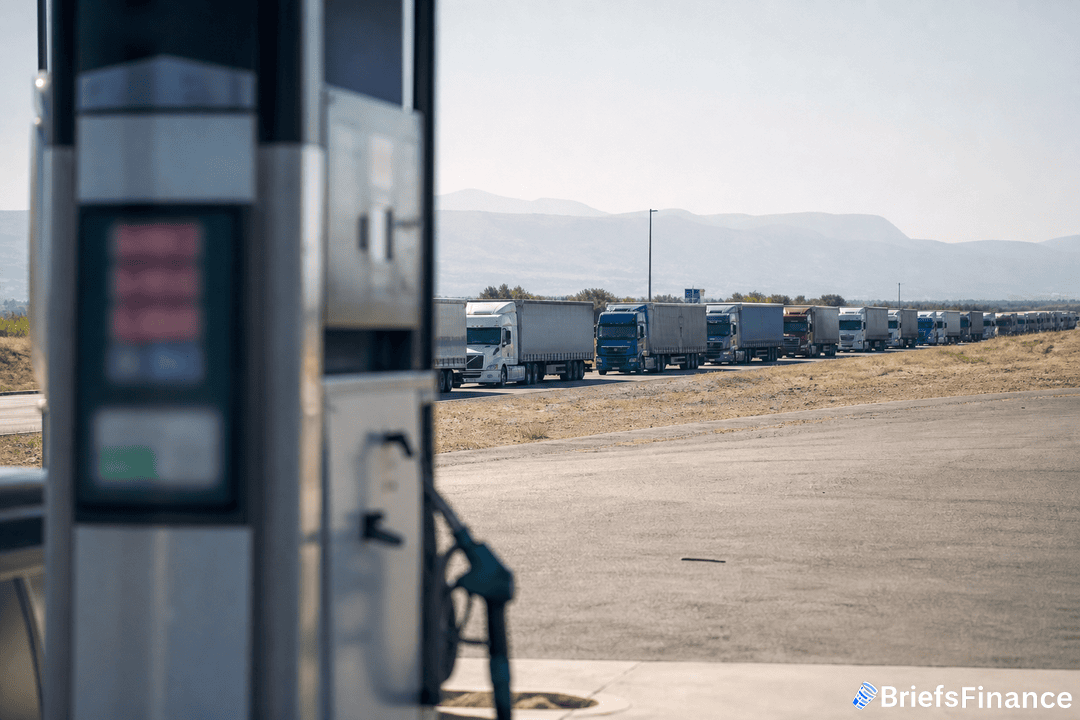
California drivers are feeling that squeeze right now.
Why Diesel Keeps Climbing
The jump is not a California quirk. Wars in Europe and the Middle East are knocking refineries offline, and the global fuel market is running short.
Consider the scale: the conflicts in Ukraine and Iran have cut about 8% of the world's diesel supply. That is a massive hole to fill.
Ukrainian drone strikes on Russian refineries led Moscow to restrict diesel exports by about 800,000 barrels per day. Middle East exports have fallen by roughly 1.2 million barrels per day because of the Strait of Hormuz disruption. Adding to the trouble, Yemen's Houthi forces attacked the Jizan Red Sea refinery, shutting its 200,000 barrels per day of capacity until at least the end of August.
Refiners are cashing in while this plays out. The margin for turning crude into diesel has reached $100 a barrel, which is higher than U.S. crude prices near $85. That kind of profit usually means supply is tight and buyers are desperate.
The result is visible at the pump across the country. The U.S. average diesel price was $5.50 a gallon on Wednesday, about 40 cents above a month earlier and $1.81 above the same point in 2025.
When diesel prices climb like this, every dollar you spend gets tighter, so grab the free Always Be Buying eBook to build wealth on any income.
The California Factor
California always feels these shocks more sharply. Andy Lipow of Lipow Oil Associates points to a few reasons: the state relies more on expensive imported crude, requires a special fuel blend, and piles on environmental regulations plus state excise and sales taxes.
That explains why California diesel is up about 37%, or $1.89 a gallon, versus the same time last year. The state's record diesel price was $7.75 in April, when Iran restricted shipping in the Strait of Hormuz. Prices dropped below $6.50 in July after Hormuz flows recovered following a U.S.-Iran memorandum.
Now prices are climbing again as farmers prepare for harvest and freight demand rises before the holiday season.
That pattern is familiar in California. The state's diesel market has swung sharply this year as geopolitical events disrupted refining and shipping. The April record followed a similar supply shock, and the July drop showed how quickly prices can retreat when flows resume.
Diesel is not just another fuel. Bob McNally of Rapidan Energy puts it plainly: "it powers transportation, heating, farming, and industry." He calls it "the important macro fuel to watch." S&P Global Vice Chairman Dan Yergin said on July 31 that about 6 million barrels per day of global refining capacity sits idle, and he warned that is affecting the whole economy.
The fuel's central role means its price ripples through every layer of commerce. When diesel gets more expensive, the cost of shipping food, clothing, and construction materials rises, and retailers pass those costs to consumers. This dynamic is why economists watch diesel prices so closely - they act as an early warning for broader inflationary pressures. In California, where the state's unique fuel blend and taxes already push prices higher, the pain is especially acute for small businesses that rely on trucking to move goods.
What Happens Next
Kevin Book of ClearView Energy Partners told CNBC's "Squawk Box" that "this is a pretty significant inflationary concern." A drop in pump prices probably won't arrive before Russian refineries that were hit restart and Middle East export volumes recover. The catch is that sanctions may slow Russian repairs and extend outages.
Chinese refiners have also reduced crude processing and are shipping less fuel abroad, which tightens the market further.
The bottom line: diesel sits at the center of the economy, so its price touches nearly everything you buy. When fuel costs rise, retailers pass those costs along. That means the $7 pump price in California is not just a headache for truckers. It is a quiet tax on every household's monthly budget.
The question now is whether the refineries come back online fast enough to cool prices before the holiday shopping season. Until then, expect the ripple effects to keep showing up in places you might not expect.
If rising fuel costs have you watching your budget, the free Always Be Buying eBook shows a simple way to invest steadily and grow richer over time.