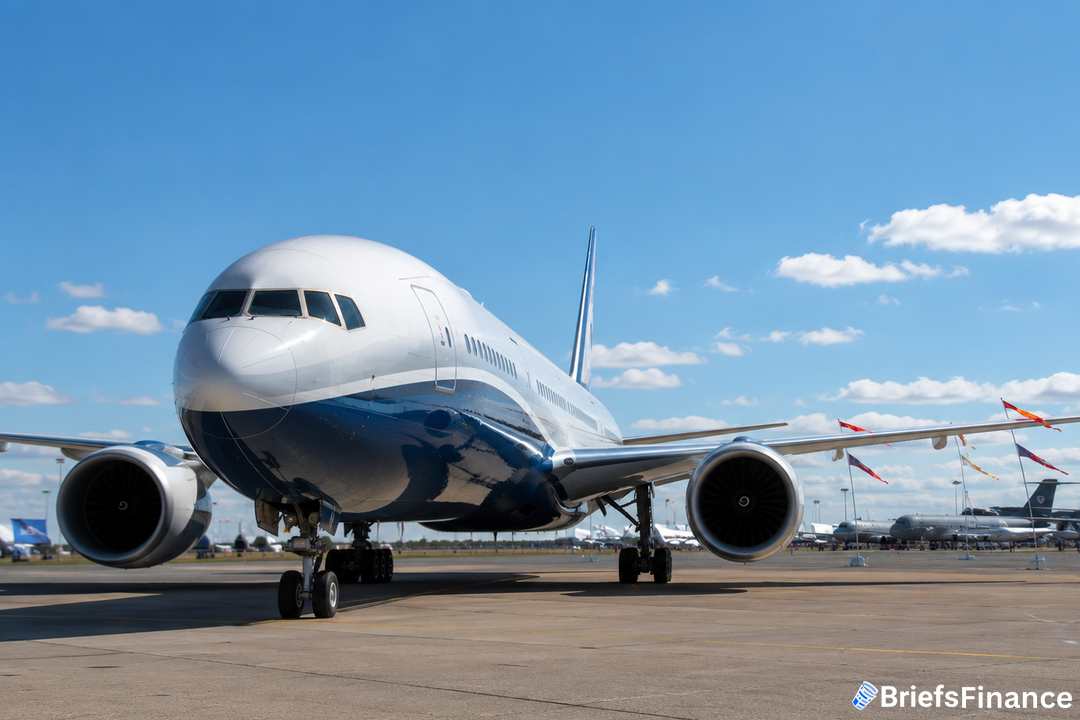
On the first day of the Farnborough International Airshow, Boeing notched up roughly 150 orders, yet Airbus responded in the afternoon with a substantial commitment of its own as the two manufacturers compete for airline and leasing company business.
The majority of orders for both manufacturers came from leasing firm SMBC Aviation Capital, which placed orders for 100 Boeing 737 Max jets and an equal number of Airbus A320neo-family aircraft. Furthermore, Boeing secured commitments for 48 Dreamliner aircraft, including both firm orders and purchase options, from Riyadh Air and Philippine Airlines.
The two companies have nearly sold out production slots for their bestselling models for many years ahead. Philippine Air, making its first Boeing purchase in about two decades, will start taking delivery of its 787s in 2031, reflecting the extensive order backlogs.
Get the market news that matters in a five-minute read with Market Briefs, our free daily newsletter
The Farnborough Airshow, a biennial event alternating with the Paris Air Show, provides a critical platform for aerospace deals. With global air travel rebounding strongly, airlines are eager to secure delivery slots, even if they face multiyear waits. Boeing's recent focus on resolving production and quality issues has made it more cautious in its ramp-up, while Airbus contends with engine delivery delays. The strong order activity at this year's show indicates sustained confidence in the sector's growth.
This year's Farnborough show, which takes place every two years and swaps with the Paris Airshow, gives Boeing a chance to step up its dealmaking. The company had been absent from the previous edition following the Air India 787 disaster that left 260 dead.
Air shows serve as traditional platforms for Airbus and Boeing to finalize large aircraft deals and announce them with signing events. At the venue, Boeing CEO Kelly Ortberg expressed optimism, saying, "demand from customers remains robust and that the public is still keen to fly despite rising ticket prices."
Boeing has concentrated on reversing its decline following a series of errors and quality problems that resulted in the removal of its former leadership. A key topic at the air show is the strategy each company is adopting for its upcoming single-aisle planes, which are central to the commercial aviation sector.
During a Monday interview, Ortberg said, "Boeing will need until the end of next decade to bring its successor to the 737 to market as it continues to repair its finances for the huge investment and because customers are still buying its current model."
Faury said, "Airbus wants to launch its next-generation aircraft in 2030, with the plane coming to market in the second half of the decade."
"So that's a bit more than 10 years away, which in our timeframe is almost tomorrow, so we feel energized," the Airbus CEO remarked in an interview with Bloomberg Television.
Join Market Briefs, our free daily newsletter, for a quick daily rundown of the markets