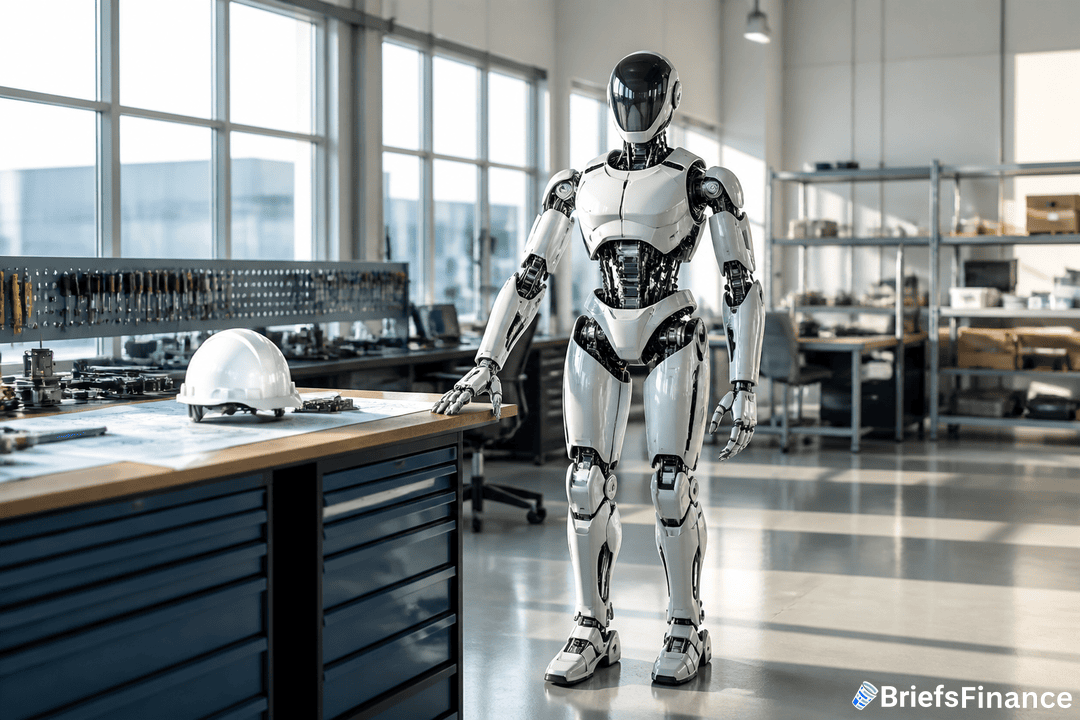
What Agility announced
Agility Robotics, based in Salem, Oregon, rolled out the Digit 5 on Tuesday and framed it for mixed human robot workplaces. That matters in a field that usually keeps humanoids cordoned off. Daniel Diez, the company's chief business officer, said the new machine reflects what customers asked for through real world use, adding, "You cannot put 150 robots into a warehouse where every one of them has to be surrounded by a 10-by-20 plexiglass set of walls." Earlier versions, including the Digit 4 that became known for stacking plastic bins, had to work behind physical safety barriers.
What Digit 5 can do and how it stays safe
Digit 5 is intended for more demanding chores like loading materials into equipment, sorting parts, sequencing, and inspections, and it is built to do that close to people without fences. To pull that off, it uses AI driven software and new sensors to recognize when someone is nearby and then respond immediately, including stopping or sitting to prevent a collision. It also signals its movements with visual and audio cues, with a software safety controller coordinating those responses in real time. More broadly, legged humanoids like Digit can be less predictable and pose greater safety risks around people than similar machines that use wheels, which is why these controls matter.
The hardware upgrades
The newest Digit has redesigned legs aimed at repetitive lifting, lifting capacity per pick rising to 50 pounds from about 35 pounds. Its battery runs for 90 minutes and can be recharged in nine minutes, according to the company. The swappable end effector can be outfitted with a paddle, pincher, claw, or a five fingered artificial hand.
Business traction and what's next for investors
Agility says it is operating in nine customer facilities, including sites for Schaeffler AG, GXO Logistics Inc., and Toyota Motor Manufacturing Canada Inc., with total operating time now exceeding 65,000 hours. According to the company, multiyear commitments for Digit are around $300 million, and it expects to begin scaling into Europe early next year. To go public this year, Agility intends to merge with Churchill Capital Corp XI, a special-purpose acquisition vehicle, in a deal that signals a $2.5 billion valuation.
In 2025, it generated about $1.8 million in revenue and recorded a $140 million operating loss. Investors have put $500 million into the company to date, and it is part of a broader humanoid wave that includes Chinese robotics firm Unitree, which listed in August on Shanghai's stock exchange.
Innovations that change how we work can reshape where long term savings find safety. Join Briefs Finance CEO Jaspreet Singh on September 29th for a FREE live investor workshop, How to Profit From A Dollar That's Losing its Value, where he shows how we're spotting investment opportunities as the dollar falls. Save your spot.
What it means for your portfolio
"Everyone is obsessed with seeing these robots in the home, and what's needed is cooperative safety - the ability for the robot to work in close proximity with people," Diez said, adding that the company believes "that the path to getting to the home is through industry." The tells to keep an eye on are the simple ones: how many real deployments, hours in the field, the size of the order book, and whether the safety and lifting upgrades unlock broader adoption as the SPAC deal approaches. If those metrics rise and the European rollout hits, this starts to look less like a demo and more like a tool that actually earns its keep on the factory floor.
When technology shifts our daily routines, steady strategies help protect and grow wealth. Our CEO Jaspreet Singh is hosting a FREE live investor workshop, How to Profit From A Dollar That's Losing its Value, on September 29th. Sign up free to join him live.