Everyone knows AI is getting smart. The harder question is whether it can learn to work with its hands.
That question is driving billions into "physical AI" - software that lets machines move, grab, and build things in the real world. But the companies chasing it admit the technology is still in its early days.
One founder compares this moment to the early stages of ChatGPT. The pieces are there. The data is not.
Big Money, Early Days
Théophile Gervet, the founder of Genesis AI, compares physical AI to where OpenAI was with its GPT-2 model. The tech showed promise, but it needed far more data and computing power before it became something the world actually used.
"No customer cares about the general-purpose robot that works at 80%," Gervet said.
That is the central problem. A robot that gets it right four out of five times fails a real job. A warehouse manager cannot risk a robot dropping their shipment. A hospital cannot trust a robot that occasionally fumbles.
Gervet's comparison to GPT-2 is telling. That model was a breakthrough when it launched, but it was still too limited for real-world use. It took years of additional training data and computing power before the technology reached the point where it could power products like ChatGPT. Physical AI is in a similar position now - the fundamental approach works, but the scale of data needed to make robots reliable in unpredictable environments is still out of reach.
So the startups taking in huge checks are picking their battles. Agility deploys robots in industrial settings. Gritt builds solar farms. Bedrock started with autonomous excavators because digging is simpler than picking up a glass of water.
The best financial decisions come from understanding the whole picture. Join Market Briefs free and get the full brief each morning.
The Race to Gather Smarter Data
Autonomous vehicles are further along because they had a head start. They can pull data from millions of miles of human-driven cars, and their job is mostly avoiding obstacles. They do not have to manipulate things or squeeze through tight spaces.
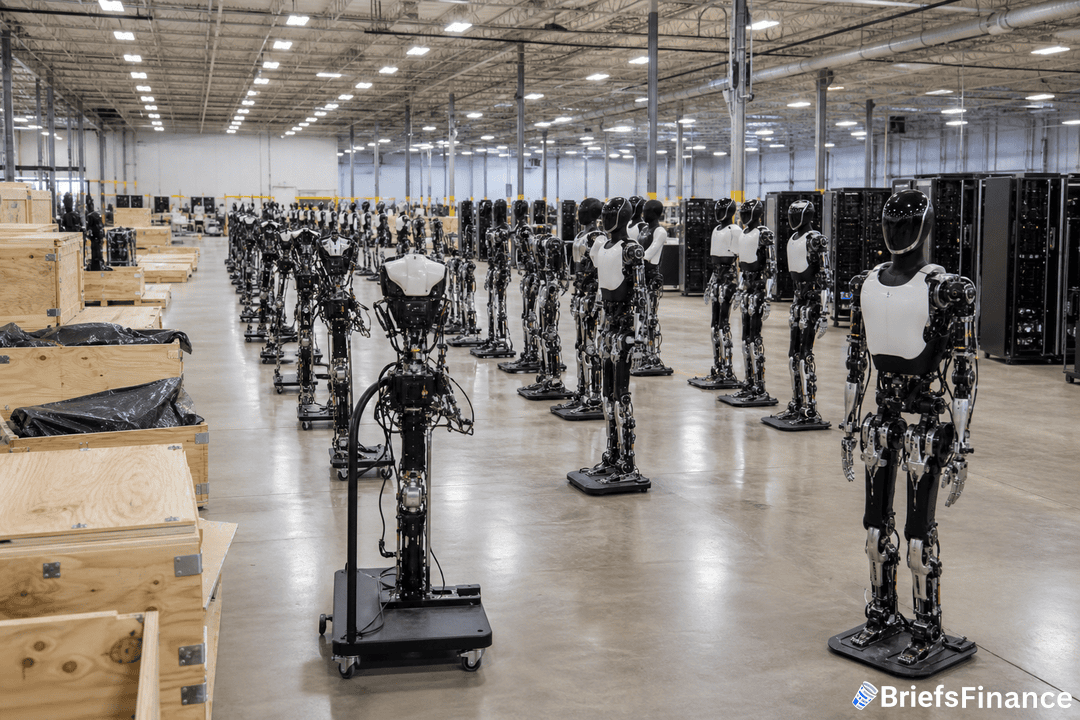
That data advantage is why Wayve and Uber both launched robotics labs focused on humanoid robots. And it is why Tesla keeps pushing its Optimus project forward.
Foxglove, a tooling company started by former Cruise employees, just launched a feature that lets engineers search through sensor data using plain language. Instead of digging through logs, they can ask questions like "show me every time a car cut us off" and the system finds it.
The idea is to make debugging faster. Teams spend enormous time finding why a robot did something wrong, and any tool that speeds that up is valuable.
What Comes Next
Sam Altman, the man behind ChatGPT, says a physical AI breakthrough is only a few years away.
For your portfolio, this is not a story about one hot stock. It is a story about a broad shift in how machines learn to work alongside people.
That shift touches everything from the construction sites that use autonomous excavators to the factories renting robots for repetitive tasks. The winners will likely be the companies that solve the boring problems first, not the ones promising a robot for every home.
The technology is coming. But as anyone who has watched a robot try to fold laundry knows, it will arrive one narrow task at a time.