Free NewsletterPro Login

Warning: Undefined variable $stocks in /var/www/briefs.co/htdocs/wp-content/plugins/oxygen/component-framework/components/classes/code-block.class.php(133) : eval()'d code on line 448

Warning: foreach() argument must be of type array|object, null given in /var/www/briefs.co/htdocs/wp-content/plugins/oxygen/component-framework/components/classes/code-block.class.php(133) : eval()'d code on line 448

Warning: Undefined variable $funds in /var/www/briefs.co/htdocs/wp-content/plugins/oxygen/component-framework/components/classes/code-block.class.php(133) : eval()'d code on line 472

Warning: foreach() argument must be of type array|object, null given in /var/www/briefs.co/htdocs/wp-content/plugins/oxygen/component-framework/components/classes/code-block.class.php(133) : eval()'d code on line 472
/* the link was here */
Free Live Investor Workshop
The dollar is losing value. Here’s how investors can still profit. Click Here to Save Your Seat →         

Mexico courts Chinese tourists as international flyers thin at marquee beach hubs

Published Sep 15, 2026
[tts_player]
Share:
Summary:
  • International air arrivals this year are down 6% in Cancún, 8% in Los Cabos and 20% in Puerto Vallarta, easing the usual crush at beaches and hotels.
  • Tourism is a $150 billion industry, about 9% of Mexico's economy and larger than any other sector, delivering a steady stream of foreign currency.
  • With U.S. demand softer, officials are turning to China, where roughly 150 million people travel abroad each year but only about 200,000 choose Mexico; the ministry estimates a typical Chinese visitor spends about $3,000 per trip.

A visible drop at the resorts

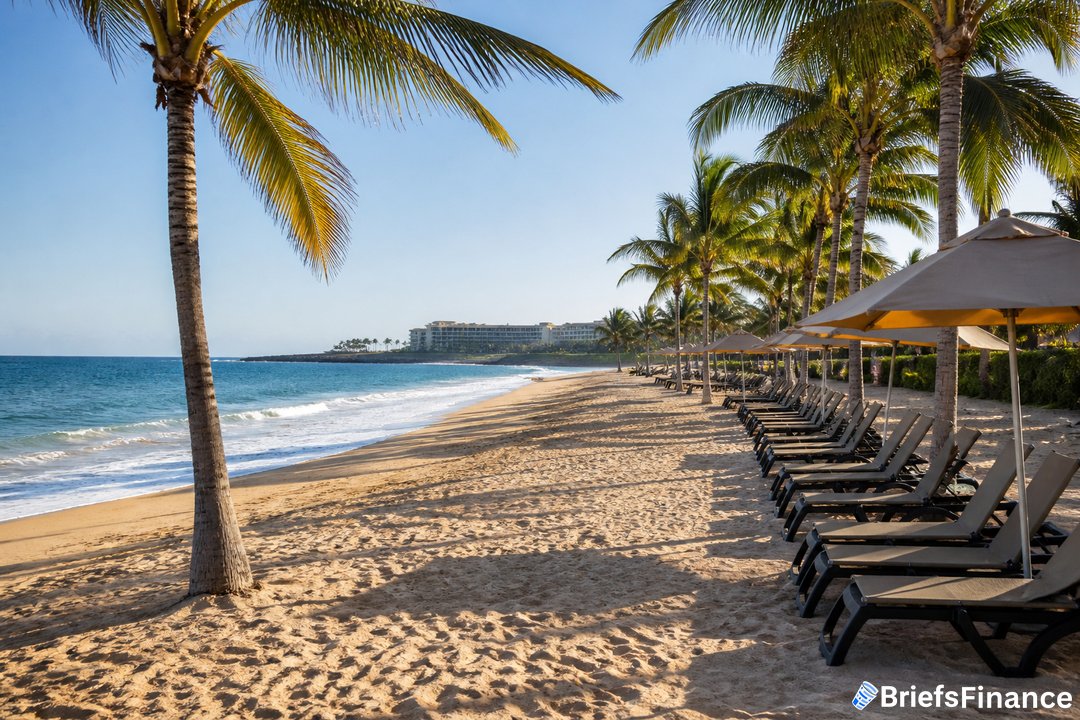
Mexico's top three beach destinations - Cancún, Los Cabos and Puerto Vallarta - have logged a second straight year of falling air passenger traffic, and the slowdown is showing up on the sand. Year to date, international arrivals are off 6% in Cancún, 8% in Los Cabos and 20% in Puerto Vallarta. The slide worsened over the summer: the operator Grupo Aeroportuario del Sureste, whose main hub is Cancún, recorded a 12% decline in international passengers in June. In August, incoming passengers to Cancún fell 15%, and the most recent month showed declines of 17% in Los Cabos and 26% in Puerto Vallarta.

President Claudia Sheinbaum has touted a 14% rise last year in "international visitors" and says, "Mexico is in fashion." That headcount includes people who do not spend the night, like cruise passengers and day trippers, and even that momentum eased to less than 8% growth in the first half of this year.

Who is spending, and how much

Travelers who arrive by plane generate about four fifths of total tourism outlays. Last year they spent more than $1,200 per trip on average. By June this year, the number of top-spending air travelers had fallen by over 4%, while their average outlay per trip climbed to roughly $1,300. For context, cruise travelers spent $84 per stop on average, and visitors crossing from the U.S. spent $59 per visit.

Tourism brings in roughly $150 billion a year, close to 9% of Mexico's annual output, more than any other industry, and provides a reliable inflow of foreign exchange that generally holds up during trade disruptions. Yet the wider economy has barely moved for years, with growth this year expected to be around 1% as officials work to attract more private investment amid questions about the future of trade ties with the U.S.

Why traffic is slowing

Tourism Minister Josefina Rodríguez cites a mix of pricier airline tickets, softer demand from the U.S., tougher competition from the Caribbean and other destinations, and a stronger peso making trips to Mexico costlier. "Jet fuel is the first thing that hits flights and frequencies between the US and Mexico," she said. "Second, inflation in the US; people aren't traveling as much," she added, referring to Mexico's top source market. Repeat outbreaks of gang violence have also discouraged some travelers, as has the spread of sargassum that accumulates on large stretches of the Caribbean coast.

Rodríguez said Mexico is competing with closer beach draws like the Dominican Republic and faraway options like Turkey. She acknowledged those destinations spend more on advertising, while arguing Mexico's breadth is the edge. "We have far more options that we really need to take advantage of," she said.

Travel trends can change quickly, so steady planning protects your savings and goals. Join Briefs Finance CEO Jaspreet Singh on September 29th for a FREE live investor workshop, How to Profit From A Dollar That's Losing its Value, where he shows how we're spotting investment opportunities as the dollar falls. Save your spot.

The China push and what changes on the ground

With plane loads easing to traditional sun and sand getaways, officials are courting China as a fresh source of demand. Rodríguez noted that about 150 million Chinese travelers vacation abroad annually, yet Mexico attracts only 200,000 of them. Her ministry estimates a Chinese visitor spends more than twice the average international tourist, or about $3,000 per trip.

The pitch is tilted to culture, not beaches: "The Chinese tourist to Mexico, first of all, isn't looking for sun," she said. "It's more of a cultural segment. They love Day of the Dead, and it's more about food and culture."

To make that work, Mexico plans to train more of its roughly 13,000 licensed guides to speak Mandarin, add Chinese-language signage at hotels and attractions, and adapt payment options to Chinese preferences. The tourism ministry also aims to expand Mexico's presence on WeChat and Weibo, and to organize Mexican creators based in China together with Chinese nationals living in Mexico as a coordinated corps of tourism ambassadors. The current push spotlights Mexico City, Baja California, Michoacán, Guanajuato and Quintana Roo. The mix leans into history and culture, with Tijuana offering direct flights to China and Cancún serving as an entry point to major Maya sites.

Money is a constraint. After years of reduced funding for cultural sites, the main tourism-promotion office received 43 million pesos this year, about $2.5 million. Rodríguez said the ministry has obtained an extra 100 million pesos to fund a campaign in the latter half of 2026, and she expects a similar allocation to be authorized via next year's budget, now before lawmakers. For your wallet, the bottom line is simple: the highest-spending air travelers are fewer but paying more per trip, and success with China at modest marketing budgets could soften the blow from higher fares, safety worries and algae-choked beaches.

When visitors come and go, a long term investment approach keeps your portfolio on track. Our CEO Jaspreet Singh is hosting a FREE live investor workshop, How to Profit From A Dollar That's Losing its Value, on September 29th. Sign up free to join him live.

Disclosure

Recent News

1 2 3 76

Get Market Briefs delivered to your inbox every morning for free!

No fluff. No noise. No politics. Just finance news you can read in 5 minutes.

Blogs

September 14, 2026
Why RAM Prices Are Soaring - and Where the Money Is Moving
  • Memory chips - the RAM inside phones, laptops, fridges, and trucks - are in a shortage Tim Cook called a 100-year flood, and some memory prices have climbed about 90% in a single quarter.
  • Four forces hit at once: AI demand, a production shutdown in 2023, build times that push any fix to 2028 at the earliest, and a bombed helium plant in Qatar.
  • The last two supply shocks ended in aggressive Fed rate hikes and market drops of around 45% and 20%, and this time Washington is spending heavily to bring memory production home.
Read More
September 11, 2026
How Is the Economy Doing? Washington Says It's Fixed, but the Numbers Don't Agree
  • Treasury Secretary Scott Bessent says the economy is fixed because lower earners' incomes are now rising faster than top earners'.
  • The Atlanta Fed and Bank of America show different numbers, and Hilton, Marriott, and McDonald's can't agree on what they're seeing either.
  • Whichever side is right, the economy is built to make investors rich, and inflation is how it does it.
Read More
September 10, 2026
US National Debt Hits $40 Trillion: Why the Economy Hasn't Collapsed Yet
  • The US national debt crossed $40 trillion in 2026 and is growing faster than the economy. The debt to GDP ratio now sits at 125%, the highest outside the pandemic and higher than World War II.
  • On September 9, 2026, Treasury Secretary Scott Bessent rolled out an emergency plan for the government to lend money to itself. Ray Dalio now says the dollar has roughly three years before real pain.
  • Empires rarely default. They debase. Since 1971, median household income grew about 8x while houses grew 17x and the S&P 500 grew 360x, so investors got richer while workers fell behind.
Read More
September 9, 2026
Your 401k Is Fueling the AI Bubble
  • About $10 trillion of 401k money sits in a $77 trillion stock market, mostly through target date funds and S&P 500 funds. Roughly 30% of every S&P 500 dollar lands in five AI-heavy tech stocks.
  • Four bubble signals run hotter today than before the 2000 crash: top-ten concentration, tech's share of the index, the Buffett Indicator, and how much of the market index funds own.
  • You only lock in an AI bubble loss if you sell. The 2022, 2020, 2008, and 2000 crashes were all buying windows for long-term investors, and the US-China AI race means government money could keep flowing in.
Read More
September 9, 2026
What Is Wealth Preservation? How To Protect Your Money From Anything
  • Wealth preservation is an investing strategy built around keeping the money you've already made instead of chasing growth.
  • It leans on assets that hold steady when markets fall - gold, Treasury bonds, and companies that keep earning through wars, crashes, and pandemics.
  • The tradeoff is real: you give up some upside, and the two key numbers to check are maximum drawdown and correlation to the market.
Read More
September 8, 2026
Why Is Everything So Expensive? Why Prices May Never Come Back Down
  • Official inflation is 3.4% and prices are up 32% since 2020, but rent (41%), gas (47%), car insurance (64%) and ground beef (79%) all outran the 28% median wage.
  • The Federal Reserve targets 2% inflation on purpose. Rising prices push extra dollars to investors and shrink the real cost of a $40 trillion national debt.
  • Investors who simply owned the S&P 500 gained about 150% over the same six years, and the Fed's September 16 decision will show whether it protects the dollar or the economy first.
Read More
September 7, 2026
The U.S. Housing Market Just Flipped: Renting a Home Now Beats Buying One
  • The US is in a buyer's market in 41 of the 50 largest metro areas, but prices sit near record highs and mortgage rates are close to 7%.
  • The same median house costs 27% more than it did in 2021 while the monthly payment costs 90% more, and incomes rose a little more than 10%.
  • A 2008-style crash is not showing up in the data, so the pressure is landing on buyers instead of prices.
Read More
September 4, 2026
An Interest Rate Hike in 2026? The Fed Just Broke Its Own Script
  • The Federal Reserve spent a year signaling cheaper money, and its new chairman just warned that an interest rate hike may be coming instead.
  • The Fed is stuck between high inflation and a weak job market, and fixing one makes the other worse.
  • Higher rates also reprice roughly a third of America's $40 trillion national debt this year, which is why Washington wants cuts so badly.
Read More
September 3, 2026
5 Passive Income Ideas That Pay You Whether You Work or Not
  • School teaches one formula: work, earn, spend. Stop working and the money stops, so the wheel never ends.
  • Five assets pay you without your labor - dividends, rent, interest, royalties, and the things you already own.
  • $80,000 a year of cash flow takes about $1 million invested at 8%, or roughly 20 years of $1,000 a month.
Read More
September 2, 2026
The Best Way to Invest 10k: Three Options To Transform 10K into 10 Million
  • Passive investing in stocks or real estate targets around 10% a year, and time in the market matters more than the price you get in at.
  • Active investing means putting your time in alongside your money, which raises the target to roughly 20% a year and raises the risk of losing it all.
  • Investing in yourself has no ceiling, because a new skill can create a new income that no market return can match.
Read More
1 2 3 26
Share via
Copy link










