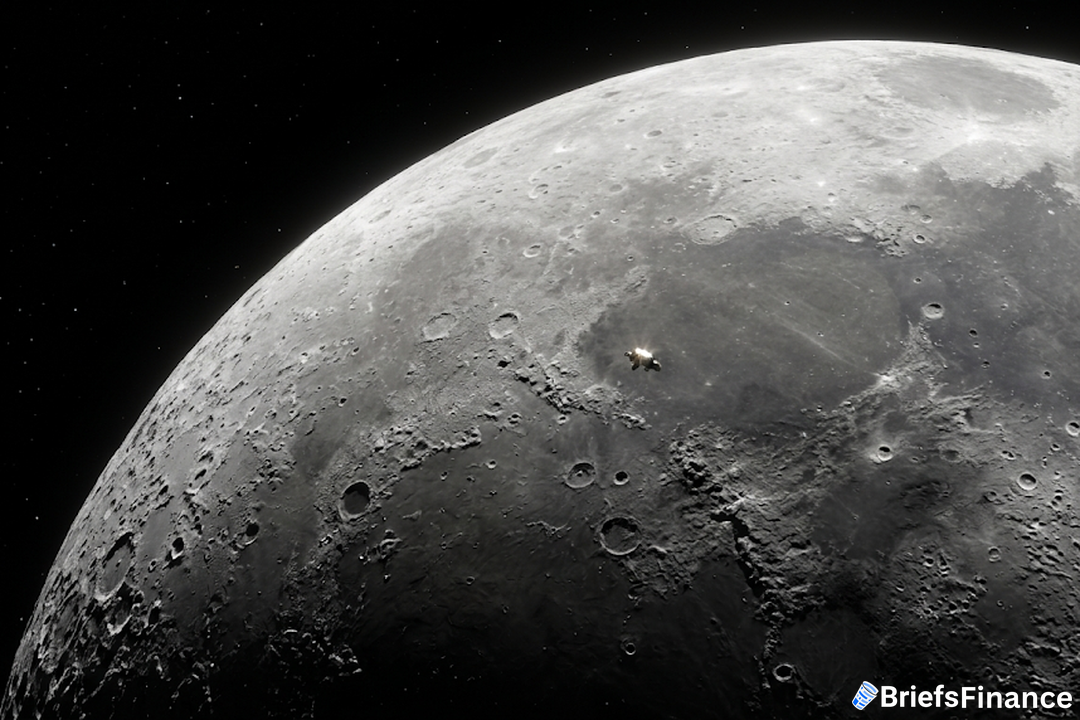
A 40-Foot Piece of Space Junk Is Coming Down
Left over from a Jan. 15, 2025 launch, the discarded upper stage is roughly 40 feet (12 meters) long and about 10,000 pounds (4,500 kilograms) in mass, and it carried two private lunar landers into space.
Among those landers was Firefly Aerospace's Blue Ghost, which achieved the first completely successful lunar landing by a private company. The other, Japan-based ispace's lander, wrecked.
The mission's dual-payload design reflected the fast-growing market for lunar delivery services, but it also meant two separate landing attempts in one shot. Firefly's success gave the company a historic win, while ispace's failure served as a reminder that reaching the moon's surface remains a difficult engineering challenge.
The abandoned rocket segment was left in a drifting orbit. Specialists say the collision might have been preventable if the upper stage had been pushed into a solar orbit instead.
The Moon Is Getting Crowded
This impact will mark only the second time a dead rocket is known to have hit the moon by accident. In 2022, a Chinese rocket piece left two craters on the far side of the moon.
Space tracking expert Bill Gray, who predicted the impact speed and location, put it simply: "Things are getting crowded up there."
Get the market news that matters in a five-minute read with Market Briefs, our free daily newsletter
The moon has taken hits on purpose before. In the Apollo years, NASA deliberately sent rocket parts and lunar modules into the moon to measure seismic activity. In 2009, NASA smashed the LCROSS spacecraft and its rocket upper stage into the lunar south pole area deliberately, looking for ice.
What the Crash Will Look Like
Astronomers are fortunate that the coming crash will happen on the side of the moon facing Earth. The upper stage is expected to hit at 5,400 mph, seven times the speed of sound.
Scientists expect the blast to dig a crater roughly 90 feet wide and 16 feet deep. The resulting hole will be invisible to ground-based telescopes but detectable from orbit. Experts say the flash from the collision, which will last under a second, will likely be faint. However, the plume of ejected soil could extend miles above the surface and stay visible to telescopes for many minutes.
Benjamin Fernando, a scientist at Los Alamos National Laboratory, explained why the dust will stick around.
"The gravity on the moon is low and there is no wind to blow the dust away," he said.
Because the event happens in the early morning, observers in the eastern U.S., eastern Canada, and much of South America may have the best look at it. Tracking specialist Bill Gray intends to watch the aftermath from New Brunswick, Canada.
What It Means for Your Portfolio
SpaceX went public in June. The company and Jeff Bezos's Blue Origin are both vying to build the lander for NASA's Artemis IV moonwalkers, whose names have not yet been chosen. They would follow the 12 Apollo astronauts who walked on the moon.
The stray rocket part is a reminder of the rising danger posed by increasingly crowded orbit. Retired astrophysicist Jonathan McDowell said the impact itself "will not be a problem."
He added: "But in a future where there are long-term bases on the moon, similar impacts would be an issue and we need not to leave rocket stages in chaotic orbits of this kind."
Scientists will use the crash to assess the risks for future astronauts. In an email, Benjamin Fernando, a Los Alamos National Laboratory researcher who has asked both trained and hobbyist skywatchers to monitor the event, explained: "Part of the reason for our interest in this event is to figure out how much of a hazard debris impacts pose to future astronauts."
The U.S. and China both want to put astronauts on the moon within the next few years.
Join Market Briefs, our free daily newsletter, for a quick daily rundown of the markets