Free NewsletterPro Login

Warning: Undefined variable $stocks in /var/www/briefs.co/htdocs/wp-content/plugins/oxygen/component-framework/components/classes/code-block.class.php(133) : eval()'d code on line 448

Warning: foreach() argument must be of type array|object, null given in /var/www/briefs.co/htdocs/wp-content/plugins/oxygen/component-framework/components/classes/code-block.class.php(133) : eval()'d code on line 448

Warning: Undefined variable $funds in /var/www/briefs.co/htdocs/wp-content/plugins/oxygen/component-framework/components/classes/code-block.class.php(133) : eval()'d code on line 472

Warning: foreach() argument must be of type array|object, null given in /var/www/briefs.co/htdocs/wp-content/plugins/oxygen/component-framework/components/classes/code-block.class.php(133) : eval()'d code on line 472
/* the link was here */

Canada Fast-Tracks Pacific Link Pipeline With Construction Targeted For September 2027

Published Oct 1, 2026
Share:
Summary:
  • Prime Minister Mark Carney labeled the Pacific Link pipeline a "project of national interest," aiming to break ground in September 2027.
  • The designation moves the process to setting build conditions and lets cabinet waive parts of existing laws and rules if needed.
  • Ottawa and Alberta will co-own the project, Pembina Pipeline Corp. starts with 10% and may go to 20%, Trans Mountain Corp. will lead development, and Carney says it could enable an extra 1 million barrels a day to Asia.

What the government announced

Prime Minister Mark Carney said Thursday he is speeding up approvals for a major new oil pipeline called Pacific Link, with a target to start construction in September 2027. He declared it a "project of national interest," tapping new powers from last year's legislation to move big projects faster by treating them as approved while regulators set the terms for construction. The move also lets the federal cabinet grant exemptions from various laws and regulations if it decides they are warranted.

Carney framed the stakes this way: "Today, 90% of Alberta's oil goes to the United States. Pacific Link will materially reduce that dependence by allowing us to export an additional one million barrels a day to growing markets in Asia." He added that a west coast pipeline fits his goal to "double our non-US exports over the next decade," saying it would create hundreds of thousands of jobs while drawing "tens and tens of billions of dollars of new investment into the Canadian economy."

Project structure, route, and costs

A new operating company will run Pacific Link, jointly owned by the federal and Alberta governments. Pembina Pipeline Corp., based in Calgary, will initially own 10% with an option to lift that to 20%, and at least 10% ownership will be offered to Indigenous groups. Development will be headed by Trans Mountain Corp., the government-owned operator responsible for the Trans Mountain expansion.

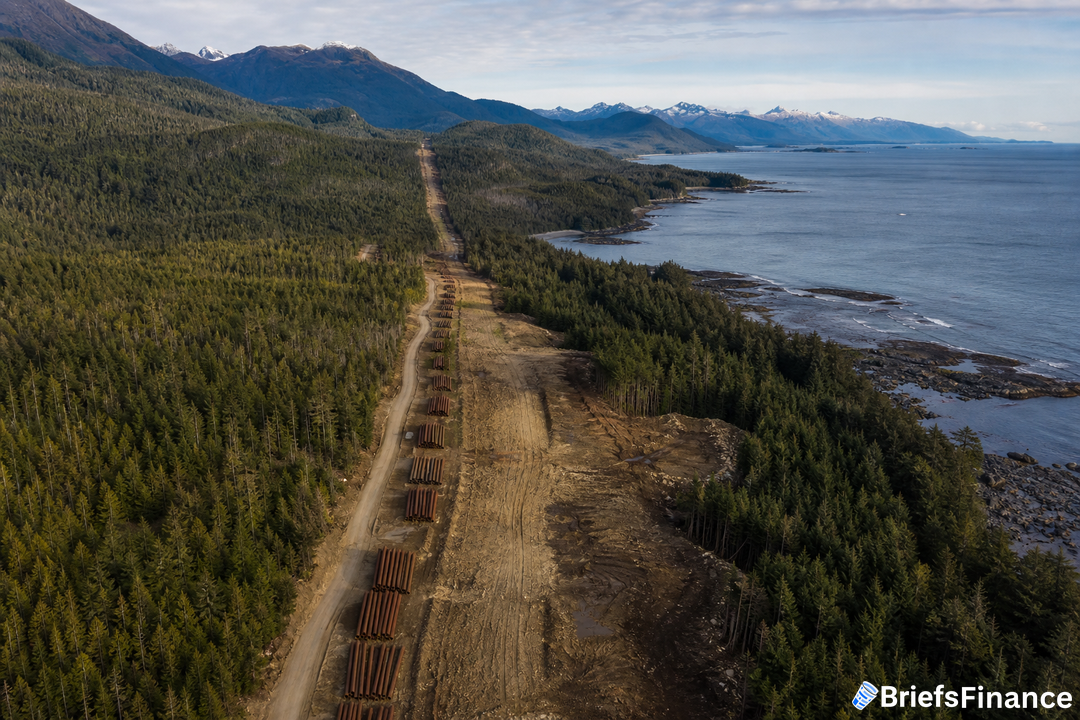
The line will link the oil sands in northern Alberta to a new terminal near Vancouver, with capacity to move up to 1 million barrels of bitumen each day onto ships bound for the Pacific. Most of the route would track the existing Trans Mountain corridor through the Rockies, but it will end at a different location because the plan includes a new deepwater port that can receive Very Large Crude Carriers. That capability is intended to sharpen the economics of longer-haul deliveries to destinations like India. The government is funding a new terminal at Roberts Bank in Delta, close to the US border.

According to Alberta, the construction price tag may fall in the range of C$35.2 billion ($24.7 billion) to C$43.7 billion if investment is approved within three years. Asked about price tags, Carney said only that "the Canadian taxpayer is going to make a lot of money off this pipeline."

When big plans stretch over years, keeping steady habits matters; download the free Always Be Buying E-Book today

Environmental, legal, and political headwinds

Carney acknowledged that previous projects got bogged down. "Over time, the way we built became weighed down by well-intentioned, but arduous and often duplicative regulatory processes," he said. Alongside the pipeline, the government is pushing a large carbon capture system in the oil sands, which Carney has pitched as a "grand bargain" to expand exports to Asia while cutting the emissions intensity of Canadian barrels.

Expect friction. The route crosses tough mountain terrain that drove big cost increases on the last build along this path, the Trans Mountain expansion. Environmental groups and some Indigenous communities are likely to challenge the project in court and in politics.

Concern is especially high around the Vancouver area, where the new terminus would increase tanker traffic. To blunt that, Carney this week pledged C$1.2 billion for ocean and marine conservation, including more capacity to track shipping, measures to reduce ocean noise, and a nationwide oil-spill response program focused on marine mammals.

Why this is happening now, and what to watch

Carney tied Pacific Link to two big forces: tariffs from President Donald Trump and the push to diversify away from a US‑centric export model. The Trans Mountain expansion that opened in May 2024 already boosted west coast capacity, and Statistics Canada data show Asia‑Pacific shipments climbed after that opening. Carney also told reporters he expects producers to ramp up, calling it "a tremendous commercial opportunity for them, given diversification of markets."

Politics are front and center. The project is also meant to signal support for Alberta's energy sector ahead of an Oct. 19 referendum on whether the province should move toward independence. Alberta Premier Danielle Smith welcomed the designation, saying it "sends a clear message: Canada is ready to build again."

Bottom line for your wallet: if Pacific Link moves on schedule, more Canadian barrels could aim for Asia on VLCCs out of Roberts Bank, which could ripple into demand for terminal services, shipping, and related infrastructure. It is a long road with real risks, but if it advances, the story to watch is how quickly Canadian producers lean into growth and how that shifts pricing and market access outside the US.

As plans unfold over many years, embrace regular investing habits and download Always Be Buying E-Book for free

Disclosure

Recent News

1 2 3 … 90

Get Market Briefs delivered to your inbox every morning for free!

No fluff. No noise. No politics. Just finance news you can read in 5 minutes.

Blogs

September 30, 2026
Dividend Investing vs. Growth Investing: Why the Slower Portfolio Can End Up Bigger
  • "What stock should I buy?" is the wrong first question. Growth, income, or wealth preservation comes first, and the goal changes which stocks even make sense.
  • At $500 a month for 30 years, 13% growth builds about $1.75 million. 10% growth plus a reinvested 4% dividend builds a little more than $2.2 million and pays a little more than $80,000 a year.
  • Income investors have US dividend ETFs, REITs, and international dividend funds to study. Growth investors have the Nasdaq 100, AI and chip funds, and small caps. None of it is a recommendation.
Read More
September 29, 2026
Why Is Gold Going Down? A 5.2% Treasury Yield Just Took Its Job
  • President Trump rejected Iran's deal to reopen the Strait of Hormuz, oil prices jumped back up, and gold fell instead of rising.
  • Treasury yields hit their highest level in more than 20 years, so investors sold gold and bought Treasuries that pay interest.
  • Higher Treasury yields make the national debt, mortgages, car loans, and credit cards more expensive, with the Fed's next rate decision due October 28.
Read More
September 28, 2026
The Strategic Bitcoin Reserve: Why the Government Wants Bitcoin to Explode
  • The US government holds about 328,000 Bitcoin, worth roughly $25 billion, and since a 2025 executive order it keeps seized coins instead of selling them.
  • Washington wants a bigger pile of assets so its $40 trillion national debt looks smaller next to them, which lets it keep borrowing and spending.
  • Bitcoin's wild price swings, and a government holding a coin built to escape governments, are the two risks investors need to watch.
Read More
September 25, 2026
BRIEFS EXCLUSIVE: 43% Of Respondents Say Bills Outran Their Income Over Past Two Years
  • 43% of the 494 Market Briefs readers surveyed said their bills grew faster than their income over the past two years, even though 79% could cover a surprise $5,000 expense tomorrow.
  • Half of readers own gold or crypto, the two classic bets against a weaker dollar, and only 13% bought nothing at all in the last 12 months.
  • The median reader says it takes $150,000 a year to feel financially secure, about $62,000 above the U.S. median household income.
Read More
September 25, 2026
The Economy Is Booming. So Why Did Stocks and Bonds Fall Together?
  • S&P Global says the US economy is growing at its fastest rate since 2021, with corporate profits up 28.9% in a year, almost four times the historical average.
  • Stocks and bonds fell at the same time, which is not how the two markets normally behave, because Treasury yields above 5% now compete with stocks for investors' money.
  • Jaspreet Singh lays out three ways to invest through a shift like this: always be buying, buy the crash, or follow the money before it hits the headlines.
Read More
September 24, 2026
The 2026 Economic Reset Is Starting: Are We in a Recession, or Is the Pain Still Ahead?
  • The Federal Reserve has flipped from stimulating the economy to fighting inflation with higher interest rates, while the White House still wants growth at almost any cost.
  • The national debt tops $40 trillion, has outgrown the entire U.S. economy, and its interest payments are now the government's fastest-growing expense.
  • Higher rates bring pain for private equity, private credit, and speculative assets, but they open opportunities for investors holding cash, treasuries, and value assets.
Read More
September 23, 2026
Are We in a Recession? Without AI, America Might Already Be in One - and Washington Knows It
  • The White House attributes about three quarters of U.S. economic growth to AI, and many believe the economy would already be in a recession without it.
  • Washington has three reasons it cannot let the AI boom slow down: staying the world's superpower, outgrowing $40 trillion in national debt, and protecting a government stock portfolio worth billions.
  • Every market goes through booms and busts, and investors who understand the cycle get to buy the downturn instead of panic-selling with the crowd.
Read More
September 22, 2026
Will Interest Rates Go Down in 2026? Where the Money Moves Either Way
  • The Fed is leaning toward higher rates to fight 4% inflation, while the White House and a cracking job market push the other way.
  • If rates rise, money has tended to move toward short-term Treasuries, floating-rate loans, energy, banks and dividend payers.
  • If rates fall, it has tended to move toward gold, silver and Bitcoin, real estate, small caps, the S&P 500 and speculative bets.
Read More
September 21, 2026
How the Federal Reserve Makes Money - and Why It Just Posted Its Biggest Loss Ever
  • For 109 years the Federal Reserve created money, lent it to the U.S. government and handed the interest it collected back to Washington - almost $1 trillion in the decade starting in 2011.
  • Pandemic-era lending locked the Fed into earning about 2% on trillions of dollars while it now pays banks around 4%, producing a record loss of hundreds of billions in 2026.
  • The Fed covers its losses by creating money and the government covers its lost revenue by borrowing, and both feed the inflation that eats at the dollars in your account.
Read More
September 18, 2026
Kevin Warsh Just Defied Trump: What the Fed Rate Hike Means for Your Money
  • The Fed raised rates for the first time since 2023 in a unanimous vote led by Kevin Warsh, the chairman President Trump appointed to cut them.
  • Higher rates make the $40 trillion national debt, business loan resets and mortgages more expensive, but they strengthen the dollar and pay investors holding cash.
  • The war with Iran is pushing up oil, grocery and chip prices, another hike is likely in 2026, and recession talk is about to get louder.
Read More
1 2 3 … 28
Share via
Copy link










