Free NewsletterPro Login

Free Live Investors Workshop

Seats limited

Tue, Sep 29.

The dollar is losing value.

Here’s how investors can still profit.

Hosted By

Jaspreet Singh

Founder, Briefs Finance

X

Warning: Undefined variable $stocks in /var/www/briefs.co/htdocs/wp-content/plugins/oxygen/component-framework/components/classes/code-block.class.php(133) : eval()'d code on line 448

Warning: foreach() argument must be of type array|object, null given in /var/www/briefs.co/htdocs/wp-content/plugins/oxygen/component-framework/components/classes/code-block.class.php(133) : eval()'d code on line 448

Warning: Undefined variable $funds in /var/www/briefs.co/htdocs/wp-content/plugins/oxygen/component-framework/components/classes/code-block.class.php(133) : eval()'d code on line 472

Warning: foreach() argument must be of type array|object, null given in /var/www/briefs.co/htdocs/wp-content/plugins/oxygen/component-framework/components/classes/code-block.class.php(133) : eval()'d code on line 472
/* the link was here */

France Warns Wine Output Could Fall To 70-Year Low After Heat And Drought

Published Sep 20, 2026
Share:
Summary:
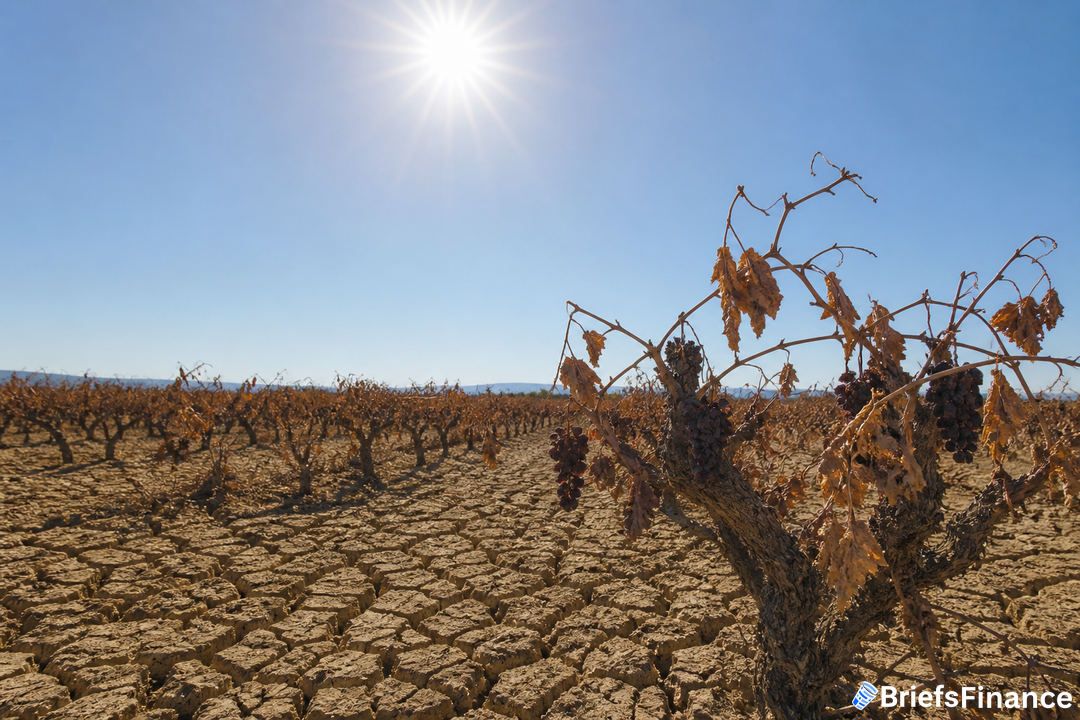
  • A record hot summer and droughts slammed French vineyards, and the agriculture ministry says 2026 wine output could sink to a 70-year low.
  • Producers report weaker yields, earlier harvests, and rising costs, prompting vine removals, consolidation, and new market bets, and, by late summer, Paris rolled out an emergency package exceeding 1 billion euros ($1.15 billion).
  • Industry voices, including Maison Louis Latour's Florent Latour and economist Jean-Marie Cardebat, say climate pressure is broad and could push France behind Italy and possibly Spain in global output.

What happened in the vines

France baked through an exceptionally hot, dry summer, with the strain on vineyards plain to see, including fields of vines torn out in Roquefort-des-Corbieres on February 3, 2025. The agriculture ministry now cautions that 2026 wine production could slump to a level not seen in 70 years, which would make it the third straight year of shrinking output. Jean-Marie Cardebat, the INSEEC Grande École chair for wines and spirits, said, "The 2023 vintage was decent, but yields have been pretty disastrous since the start of the decade." "We are realizing that no region in France is safe from heatwaves today."

Those heatwaves have not hit evenly. The areas that typically have gentler climates, notably the Loire Valley and Champagne, are paradoxically among the hardest hit, while producers in Bordeaux and Languedoc-Roussillon reported bigger harvests than a year ago.

High temperatures are also pulling harvest dates forward. "This year we started on the 14th of August, which is the earliest ever for the Latour domaine," said Florent Latour, CEO of Maison Louis Latour. He added that, decade by decade, the midpoint of harvest has shifted earlier by about three days, which adds up to roughly a month since the 1930s. The bottleneck is increasingly people, not grapes: "You have to have the flexibility to get your team in the vineyard at essentially a moment's notice because your predictions turn out to be wrong."

Rules, cash, and a vicious circle

Climate stress is colliding with the rulebook. Last year, Chateau Lafleur, owned by the Guinaudeau family, stepped away from Pomerol and broader Bordeaux appellation designations for six wines. The family argued that strict AOC rules on things like irrigation, planting density, and permitted grape varieties made it harder to adapt to a hotter climate. Leaving those constraints, they said, lets them face "the reality of climate change with precision and effectiveness" and is "a bold decision that enables the entire Lafleur Family … to ensure the perennity of our vineyards and the quality and identity of our wines. In a word: the future."

Cardebat contrasted France with Spain on readiness: "Spain is more often affected by heatwaves and global warming; however, it is better prepared," he said, citing the advantage of an established irrigation network. In France, irrigation is rare and allowed only in exceptional cases, and "setting up such measures takes time." The timing matters because finances are stretched.

"Treasuries are currently depleted. The more the climate is disrupted, the less capacity there is to invest - even though we need to invest more ... You can see that we are being drawn into a vicious circle," he said.

"I looked at business failures. They have tripled in the wine sector between 2019 and 2025. I think 2026 risks being just as catastrophic from this point of view."

Pulling vines, adding scale, chasing new buyers

Pressure on demand makes the math harder. Daily wine drinking in France slid from nearly half of the population in 1960 to below 10% by 2018, and the last five years of higher inflation and tariffs have helped swell inventories. Producers are cutting supply to cope.

Since 2023, roughly 20,000 hectares have been taken out in Bordeaux, leaving about 83,000 hectares under vine. Nationwide in 2026, around 4% of vines will be removed under a government program paying 4,000 euros ($4,590) per hectare for permanent uprooting.

When unexpected shocks touch daily life, keeping your savings steady pays off. Join Briefs Finance CEO Jaspreet Singh on September 29th for a FREE live investor workshop, How to Profit From A Dollar That's Losing its Value, where he shows how we're spotting investment opportunities as the dollar falls. Save your spot.

The state is also trying to cushion the blow. As summer concluded, Paris unveiled emergency support totaling more than 1 billion euros ($1.15 billion) for farmers and winegrowers hit by heatwaves. Meanwhile, estates are getting bigger.

Cardebat notes a clear 25-year trend toward larger properties, and Latour explained why scale helps now: "Quality does require, I think, a certain scale at this point in time, because of all this human resources, equipment and facilities investment. It's easier to absorb these costs with a certain scale." He also argued that being family owned and run is increasingly valued by customers.

Producers are testing new products and geographies too. Cardebat pointed to alternative formats such as ready-to-drink as worth trying, with the United States a useful sandbox for winning over consumers. He also highlighted South America, Brazil, and India as attractive because of a wave of recent trade deals. Latour wants to reach younger buyers and broaden access: "What's important is ... to make great quality wine more accessible, price-wise." Maison Louis Latour is leaning into South America and Brazil, and sees opportunity across the African continent given its younger demographics.

The ranking, the economy, and your money

Lower output may hit national bragging rights and balance sheets at the same time. "This year's harvest could push us back to third place among wine-producing countries - whereas 12 to 15 years ago, we were still first, ahead of Italy. Now Italy is clearly in the lead," Cardebat said.

"Spain could overtake us. This drop to third place indicates that France has a genuine production problem." It is symbolic, he said, but it also means a substantial hit to potential revenue for both the country and producers. The macro backdrop reflects the strain: in early September, the government lowered the outlook for growth to 0.5%, down from 1% earlier this year, and estimated that heat and drought will subtract 0.1 percentage point from growth this year.

None of this dampens Latour's belief that storytelling and quality still carry weight. "We felt we were so close," he said of the summer's weather. "Just a bit more rain would have produced a fantastic harvest on both counts, but we had to settle for quality, and about half of a harvest." As he put it, "As long as we're able to do this and in a way that is simple and also meaningful to the younger generation, and as long as quality is there and can be appreciated by the consumer, we have, I think, a very attractive future."

For your wallet, the takeaway is simple: a hotter climate is reshaping supply, costs, and where French wine looks for growth. That could shift which regions and brands perform, how prices move on shelves, and where innovation shows up first.

Long term goals benefit when you learn simple ways to protect and grow. Our CEO Jaspreet Singh is hosting a FREE live investor workshop, How to Profit From A Dollar That's Losing its Value, on September 29th. Sign up free to join him live.

Disclosure

Recent News

1 2 3 80

Get Market Briefs delivered to your inbox every morning for free!

No fluff. No noise. No politics. Just finance news you can read in 5 minutes.

Blogs

September 18, 2026
Kevin Warsh Just Defied Trump: What the Fed Rate Hike Means for Your Money
  • The Fed raised rates for the first time since 2023 in a unanimous vote led by Kevin Warsh, the chairman President Trump appointed to cut them.
  • Higher rates make the $40 trillion national debt, business loan resets and mortgages more expensive, but they strengthen the dollar and pay investors holding cash.
  • The war with Iran is pushing up oil, grocery and chip prices, another hike is likely in 2026, and recession talk is about to get louder.
Read More
September 17, 2026
Why America Bailed Out the Yen: The Japan Carry Trade, the Dollar and Your Mortgage Rate
  • In July 2026 the US sent money to steady the yen because Japan is the largest foreign owner of US debt, and Washington needs Japan to keep lending.
  • For decades the Japan carry trade let Wall Street borrow yen at essentially 0% and pour it into US stocks, real estate and Treasuries, and rising Japanese rates are shutting that off.
  • A weaker yen means fewer buyers for the dollar and for US debt, which pushes Treasury rates up and drags mortgage, car loan and credit card rates up with them.
Read More
September 16, 2026
Treasury Yields Are Spiking Because Lenders Are Backing Away From U.S. Debt
  • The U.S. is paying its highest 30-year borrowing rate in about two decades because its biggest lenders, the Fed, foreign governments, and banks, are all pulling back from Treasuries.
  • Every mortgage, car loan, credit card, and business loan is priced off the 10-year Treasury yield, so when Washington pays more to borrow, so do you.
  • With about $40 trillion of debt against a $32 trillion economy, the country either outgrows its debt or slides into a doom loop, and investors need a plan for both.
Read More
September 15, 2026
Fiat Currency Runs on Trust, and the World Just Stopped Trusting the Dollar
  • Gold has overtaken US treasuries as the world's top reserve asset, and central banks are now buying less US debt and more gold.
  • The US dollar is a fiat currency, meaning it's backed by a promise rather than gold, so it loses value when fewer countries want to hold it.
  • Whether the US economy or its national debt grows faster from here decides which assets stand to benefit next.
Read More
September 14, 2026
Why RAM Prices Are Soaring - and Where the Money Is Moving
  • Memory chips - the RAM inside phones, laptops, fridges, and trucks - are in a shortage Tim Cook called a 100-year flood, and some memory prices have climbed about 90% in a single quarter.
  • Four forces hit at once: AI demand, a production shutdown in 2023, build times that push any fix to 2028 at the earliest, and a bombed helium plant in Qatar.
  • The last two supply shocks ended in aggressive Fed rate hikes and market drops of around 45% and 20%, and this time Washington is spending heavily to bring memory production home.
Read More
September 11, 2026
How Is the Economy Doing? Washington Says It's Fixed, but the Numbers Don't Agree
  • Treasury Secretary Scott Bessent says the economy is fixed because lower earners' incomes are now rising faster than top earners'.
  • The Atlanta Fed and Bank of America show different numbers, and Hilton, Marriott, and McDonald's can't agree on what they're seeing either.
  • Whichever side is right, the economy is built to make investors rich, and inflation is how it does it.
Read More
September 10, 2026
US National Debt Hits $40 Trillion: Why the Economy Hasn't Collapsed Yet
  • The US national debt crossed $40 trillion in 2026 and is growing faster than the economy. The debt to GDP ratio now sits at 125%, the highest outside the pandemic and higher than World War II.
  • On September 9, 2026, Treasury Secretary Scott Bessent rolled out an emergency plan for the government to lend money to itself. Ray Dalio now says the dollar has roughly three years before real pain.
  • Empires rarely default. They debase. Since 1971, median household income grew about 8x while houses grew 17x and the S&P 500 grew 360x, so investors got richer while workers fell behind.
Read More
September 9, 2026
Your 401k Is Fueling the AI Bubble
  • About $10 trillion of 401k money sits in a $77 trillion stock market, mostly through target date funds and S&P 500 funds. Roughly 30% of every S&P 500 dollar lands in five AI-heavy tech stocks.
  • Four bubble signals run hotter today than before the 2000 crash: top-ten concentration, tech's share of the index, the Buffett Indicator, and how much of the market index funds own.
  • You only lock in an AI bubble loss if you sell. The 2022, 2020, 2008, and 2000 crashes were all buying windows for long-term investors, and the US-China AI race means government money could keep flowing in.
Read More
September 9, 2026
What Is Wealth Preservation? How To Protect Your Money From Anything
  • Wealth preservation is an investing strategy built around keeping the money you've already made instead of chasing growth.
  • It leans on assets that hold steady when markets fall - gold, Treasury bonds, and companies that keep earning through wars, crashes, and pandemics.
  • The tradeoff is real: you give up some upside, and the two key numbers to check are maximum drawdown and correlation to the market.
Read More
September 8, 2026
Why Is Everything So Expensive? Why Prices May Never Come Back Down
  • Official inflation is 3.4% and prices are up 32% since 2020, but rent (41%), gas (47%), car insurance (64%) and ground beef (79%) all outran the 28% median wage.
  • The Federal Reserve targets 2% inflation on purpose. Rising prices push extra dollars to investors and shrink the real cost of a $40 trillion national debt.
  • Investors who simply owned the S&P 500 gained about 150% over the same six years, and the Fed's September 16 decision will show whether it protects the dollar or the economy first.
Read More
1 2 3 27
Share via
Copy link











