What Washington Just Funded
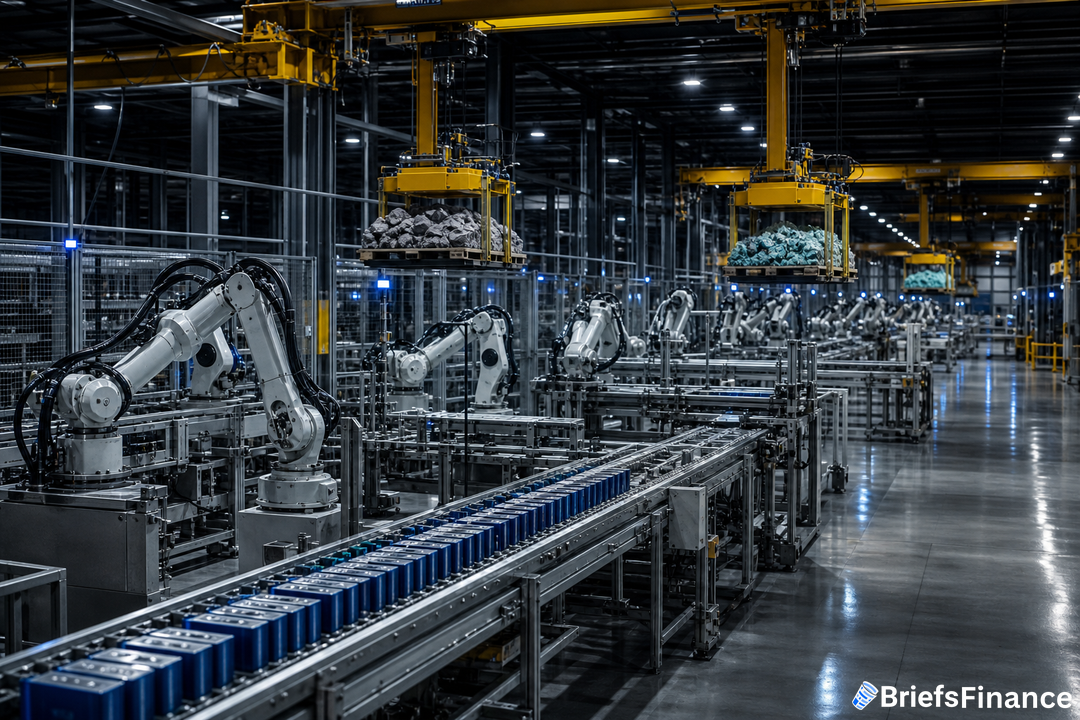
Arriving in August, the Trump administration's newest battery initiative sent $500 million from the Department of Energy to seven firms working on battery minerals, materials, manufacturing, and recycling. The move sits within a wider effort to lock down critical minerals and related inputs, and it came after many Biden-era policies backing battery manufacturing and financing for electric vehicles were rolled back.
This is the inaugural tranche from two $3 billion DOE programs for battery technology and materials, which were established via the Biden-era Infrastructure Investment and Jobs Act. According to Richard Wang, CEO of Voya Energy, strengthening the U.S. battery supply chain was a top focus for the previous administration. "A lot of those policies have reversed themselves under the Trump administration and/or shifted," he said.
The administration additionally eliminated federal EV tax credits and cut off other funding for those vehicles and their batteries. Atlas Public Policy reports that after Trump took office in January 2025, previously announced battery projects totaling close to $24 billion were scrapped.
Why China Still Dominates
China holds major shares across the battery chain, from minerals and chemicals to finished products like EVs and energy storage systems. Its real advantage is refining and processing, and the International Energy Agency says China's refining share has grown since 2020. In 2025, Beijing tightened control by imposing strict export curbs on rare earths plus a variety of other minerals and processing equipment.
The lead extends into midstream and downstream steps.
Scale is a big part of the edge. Wang pointed to CATL - headquartered in China - as the largest EV and energy storage battery maker, saying the company has built a significant technology and manufacturing lead worldwide and is among the few with high revenue and strong profitability due to manufacturing and supply chain strength.
That is the competition any U.S. firm faces. According to Tu Le of Sino Auto Insights, matching China's comprehensive supply chain would require a multi-decade effort and investment on the order of tens - potentially hundreds - of billions of dollars, while the U.S. window to become competitive is roughly five to seven years.
Shifts in global supply chains remind us to keep portfolios resilient and balanced. Join Briefs Finance CEO Jaspreet Singh on September 29th for a FREE live investor workshop, How to Profit From A Dollar That's Losing its Value, where he shows how we're spotting investment opportunities as the dollar falls. Save your spot.
Meanwhile, China's EV market keeps pulling the battery industry forward. The U.S. is on a different trajectory: By comparison, in the United States, EVs, hybrids, and plug-ins comprised about 24% of sales during the second quarter of 2026, the Energy Information Administration reports. And the markets differ in scale, with about 16.3 million U.S. new car sales in 2025 versus 23.7 million in China, according to Cox Automotive.
The Tech Bets In This Round
Several awardees are targeting bottlenecks where China is strongest. Coreshell Technologies received $50 million to produce battery anodes using domestically sourced silicon instead of Chinese-sourced graphite. Lilac Solutions was awarded $100 million for a technique that pulls lithium from salt water brine while bypassing a common refining step typically required when lithium comes from hard rock.
He noted that 95% of spodumene processing takes place in China. "If you use our technology, you're producing battery grade lithium carbonate or hydroxide at the site of production," Sully said. "And you're bypassing that important step, that processing step that China has a chokehold on today."
Beyond EVs, energy storage has surged, with demand growing at an average rate of 70% since 2022, according to the EIA. Even so, the IEA reports that EVs continue to make up over 70% of all lithium‑ion battery deployment.
What It Means For Your Money
Policy is pulling in opposite directions. On one side, the first $500 million round under the $3 billion programs is a start. On the other, ending EV tax credits and the axing of nearly $24 billion in battery projects since January 2025 signal a harder path to build out capacity. Add in China's growing refining share since 2020 and its 2025 export controls, and the center of gravity for critical battery materials is still firmly in China.
The practical takeaway: the U.S. is putting chips on technologies that cut out Chinese-dominated steps and rebuild midstream capacity, but catching up will take serious time and capital. For everyday investors, that mix of early-stage bets and policy whiplash means volatility in the near term and a longer runway for any payoff.
Through every policy change, steady planning helps protect savings and grow opportunities. Our CEO Jaspreet Singh is hosting a FREE live investor workshop, How to Profit From A Dollar That's Losing its Value, on September 29th. Sign up free to join him live.