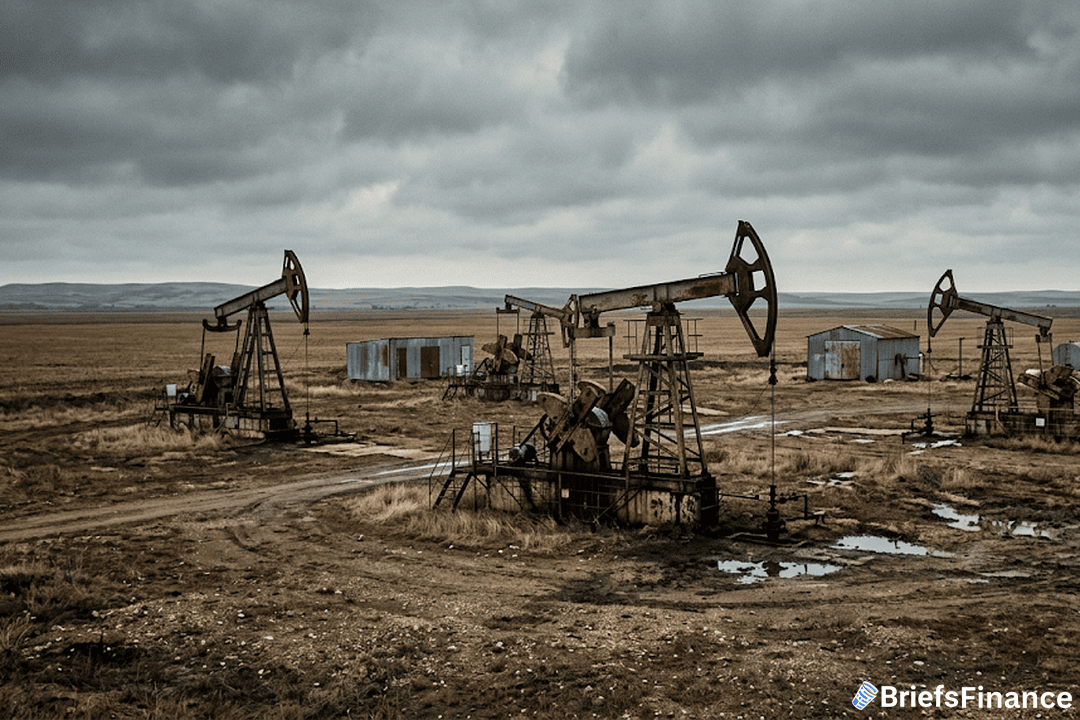
You would think a war that pushes oil prices higher would be great news for a country that lives off oil exports. Russia is finding out it is not that simple.
The Kremlin is collecting more energy revenue than it has in over a year, yet its budget deficit is growing fast. The extra cash is disappearing into a spending machine that shows no signs of slowing down.
A Record Shortfall Arrives Despite an Oil Windfall
In July, new government data showed Russia's federal budget shortfall reached 724 billion rubles ($8.8 billion). That reverses the surplus the country recorded just a month earlier.
The numbers add up quickly. Over January through July, the total shortfall climbed to 6.5 trillion rubles, equivalent to 2.8% of Russia's gross domestic product (GDP). GDP is simply the total value of everything a country produces in a year, so this shows how much the shortfall matters relative to the size of the whole economy.
The problem is not a lack of money coming in. Total revenue in July actually jumped 28% from a year earlier, with gains across both energy and non-energy sources.
The issue is how fast the money is going out the door.
Get the free Always Be Buying eBook and learn the simple system for building wealth on any income
Spending Out of Control
July outlays rose 6% from a year earlier, and that actually counts as a slowdown. In June, spending was up 13%.
The government has been making advance payments to state contractors, a common move early in the fiscal year. That practice, combined with heavy spending on the war in Ukraine, is pushing total outlays for the first seven months to 28.6 trillion rubles.
Here is the striking part: government procurement spending, which is money the state pays for goods and services, jumped 39% to 8.4 trillion rubles. That means Russia has already spent more than 80% of its full-year procurement plan, and it is only August.
Lawmakers have already approved amendments that let the government increase spending without going through the normal budget revision process. Ordinarily, the budget is revised later in the year, but this measure provides a quicker route.
Finance Minister Anton Siluanov indicated that the annual deficit goal of 1.6% of GDP will be revised upward, signaling that the shortfall is expected to widen.
Where the Oil Money Comes From
Russia's oil-and-gas revenue for July hit 934 billion rubles. Oil tax revenue alone reached a 15-month high.
Higher crude prices after the US-Israeli war with Iran helped push those numbers up. Russia also cut state payments to domestic refiners, which left more money in the treasury.
Urals crude prices have slipped recently as the US and Iran talk, but they still sit above the level Moscow assumed when it built this year's budget. That cushion should keep energy revenue flowing for now.
Yet the bigger picture is hard to ignore. Russia is pouring resources into its fifth year of war in Ukraine. High interest rates meant to control inflation have slowed the domestic economy.
Ukraine has expanded long-range drone strikes on Russian industrial sites, while Russia has stepped up air attacks on Ukrainian infrastructure. None of that is cheap, and none of it is stopping.
The bottom line: Russia is earning more from oil than it has in over a year, and it still cannot spend fast enough to stay ahead of its obligations. For the Russian economy, that is a sign that no amount of extra crude revenue can fix a budget built on war. For the rest of the world, it is a reminder that oil windfalls do not always flow where you expect, and that global conflicts keep reshaping energy markets in ways that eventually reach your own fuel prices and portfolio.
Download the free Always Be Buying eBook and start putting your money to work today