Free NewsletterPro Login

Warning: Undefined variable $stocks in /var/www/briefs.co/htdocs/wp-content/plugins/oxygen/component-framework/components/classes/code-block.class.php(133) : eval()'d code on line 448

Warning: foreach() argument must be of type array|object, null given in /var/www/briefs.co/htdocs/wp-content/plugins/oxygen/component-framework/components/classes/code-block.class.php(133) : eval()'d code on line 448

Warning: Undefined variable $funds in /var/www/briefs.co/htdocs/wp-content/plugins/oxygen/component-framework/components/classes/code-block.class.php(133) : eval()'d code on line 472

Warning: foreach() argument must be of type array|object, null given in /var/www/briefs.co/htdocs/wp-content/plugins/oxygen/component-framework/components/classes/code-block.class.php(133) : eval()'d code on line 472
/* the link was here */

Ford Invests C$700M in Essex Engine Plant, Backs USMCA Pact

Published Jul 20, 2026
[tts_player]
Share:
Summary:
  • A new three-year contract between Ford and Unifor provides hourly workers with a 9% wage increase and ratification bonuses of C$10,000 for permanent staff and C$2,000 for temporary employees.
  • The automaker is investing C$700 million ($499 million) in its Essex Engine Plant in Windsor, Ontario, to increase production of 5.0-liter and larger engines, many destined for U.S. assembly lines.
  • Ford CEO Jim Farley emphasized that a revised USMCA is critical to competing against cost and currency advantages of Korean and Japanese imports.

Ford Motor Company and Unifor, the union for its Canadian workforce, have formally approved a new three-year labor agreement that includes pay raises and lump-sum payments for roughly 5,000 employees.

Under the three-year deal, hourly employees will see a 9% raise, Ford announced in a Sunday news release. Full-time permanent staff will receive a C$10,000 ratification bonus, while temporary workers are eligible for C$2,000.

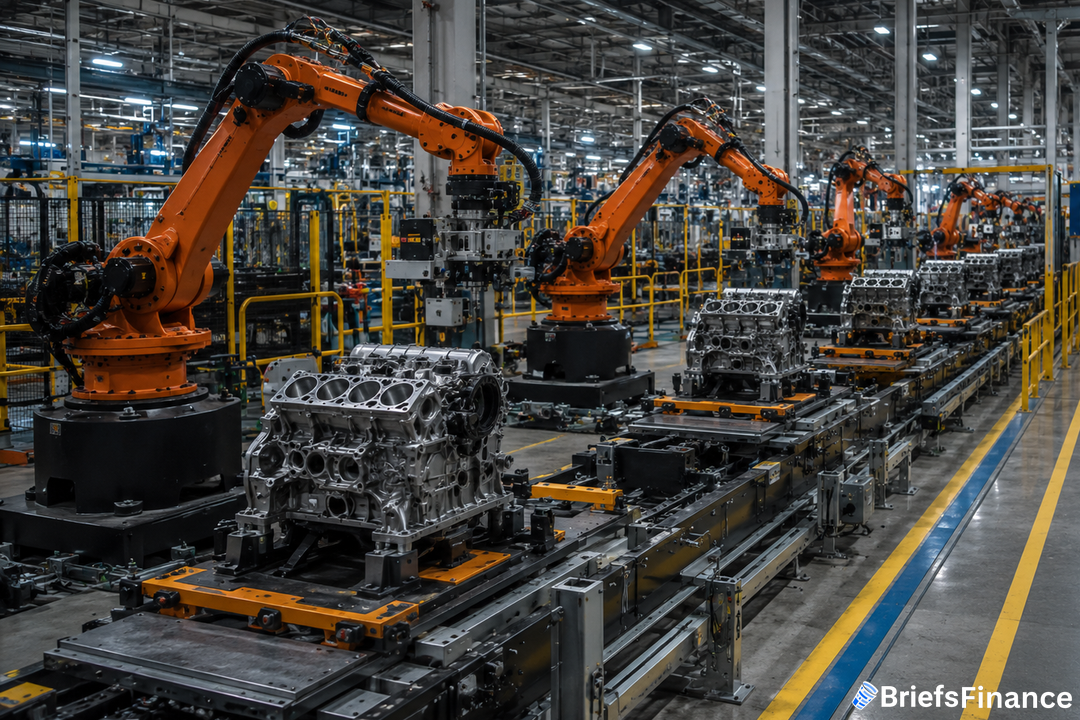
The contract also features a fresh C$700 million ($499 million) injection into the Essex Engine Plant.

This is on top of an earlier committed C$550 million for the Oakville assembly plant, which is preparing to increase output of large pickup trucks. According to Ford, the Essex funds will "maximize 5.0-liter engine production" and enable production of even bigger engines.

The Essex plant sits a short distance from the Gordie Howe International Bridge, which is scheduled to open this month and aims to streamline automotive and other trade between Canada and the U.S.

Get the market news that matters in a five-minute read with Market Briefs, our free daily newsletter

Background and Context

The new investment underscores Ford's long-term commitment to its Windsor operations, which have historically supplied critical engines and transmissions for vehicles built across North America. With the Oakville factory transitioning to large pickup production and the Essex plant expanding its output, Ford is deepening its reliance on an integrated cross-border supply chain - a model that depends on stable trade agreements like the USMCA to remain competitive against Asian imports.

This infrastructure improvement complements Ford's investment by lowering logistical costs and enhancing just-in-time delivery for engines destined for U.S. assembly plants. Additionally, the three-year labor agreement provides workforce stability, allowing Ford to plan production schedules without the risk of strikes or disruptions.

The Windsor engine plant has been a cornerstone of Ford's North American powertrain network for decades, and this fresh infusion of capital secures its role in supplying engines for high-demand truck models assembled in the United States. The proximity to the new Gordie Howe International Bridge further enhances logistical efficiency, reducing transit times and costs for components moving between Canada and the U.S.

Ford's Essex Engine Plant, long a vital source of engines for the company's North American truck models, will continue operating thanks to this new funding.

Ford CEO Jim Farley said, "This agreement is about investing in our people and Canada's future."

Farley additionally expressed support for the USMCA, which has yet to be renewed by the Trump administration. "A strong, integrated North American manufacturing system is essential to our competitiveness, and a revised USMCA is critical to fending off the cost and currency advantages enjoyed by imported vehicles from Korea and Japan," he said.

Unifor, the union representing approximately 5,000 Ford employees in Canada, negotiated the deal.

The broader trade environment is also a key factor behind this investment. The USMCA, which governs tariff-free automotive trade across North America, faces a scheduled review in 2026. Ford's push for renewal aligns with its strategy to keep production costs low relative to Asian rivals, particularly as Korean and Japanese automakers benefit from favorable exchange rates and lower labor costs. By locking in Canadian engine production and leveraging the new bridge, Ford aims to maintain its competitive edge in the lucrative full-size truck market.

Join Market Briefs, our free daily newsletter, for a quick daily rundown of the markets
Disclosure

Recent News

1 2 3 68

Get Market Briefs delivered to your inbox every morning for free!

No fluff. No noise. No politics. Just finance news you can read in 5 minutes.

Blogs

September 4, 2026
An Interest Rate Hike in 2026? The Fed Just Broke Its Own Script
  • The Federal Reserve spent a year signaling cheaper money, and its new chairman just warned that an interest rate hike may be coming instead.
  • The Fed is stuck between high inflation and a weak job market, and fixing one makes the other worse.
  • Higher rates also reprice roughly a third of America's $40 trillion national debt this year, which is why Washington wants cuts so badly.
Read More
September 3, 2026
5 Passive Income Ideas That Pay You Whether You Work or Not
  • School teaches one formula: work, earn, spend. Stop working and the money stops, so the wheel never ends.
  • Five assets pay you without your labor - dividends, rent, interest, royalties, and the things you already own.
  • $80,000 a year of cash flow takes about $1 million invested at 8%, or roughly 20 years of $1,000 a month.
Read More
September 2, 2026
The Best Way to Invest 10k: Three Options To Transform 10K into 10 Million
  • Passive investing in stocks or real estate targets around 10% a year, and time in the market matters more than the price you get in at.
  • Active investing means putting your time in alongside your money, which raises the target to roughly 20% a year and raises the risk of losing it all.
  • Investing in yourself has no ceiling, because a new skill can create a new income that no market return can match.
Read More
September 1, 2026
The Tax Write Offs the Rich Are Using in 2026 While the IRS Shrinks
  • The 2026 tax brackets landed lower than they were headed, and the standard deduction jumped from a planned $8,350 to $16,100 for single filers.
  • New write offs for overtime, tips, seniors and car loan interest are live now, and most of them are written to expire in 2028.
  • About a third of IRS auditors have been fired, and four assets do most of the work for people who want income without a matching tax bill.
Read More
August 31, 2026
America Is Running Out of Debt Buyers. Treasury Bills Are the Government's Fix
  • The government took in about $5 trillion in taxes in 2025 and spent about $7 trillion, and the national debt is now over $40 trillion.
  • Investors, banks, and foreign countries are all lending less to the U.S., so starting September 9 the government plans to sell more short-term treasury bills and use that cash to buy back its long-term debt.
  • Government interest rates set the floor for your mortgage, your car loan, and your credit card, and short-term Treasury ETFs like SGOV are one way investors are playing it.
Read More
August 23, 2026
How to Get the Most From Your Guideline 401k
  • Guideline is a company that provides low-cost 401k plans, popular with small businesses and their employees.
  • A "Guideline 401k" follows the same core rules as any 401k: tax-advantaged growth, contribution limits, and often an employer match.
  • The biggest results come from capturing the full match, choosing low-cost funds, and picking Roth or traditional to fit your situation.
Read More
August 23, 2026
Principal 401k: What to Know About Your Plan
  • Principal is one of many companies that manage workplace 401k plans, so a "Principal 401k" is simply a 401k where Principal is the provider.
  • The rules of a 401k are the same no matter who runs it: pre-tax or Roth contributions, tax-advantaged growth, and often an employer match.
  • The biggest wins come from grabbing the full match, picking low-cost funds, and knowing whether Roth or traditional fits you.
Read More
August 23, 2026
What a Tariff Dividend Means for Your Money
  • A "tariff dividend" is the idea of taking money the government collects from tariffs and paying some of it back to citizens.
  • To judge the idea, you first need to know what a tariff is: a tax on imported goods, usually paid by the companies bringing them in.
  • Tariffs ripple through prices, businesses, and your investments, so the smart move is understanding those ripples, not just the headline.
Read More
August 23, 2026
No Tax on Overtime: How Overtime Pay Is Taxed
  • "No tax on overtime" refers to a tax break that lets certain workers deduct some overtime pay, lowering the income they get taxed on.
  • A deduction does not mean overtime is truly tax-free. It means part of that pay is subtracted before your tax is figured.
  • The bigger money lesson: how you earn money changes how it is taxed, and investors often get the friendliest treatment of all.
Read More
August 23, 2026
Reading the Silver Price Forecast for 2026
  • Nobody can honestly promise a specific silver price for 2026. Any exact number is a guess, so treat forecasts as opinions, not facts.
  • Silver is unusual because it is both a precious metal and an industrial metal, so its price answers to two very different forces.
  • Instead of chasing a forecast, learn the drivers - inflation, interest rates, recession fear, and industrial demand - so you can judge any prediction yourself.
Read More
1 2 3 26
Share via
Copy link











