Ford Motor Company and Unifor, the union for its Canadian workforce, have formally approved a new three-year labor agreement that includes pay raises and lump-sum payments for roughly 5,000 employees.
Under the three-year deal, hourly employees will see a 9% raise, Ford announced in a Sunday news release. Full-time permanent staff will receive a C$10,000 ratification bonus, while temporary workers are eligible for C$2,000.
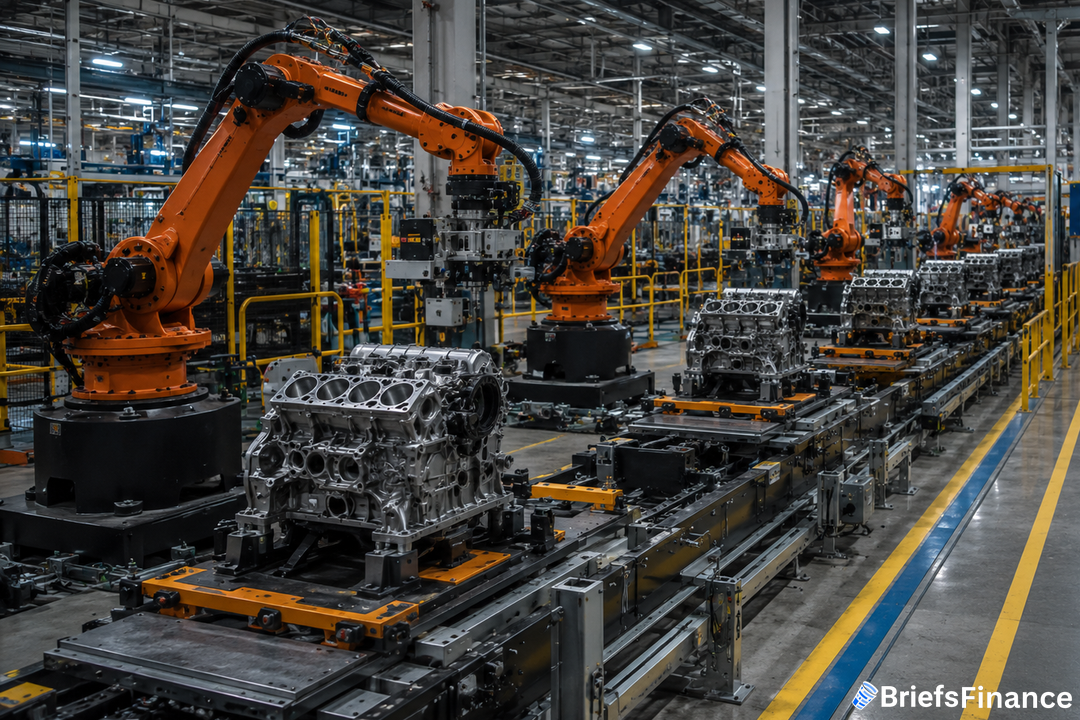
The contract also features a fresh C$700 million ($499 million) injection into the Essex Engine Plant.
This is on top of an earlier committed C$550 million for the Oakville assembly plant, which is preparing to increase output of large pickup trucks. According to Ford, the Essex funds will "maximize 5.0-liter engine production" and enable production of even bigger engines.
The Essex plant sits a short distance from the Gordie Howe International Bridge, which is scheduled to open this month and aims to streamline automotive and other trade between Canada and the U.S.
Get the market news that matters in a five-minute read with Market Briefs, our free daily newsletter
Background and Context
The new investment underscores Ford's long-term commitment to its Windsor operations, which have historically supplied critical engines and transmissions for vehicles built across North America. With the Oakville factory transitioning to large pickup production and the Essex plant expanding its output, Ford is deepening its reliance on an integrated cross-border supply chain - a model that depends on stable trade agreements like the USMCA to remain competitive against Asian imports.
This infrastructure improvement complements Ford's investment by lowering logistical costs and enhancing just-in-time delivery for engines destined for U.S. assembly plants. Additionally, the three-year labor agreement provides workforce stability, allowing Ford to plan production schedules without the risk of strikes or disruptions.
The Windsor engine plant has been a cornerstone of Ford's North American powertrain network for decades, and this fresh infusion of capital secures its role in supplying engines for high-demand truck models assembled in the United States. The proximity to the new Gordie Howe International Bridge further enhances logistical efficiency, reducing transit times and costs for components moving between Canada and the U.S.
Ford's Essex Engine Plant, long a vital source of engines for the company's North American truck models, will continue operating thanks to this new funding.
Ford CEO Jim Farley said, "This agreement is about investing in our people and Canada's future."
Farley additionally expressed support for the USMCA, which has yet to be renewed by the Trump administration. "A strong, integrated North American manufacturing system is essential to our competitiveness, and a revised USMCA is critical to fending off the cost and currency advantages enjoyed by imported vehicles from Korea and Japan," he said.
Unifor, the union representing approximately 5,000 Ford employees in Canada, negotiated the deal.
The broader trade environment is also a key factor behind this investment. The USMCA, which governs tariff-free automotive trade across North America, faces a scheduled review in 2026. Ford's push for renewal aligns with its strategy to keep production costs low relative to Asian rivals, particularly as Korean and Japanese automakers benefit from favorable exchange rates and lower labor costs. By locking in Canadian engine production and leveraging the new bridge, Ford aims to maintain its competitive edge in the lucrative full-size truck market.
Join Market Briefs, our free daily newsletter, for a quick daily rundown of the markets