Free NewsletterPro Login
S&P 500 6,287 +0.42%
DOW 44,521 -0.18%
NASDAQ 21,103 +0.71%
S&P 500 +12.4%
Briefs Finance Fund +24.8%
JOIN THE FUND →

Ford Invests C$700M in Essex Engine Plant, Backs USMCA Pact

Published Jul 20, 2026
[tts_player]
Share:
Summary:
  • A new three-year contract between Ford and Unifor provides hourly workers with a 9% wage increase and ratification bonuses of C$10,000 for permanent staff and C$2,000 for temporary employees.
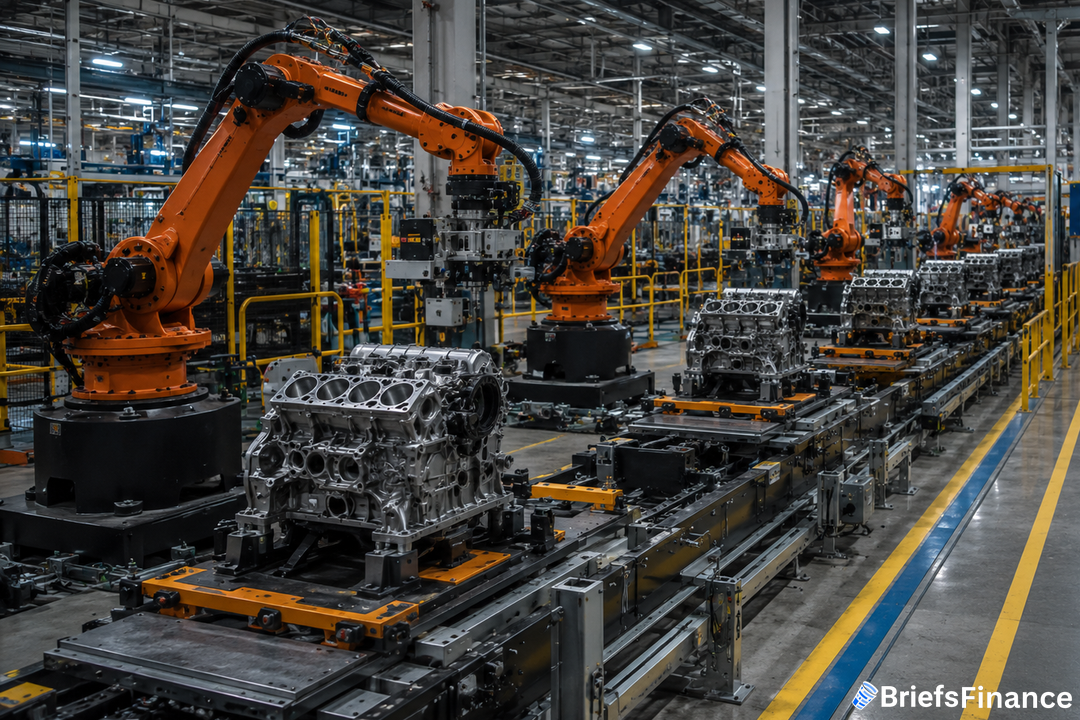
  • The automaker is investing C$700 million ($499 million) in its Essex Engine Plant in Windsor, Ontario, to increase production of 5.0-liter and larger engines, many destined for U.S. assembly lines.
  • Ford CEO Jim Farley emphasized that a revised USMCA is critical to competing against cost and currency advantages of Korean and Japanese imports.

Ford Motor Company and Unifor, the union for its Canadian workforce, have formally approved a new three-year labor agreement that includes pay raises and lump-sum payments for roughly 5,000 employees.

Under the three-year deal, hourly employees will see a 9% raise, Ford announced in a Sunday news release. Full-time permanent staff will receive a C$10,000 ratification bonus, while temporary workers are eligible for C$2,000.

The contract also features a fresh C$700 million ($499 million) injection into the Essex Engine Plant.

This is on top of an earlier committed C$550 million for the Oakville assembly plant, which is preparing to increase output of large pickup trucks. According to Ford, the Essex funds will "maximize 5.0-liter engine production" and enable production of even bigger engines.

The Essex plant sits a short distance from the Gordie Howe International Bridge, which is scheduled to open this month and aims to streamline automotive and other trade between Canada and the U.S.

Get the market news that matters in a five-minute read with Market Briefs, our free daily newsletter

Background and Context

The new investment underscores Ford's long-term commitment to its Windsor operations, which have historically supplied critical engines and transmissions for vehicles built across North America. With the Oakville factory transitioning to large pickup production and the Essex plant expanding its output, Ford is deepening its reliance on an integrated cross-border supply chain - a model that depends on stable trade agreements like the USMCA to remain competitive against Asian imports.

This infrastructure improvement complements Ford's investment by lowering logistical costs and enhancing just-in-time delivery for engines destined for U.S. assembly plants. Additionally, the three-year labor agreement provides workforce stability, allowing Ford to plan production schedules without the risk of strikes or disruptions.

The Windsor engine plant has been a cornerstone of Ford's North American powertrain network for decades, and this fresh infusion of capital secures its role in supplying engines for high-demand truck models assembled in the United States. The proximity to the new Gordie Howe International Bridge further enhances logistical efficiency, reducing transit times and costs for components moving between Canada and the U.S.

Ford's Essex Engine Plant, long a vital source of engines for the company's North American truck models, will continue operating thanks to this new funding.

Ford CEO Jim Farley said, "This agreement is about investing in our people and Canada's future."

Farley additionally expressed support for the USMCA, which has yet to be renewed by the Trump administration. "A strong, integrated North American manufacturing system is essential to our competitiveness, and a revised USMCA is critical to fending off the cost and currency advantages enjoyed by imported vehicles from Korea and Japan," he said.

Unifor, the union representing approximately 5,000 Ford employees in Canada, negotiated the deal.

The broader trade environment is also a key factor behind this investment. The USMCA, which governs tariff-free automotive trade across North America, faces a scheduled review in 2026. Ford's push for renewal aligns with its strategy to keep production costs low relative to Asian rivals, particularly as Korean and Japanese automakers benefit from favorable exchange rates and lower labor costs. By locking in Canadian engine production and leveraging the new bridge, Ford aims to maintain its competitive edge in the lucrative full-size truck market.

Join Market Briefs, our free daily newsletter, for a quick daily rundown of the markets
Disclosure

Recent News

1 2 3 39

Get Market Briefs delivered to your inbox every morning for free!

No fluff. No noise. No politics. Just finance news you can read in 5 minutes.

Blogs

June 29, 2026
Portfolio Diversification: Why Putting All Your Eggs in One Basket Destroys Wealth
  • Real diversification means spreading investments across all 11 economic sectors plus bonds, alternatives, and cash so no single bet can sink the portfolio.
  • Different sectors perform at different times, so a diversified portfolio captures upswings while smoothing the brutal drawdowns that wipe out concentrated bets.
  • Total market index funds offer the simplest path to diversification, and annual rebalancing is what keeps the structure working over time.
Read More
June 29, 2026
Non Taxable Income: What It Is and Why It Matters
  • Non taxable income is money you receive that you don't owe income tax on.
  • The tax code treats workers, investors, and business owners very differently, and investors often come out ahead.
  • Learning how income is taxed is a quiet superpower for keeping more of what you earn.
Read More
June 29, 2026
Semiconductor Stocks: A Simple Guide for Investors
  • Semiconductor stocks are companies that design and make computer chips, the brains inside nearly every modern device.
  • The AI boom has turned chips into one of the market's most important and most watched groups.
  • They offer big growth potential, but come with high valuations and a notoriously cyclical history.
Read More
June 25, 2026
How Stocks Work: A Simple Guide for Beginners
  • A stock is a slice of ownership in a company - buy one, and you own a piece of the business.
  • You make money two ways: the share price rising over time, and dividends paid to shareholders.
  • The simplest path for most beginners is buying into the whole market through a low-cost index fund.
Read More
June 25, 2026
Stop Loss vs Stop Limit: What's the Difference?
  • A stop loss order sells your stock once it hits a trigger price, prioritizing getting you out.
  • A stop limit order only sells within a price range you set, prioritizing price over a guaranteed exit.
  • The trade-off: a stop loss almost always executes; a stop limit might not if the price moves too fast.
Read More
June 25, 2026
Energy Stocks: A Simple Guide for Investors
  • Energy stocks are companies that produce and supply the power the world runs on, from oil and gas to newer sources.
  • They make up one of the 11 sectors of the market and tend to move with energy prices and big-picture shifts.
  • Like any sector, the key is diversification and understanding the forces driving demand.
Read More
June 18, 2026
What Is a Stop Loss Order? A Simple Guide
  • A stop loss order automatically sells a stock once it falls to a price you set.
  • It's a tool to cap losses or lock in gains without watching the market all day.
  • It works best for active strategies, and can backfire if used carelessly on long-term holdings.
Read More
June 18, 2026
Best S&P 500 Index Fund: How to Choose One
  • The best S&P 500 index fund for most investors is simply the cheapest, most established one that tracks the index well.
  • Funds like VOO, IVV, and SPY all hold the same 500 companies, so the biggest difference is the fee.
  • Pick one, automate your buys, and let time do the heavy lifting.
Read More
June 17, 2026
What Are Penny Stocks? Risks and Rewards Explained
  • Penny stocks are very low-priced shares of very small companies, often trading for just a few dollars or less.
  • They promise huge gains but carry huge risks: low liquidity, high failure rates, and wild price swings.
  • Most investors are better served by quality companies and funds than by chasing cheap shares.
Read More
June 17, 2026
Best Stocks for Beginners With Little Money
  • The best stocks for beginners with little money usually aren't individual stocks at all - they're low-cost index funds.
  • You can start with $100 or less and use small, regular investments to build wealth over time.
  • Focus on diversification and consistency, not on picking the next big winner.
Read More
1 2 3 24
Share via
Copy link











