Free NewsletterPro Login
S&P 500 6,287 +0.42%
DOW 44,521 -0.18%
NASDAQ 21,103 +0.71%
S&P 500 +12.4%
Briefs Finance Fund +24.8%
JOIN THE FUND →

FDA Authorizes 20 Zyn Pouches for Reduced-Risk Labeling

Published Jun 30, 2026
[tts_player]
Share:
Summary:
  • The FDA authorized 20 Zyn nicotine pouches to carry labels stating they lower the risk of certain smoking-related illnesses based on evidence of switching from cigarettes.
  • Philip Morris received this marketing approval in June 2026, following a January 2025 sales authorization that did not allow disease-risk claims.
  • Critics argue flavored pouches and widespread promotion could normalize nicotine use among non-smokers, including youth.

The FDA just informed smokers that using a Zyn pouch instead of cigarettes reduces their chances of developing various diseases linked to smoking. But critics warn the same flavored pouches could normalize nicotine for people who never smoked before. That tension is the heart of this story.

The Decision and What It Means for Philip Morris

The FDA granted Philip Morris (ticker: PM) permission to market its Zyn nicotine pouches as a less harmful alternative to cigarettes. The decision covers 20 specific products, including varieties such as Wintergreen, Spearmint, Smooth, Peppermint, Menthol, Cool Mint, Coffee, Citrus, Cinnamon, and Zyn Chill, each offered in both 3-milligram and 6-milligram nicotine strengths. This is not a full safety endorsement, but it is a powerful marketing tool.

Stacey Kennedy, who serves as the U.S. CEO of Philip Morris, described the announcement as "an important moment for the more than 45 million legal-age nicotine consumers in America." The company can now put a clear disease-risk reduction claim on its packaging and advertising. The FDA's evaluation determined that people who fully transition from smoking to using Zyn have a decreased risk of conditions including chronic bronchitis, emphysema, stroke, lung cancer, heart disease, and oral cancer.

Get your free investing masterclass bonus when you join Market Briefs, our free daily newsletter

This FDA authorization follows the agency's Modified Risk Tobacco Product (MRTP) framework, which allows companies to market products with reduced-risk claims only if rigorous scientific evidence shows a meaningful reduction in harm relative to traditional cigarettes. Previously, in January 2025, the same 20 Zyn products received premarket tobacco product authorization for sale - but without permission to advertise health benefits. The June 2026 upgrade gives Philip Morris a significant edge in the nicotine pouch market.

The Political and Regulatory Shift

This authorization comes during a Trump administration that has taken a more industry-friendly stance on nicotine products. White House spokesperson Kush Desai said, "President Trump consistently pledged on the campaign trail to expand access to nicotine vapes, pouches, and other products that evidence shows help adults quit smoking." The president's promise to "save vaping" was a campaign talking point, and the Zyn decision follows heavy lobbying from tobacco and vaping companies.

The FDA's acting director of the Center for Tobacco Products, Bret Koplow, said the agency's review "is intended to ensure that adult users have clear, science-based information about the relative harms of tobacco products, so they can make informed choices." The decision was announced on June 30, 2026.

Critics and Controversy

Not everyone is celebrating. The product has already become a cultural phenomenon, helped by former Fox News host Tucker Carlson, who popularized Zyn among conservative audiences before he later turned against the brand and started his own nicotine pouch company, Alp. Sources have reported that Robert F. Kennedy Jr., the Health and Human Services Secretary, also uses nicotine pouches.

The concern is that a "less harmful" label could make nicotine feel safe to a new generation. The FDA's authorization does not mean Zyn is harmless; it merely indicates that the evidence shows it is less dangerous than smoking cigarettes. But for investors, the key number is 20: that is how many products now carry an official government-backed risk reduction claim.

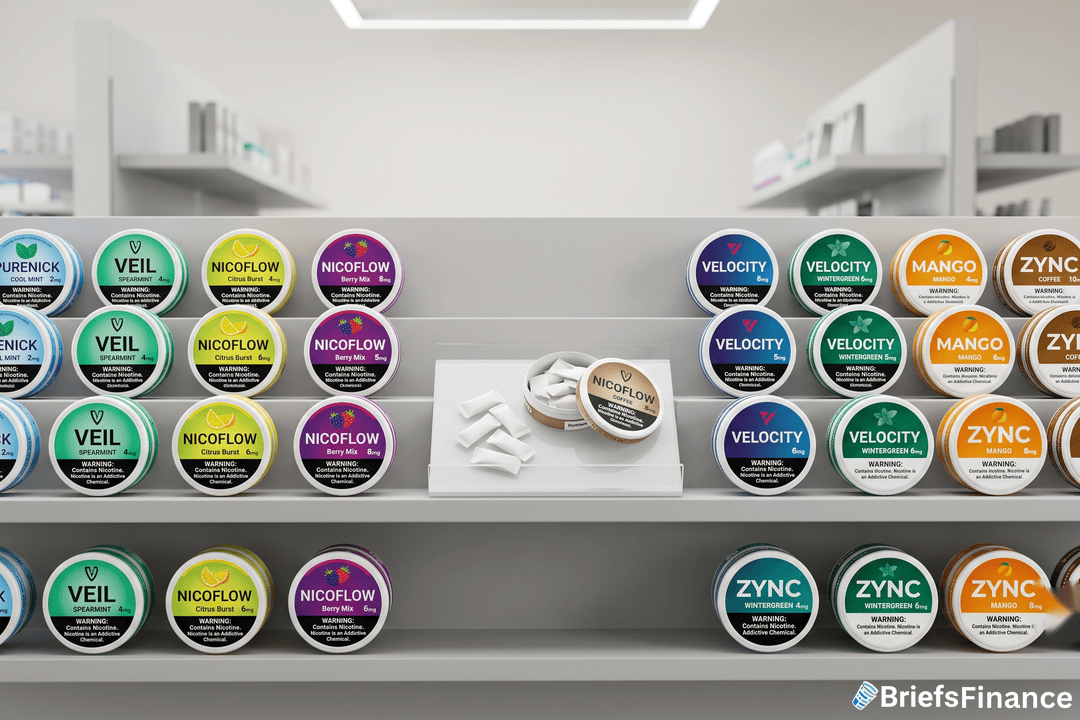
Zyn pouches are placed between the gum and lip, delivering nicotine without burning tobacco. Their discreet use has made them popular in workplaces and social settings, but also raised concerns about youth uptake.

Subscribe to Market Briefs, our free daily newsletter, and claim your bonus investing masterclass

Disclosure

Recent News

1 2 3 30

Get Market Briefs delivered to your inbox every morning for free!

No fluff. No noise. No politics. Just finance news you can read in 5 minutes.

Blogs

June 29, 2026
Portfolio Diversification: Why Putting All Your Eggs in One Basket Destroys Wealth
  • Real diversification means spreading investments across all 11 economic sectors plus bonds, alternatives, and cash so no single bet can sink the portfolio.
  • Different sectors perform at different times, so a diversified portfolio captures upswings while smoothing the brutal drawdowns that wipe out concentrated bets.
  • Total market index funds offer the simplest path to diversification, and annual rebalancing is what keeps the structure working over time.
Read More
June 29, 2026
Non Taxable Income: What It Is and Why It Matters
  • Non taxable income is money you receive that you don't owe income tax on.
  • The tax code treats workers, investors, and business owners very differently, and investors often come out ahead.
  • Learning how income is taxed is a quiet superpower for keeping more of what you earn.
Read More
June 29, 2026
Semiconductor Stocks: A Simple Guide for Investors
  • Semiconductor stocks are companies that design and make computer chips, the brains inside nearly every modern device.
  • The AI boom has turned chips into one of the market's most important and most watched groups.
  • They offer big growth potential, but come with high valuations and a notoriously cyclical history.
Read More
June 25, 2026
How Stocks Work: A Simple Guide for Beginners
  • A stock is a slice of ownership in a company - buy one, and you own a piece of the business.
  • You make money two ways: the share price rising over time, and dividends paid to shareholders.
  • The simplest path for most beginners is buying into the whole market through a low-cost index fund.
Read More
June 25, 2026
Stop Loss vs Stop Limit: What's the Difference?
  • A stop loss order sells your stock once it hits a trigger price, prioritizing getting you out.
  • A stop limit order only sells within a price range you set, prioritizing price over a guaranteed exit.
  • The trade-off: a stop loss almost always executes; a stop limit might not if the price moves too fast.
Read More
June 25, 2026
Energy Stocks: A Simple Guide for Investors
  • Energy stocks are companies that produce and supply the power the world runs on, from oil and gas to newer sources.
  • They make up one of the 11 sectors of the market and tend to move with energy prices and big-picture shifts.
  • Like any sector, the key is diversification and understanding the forces driving demand.
Read More
June 18, 2026
What Is a Stop Loss Order? A Simple Guide
  • A stop loss order automatically sells a stock once it falls to a price you set.
  • It's a tool to cap losses or lock in gains without watching the market all day.
  • It works best for active strategies, and can backfire if used carelessly on long-term holdings.
Read More
June 18, 2026
Best S&P 500 Index Fund: How to Choose One
  • The best S&P 500 index fund for most investors is simply the cheapest, most established one that tracks the index well.
  • Funds like VOO, IVV, and SPY all hold the same 500 companies, so the biggest difference is the fee.
  • Pick one, automate your buys, and let time do the heavy lifting.
Read More
June 17, 2026
What Are Penny Stocks? Risks and Rewards Explained
  • Penny stocks are very low-priced shares of very small companies, often trading for just a few dollars or less.
  • They promise huge gains but carry huge risks: low liquidity, high failure rates, and wild price swings.
  • Most investors are better served by quality companies and funds than by chasing cheap shares.
Read More
June 17, 2026
Best Stocks for Beginners With Little Money
  • The best stocks for beginners with little money usually aren't individual stocks at all - they're low-cost index funds.
  • You can start with $100 or less and use small, regular investments to build wealth over time.
  • Focus on diversification and consistency, not on picking the next big winner.
Read More
1 2 3 24
Share via
Copy link










