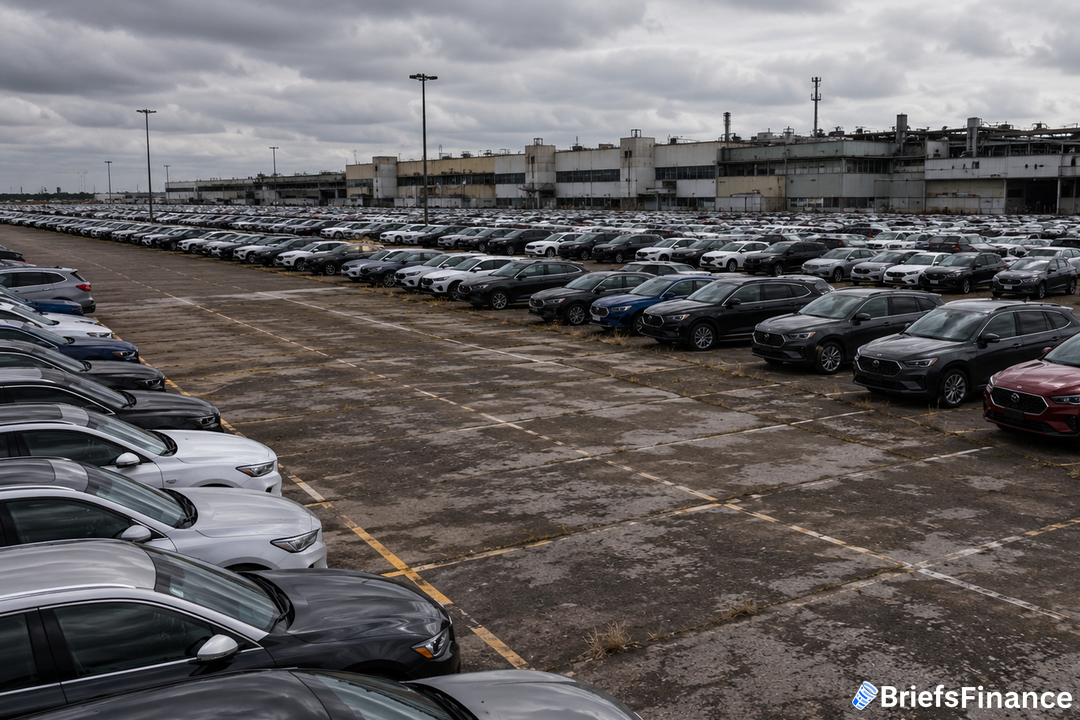
Too Many Models, Too Many Parts
Walk into a car dealership today and you will see a wall of chrome and plastic. Different nameplates, different trims, different engine choices. Under the hood, though, a lot of that variety is costing the companies that build them a fortune.
Legacy car companies are scrutinizing their extensive vehicle portfolios. The reason is simple: money.
Chinese car companies are expanding globally with cheaper vehicles, and they are forcing the old guard to rethink everything. At the same time, traditional automakers are burning billions of dollars on electric-vehicle development and getting tangled in new tariffs. Something has to give.
Volkswagen may be the most direct in admitting this challenge. The German giant plans to cut its total number of global models by half by 2030. It also wants to shrink what it calls product complexity - the number of different variants and powertrain options - by 75%.
Get the market news that matters in a five-minute read with Market Briefs, our free daily newsletter
Volkswagen's chief financial officer, Arno Antlitz, put it bluntly. "We have to tackle the complexity," he said. "On the customer side, we have too many models."
The numbers back him up. Volkswagen expects its vehicle deliveries to drop between 3% and 7% in 2026.
Copying the Copycats
The playbook is already written. Companies like Tesla and China's BYD have been building multiple vehicles on the same basic platform for years, using the same parts across different models. That keeps costs low and profits high.
Morningstar equity strategist Seth Goldstein, who covers the auto sector, noted that legacy manufacturers are paying attention. "I think automakers are likely copying Tesla and BYD," he said. "These companies are selling a lot of cars on the same platform, and they're very profitable. The legacy makers are asking, 'How can we take some of their lessons and simplify the number of parts we need on an assembly line?'"
Ford is one of them. It is working on a new electric-vehicle platform that uses fewer parts and fewer manufacturing steps. The first product from that platform? A midsize electric pickup with a sticker price around $30,000, due in 2027.
Stellantis, Nissan, and Rivian are also moving toward modular designs that share components across vehicles. The goal is the same: stop building everything from scratch each time and start reusing what works.
According to Sam Abuelsamid, Telemetry's vice president of market research, the reasoning is clear. "A lot of automakers are taking a long, hard look at their lineups," he said. "The more different vehicles you have, that adds manufacturing, marketing, and engineering complexity. You've got a lot of different variations of parts to stock in plants. That all adds up."
There is a real trade-off. Cars could start to feel more alike. When every automaker uses the same basic platform and the same handful of parts, the distinctiveness that brands rely on to charge a premium might fade. Yet the benefit could be vehicles that are cheaper to produce, and possibly more affordable for consumers.
Seth Goldstein sees the demand clearly. "If automakers can offer a more affordable vehicle while getting their costs down to be able to do so profitably," he said, "I think that's still in high demand from consumers."
Join Market Briefs, our free daily newsletter, for a quick daily rundown of the markets