Free NewsletterPro Login

The Airport Security Line Is Now a Two-Tier System — and It's Getting Worse

A stylized illustration of a cylindrical cup with blue arrows and lines indicating a swirling or rotational motion inside the cup.
Published Mar 30, 2026
Share:
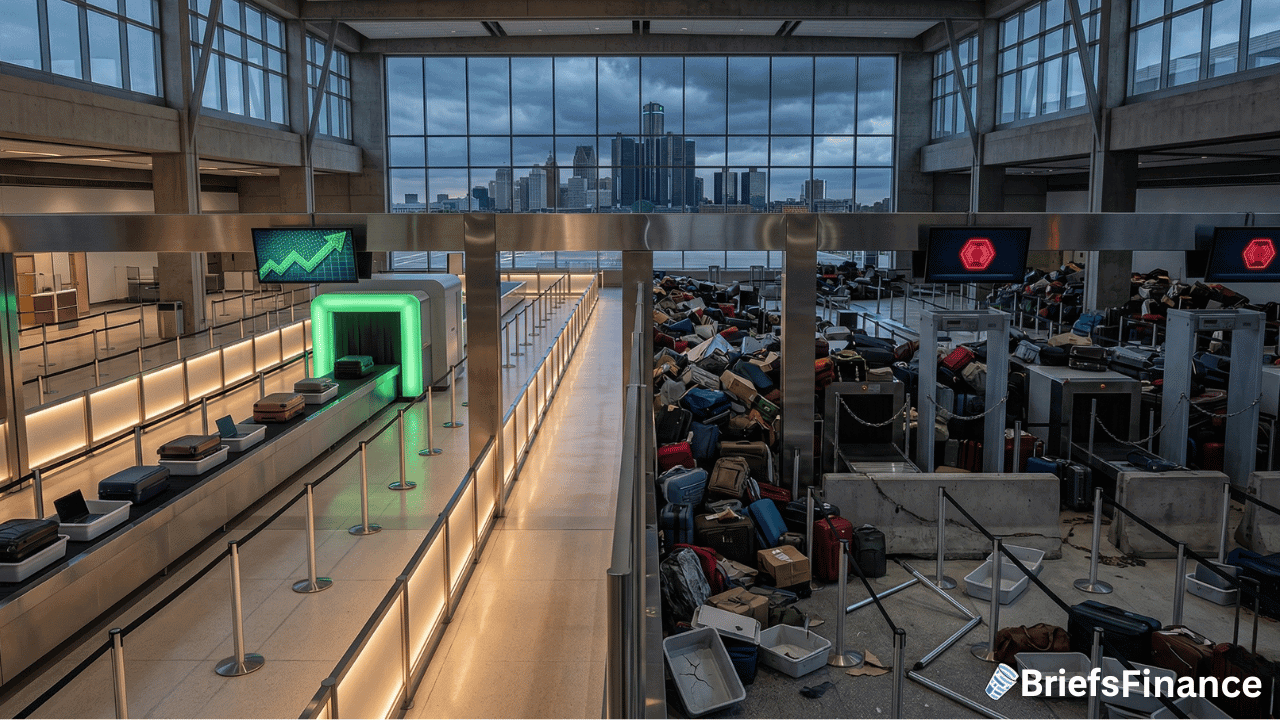
A split-screen of an airport security area highlights a two-tier system: one side shows an orderly security line with luggage and a green arrow, while the other side is chaotic with scattered bags and a red warning symbol.
Summary:

  • The partial government shutdown has created the longest TSA wait times in U.S. history, with lines topping four hours at some major hubs.
  • Travelers with TSA PreCheck, CLEAR, or premium tickets are sailing through. Everyone else is waiting — sometimes missing their flights entirely.
  • More than 480 TSA officers have quit since the shutdown began February 14. The longer it drags on, the worse it gets.

The airport is now two airports. One for people who can pay their way out. One for everyone else.

How Bad It Is

The partial government shutdown has left roughly 61,000 TSA officers working without pay since February 14. More than 480 have quit, and callout rates have more than doubled — from around 2% before the shutdown to a nationwide average of 6%. At Houston Hobby Airport, 55% of staff called out sick on a single day. JFK hit 76% during a winter storm. Atlanta has advised passengers to allow at least four hours for security.

Philadelphia has closed three checkpoints entirely. Dallas-Fort Worth is telling travelers to budget two hours for domestic flights. This is happening during peak spring break travel season.

Who's Getting Through

TSA PreCheck remains operational, though it's not immune to the chaos — some airports have temporarily closed PreCheck lanes when staffing gets too thin. CLEAR, the private biometric identity service that costs about $200 a year, lets members skip to the front of the document check line at the 60 airports where it operates.

Airlines have quietly become part of the solution too. Passengers with higher-fare tickets — including those who bought up to first class specifically to access premium lanes — are moving through security faster at some airports that offer dedicated check-in areas. Private aviation avoids TSA checkpoints entirely.

The inequity isn't lost on travelers stuck in standard lines watching others breeze past.

The Politics Behind It

The shutdown is a standoff between congressional Democrats and Republicans over DHS funding. Democrats have pushed for new restrictions on ICE; Republicans have largely opposed them. The Senate unanimously passed a bill this month to end Congress members' own ability to skip TSA lines — an acknowledgment that the optics had become untenable.

Transportation Secretary Sean Duffy warned CNN that if a deal isn't reached: "You're going to see what's happening today look like child's play."

There's no timeline for resolution.
Disclosure

Get Market Briefs delivered to your inbox every morning for free!

No fluff. No noise. No politics. Just finance news you can read in 5 minutes.

Blogs

May 30, 2026
Financial Literacy Books That Actually Build Wealth
  • The best financial literacy books don't just teach budgeting, they shift how you think about money.
  • Two classics stand out: The Intelligent Investor for valuing investments, and Rich Dad Poor Dad for the owner's mindset.
  • Reading is only step one. The real wealth comes from acting on what you learn.
Read More
May 30, 2026
What Is a Roth Conversion? A Simple Guide
  • A Roth conversion moves money from a traditional retirement account into a Roth account.
  • You pay taxes on the money now, in exchange for tax-free growth and withdrawals later.
  • It can pay off if you expect higher taxes or more income in the future, but the timing and tax hit matter a lot.
Read More
May 30, 2026
Trailing Stop Loss: How to Protect Your Gains
  • A trailing stop loss is an order that automatically sells a stock if it falls a set percentage from its recent high.
  • As the stock rises, the sell point rises with it, locking in gains while capping losses.
  • It's most useful for active strategies like momentum investing, not for long-term buy-and-hold.
Read More
May 30, 2026
5 Types of Wealth: Why Money Is Only One of Them
  • Real wealth is more than a bank balance. It spans your finances, health, mind, purpose, and freedom.
  • Money is powerful, but it amplifies the life you already have rather than fixing a broken one.
  • True financial wealth means your cash flow covers your expenses, so your money works while you live.
Read More
May 30, 2026
How to Invest in Private Equity: A Beginner's Guide
  • Private equity means investing in companies that aren't listed on the stock market.
  • Traditional private equity is built for experienced, high-net-worth investors with large amounts to invest.
  • New rules have opened more accessible paths, like startup crowdfunding and real estate deals, often starting around $100.
Read More
May 30, 2026
What Is a Call Option? A Simple Guide With Examples
  • A call option gives you the right to buy a stock at a set price by a set date.
  • Investors buy calls when they expect a stock to rise, using less money than buying the shares outright.
  • The most you can lose buying a call is the premium, but time works against you, so it's an advanced tool.
Read More
May 30, 2026
EBITDA Formula: How to Calculate It Step by Step
  • EBITDA stands for Earnings Before Interest, Taxes, Depreciation, and Amortization, a measure of a company's core profit.
  • The formula adds those four items back to net income to show what the underlying business earns.
  • Investors use EBITDA to compare companies and to judge how many times earnings a stock is selling for.
Read More
May 30, 2026
What Is a Stock Option? A Plain-English Guide
  • A stock option is a contract giving you the right, but not the obligation, to buy or sell a stock at a set price by a set date.
  • There are two types: calls (the right to buy) and puts (the right to sell).
  • Options are powerful but risky, so they suit investors who already have the basics down.
Read More
May 30, 2026
Put Option: What It Is and How It Works
  • A put option gives you the right to sell a stock at a set price by a set date.
  • Investors use puts to bet a stock will fall, or as insurance to protect shares they own.
  • The most you can lose buying a put is the premium you paid, which makes it a defined-risk tool.
Read More
May 30, 2026
Operating Margin: What It Is and How to Calculate It
  • Operating margin shows how much profit a company keeps from its core business after paying its running costs.
  • The formula is operating income divided by revenue, shown as a percent.
  • A strong, steady operating margin signals a well-run business that controls its costs.
Read More
1 2 3 22
Share via
Copy link










