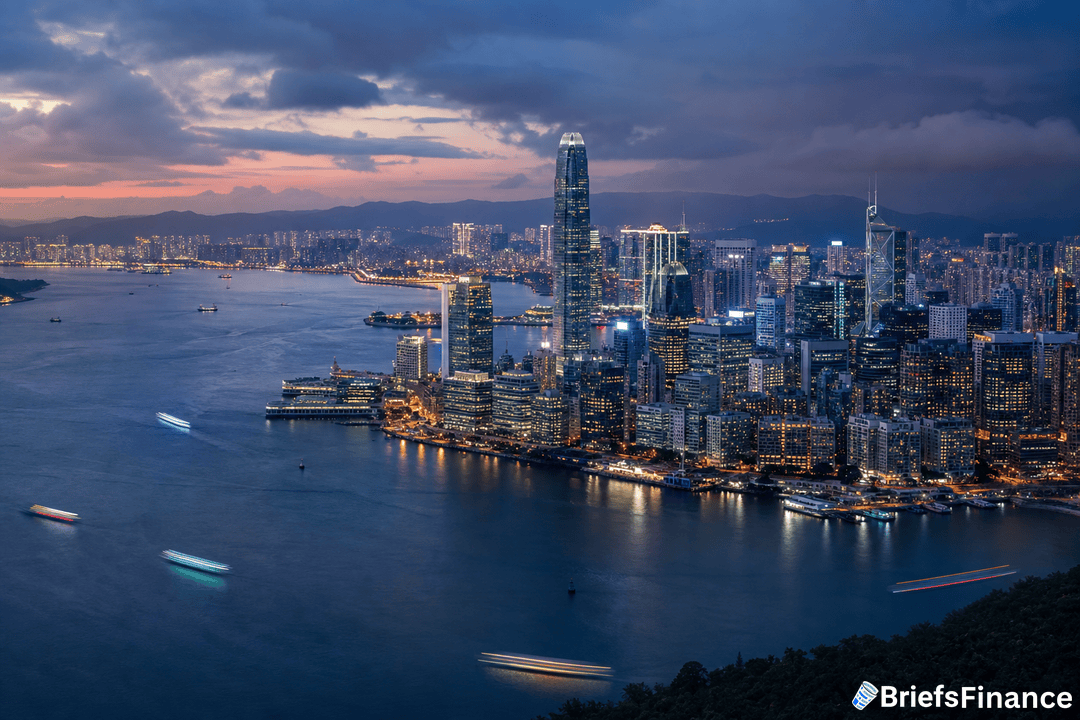
Hong Kong's bourse just wrapped up its strongest six-month period on record, as a flood of initial public offerings brought in over $40 billion. That figure already exceeds the $37 billion collected in all of 2025, underscoring the market's renewed vigor. The surge in listings is accompanied by strong trading activity: average daily turnover has climbed to HK$280 billion since January, compared with HK$250 billion for the whole of last year. Secondary share sales - where already-listed companies issue additional shares - have also topped $50 billion, approaching the $66 billion seen in 2025.
The boom has directly benefited the exchange's operator, HKEX. It reported a record half-year profit, with net earnings up 24% year-on-year to HK$10.57 billion ($1.35 billion), beating analysts' forecasts.
The strong performance marks a sharp reversal from the recent past, when Hong Kong's IPO market faced a prolonged downturn amid global monetary tightening and geopolitical tensions. The latest figures signal that investor confidence has returned, with the exchange benefitting from a wave of companies seeking to list in the city.
Understanding what moved a market beats knowing that it moved. Get the free Market Briefs daily newsletter and follow the drivers.
The rebound builds on Hong Kong's established role as a gateway between mainland China and international capital. The exchange has long served as a fundraising hub for Chinese companies, and the current wave of listings shows that role is intact. The jump in turnover also points to growing global interest in the market, beyond the mainland investors who have traditionally been active.
The recovery follows a period of global market uncertainty, where rising interest rates and political frictions had kept many issuers on the sidelines. Hong Kong's position as a gateway between mainland China and international capital has helped it attract companies looking for access to deep pools of investors.
CEO Bonnie Chan said, "The IPO pipeline is well-diversified beyond tech, with strong candidates in biotech, mining, and consumer sectors." "Companies in other sectors are also lining up to list," she told CNBC, adding that the exchange has a full calendar ahead. "We still have a lot of pretty good high quality companies in the pipeline trying to get their IPOs done before the end of the year," Chan said.
Having a wide range of sectors represented is a major advantage. It means the exchange is not reliant on a single industry, giving investors a broader range of options. Chan also highlighted the role of "high quality investors," including sovereign wealth funds, who act as cornerstone investors. "These funds put up money early, which signals confidence to the rest of the market," she explained.
The buying is not limited to local players. Chan noted that while Southbound trading (mainland Chinese investors buying Hong Kong stocks) remained stable, overall turnover increased because international participation grew. "From the perspective of Southbound trading, turnover was relatively stable, but because the overall turnover has increased, that means the rest of the world is trading more in our market," she said. "Overall, I see more participation from institutional investors globally, and even regional retail investors are coming into our market in significant volumes."
In essence, mainland Chinese investors are still active, but they are now joined by a broader global audience. This shift makes Hong Kong more than just a tech-focused market. For investors seeking exposure to Asian markets, this diversification is a positive development.
Looking ahead, the question is whether the pipeline of new listings will remain full for the rest of the year. With record numbers so far, Hong Kong's market is clearly in a strong position.
A few minutes a day is enough to stay genuinely informed about your money. Join Market Briefs free and start tomorrow.