Free NewsletterPro Login
S&P 500 6,287 +0.42%
DOW 44,521 -0.18%
NASDAQ 21,103 +0.71%

Warning: Undefined variable $funds in /var/www/briefs.co/htdocs/wp-content/plugins/oxygen/component-framework/components/classes/code-block.class.php(133) : eval()'d code on line 491

Warning: foreach() argument must be of type array|object, null given in /var/www/briefs.co/htdocs/wp-content/plugins/oxygen/component-framework/components/classes/code-block.class.php(133) : eval()'d code on line 491
/* the link was here */

Midwest Grid Pulls Ahead in U.S. Power Capacity as Solar Booms

Published Aug 19, 2026
[tts_player]
Share:
Summary:
  • MISO ended the first quarter with 230 gigawatts of capacity, just ahead of PJM's 227 gigawatts.
  • MISO added 7.45 gigawatts of solar from April 2024 through March 2026, while PJM added 3 gigawatts.
  • AI data-center demand and extreme summer heat are driving the Midwest solar buildout.

The Midwest Overtakes the Mid-Atlantic

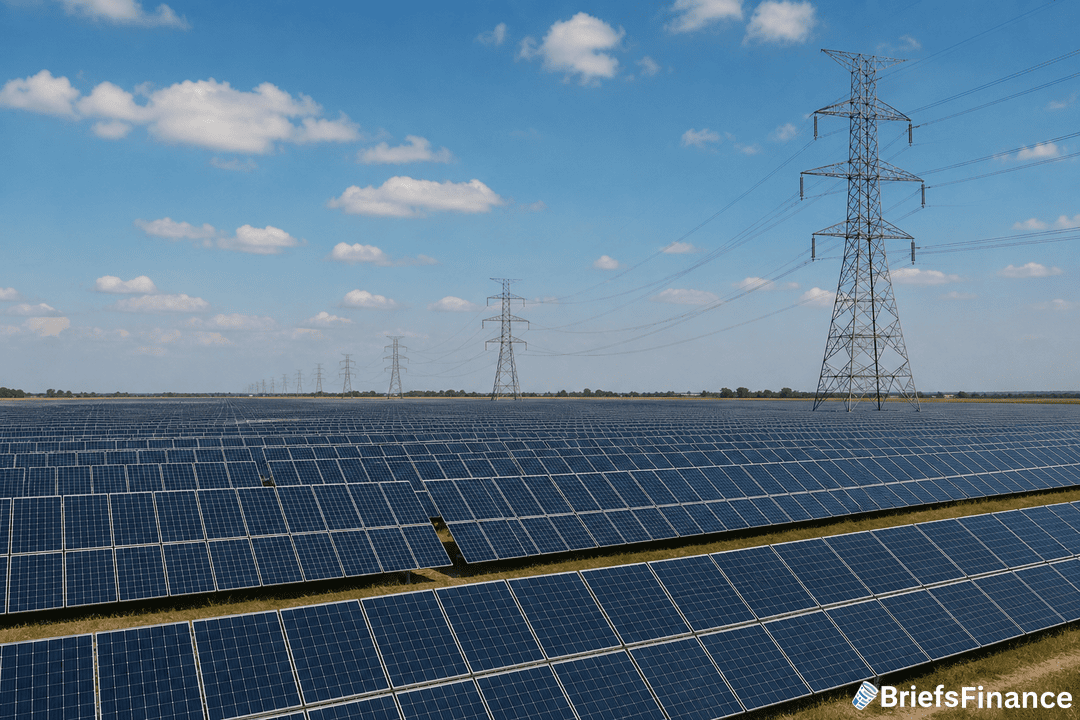
The largest U.S. electricity system by capacity no longer sits along the dense urban corridor between Washington and Boston. It is now in the middle of the country, where a burst of new solar farms has quietly reshaped the map of American electricity.

The Midwest power grid, run by a group called MISO, now has the largest generating capacity of any electric system in the United States. It pulled ahead of PJM Interconnection, the grid serving the Mid-Atlantic region that had held the top spot until last year.

Think of generating capacity as the total amount of power a grid can produce at a single moment.

Even though PJM built slightly more individual solar units, the ones going up in the Midwest were much bigger. According to BloombergNEF, the solar projects on the Midwest grid since early 2024 were close to double the average size of those in the Mid-Atlantic.

All of that new power serves a huge customer base. MISO provides electricity to 45 million people across 15 states, from Indiana and Missouri up through Minnesota.

Why the Rush to Build Solar

The push for more power is coming from a simple squeeze: as one grid official said, "demand is spiking, and nobody wants the lights to go out."

If the Midwest solar boom can reshape the power grid, let the free Always Be Buying eBook reshape your finances.

Demand is being driven by the explosion of data centers built for artificial intelligence, which suck up electricity around the clock, and by extreme summer heat, which sends air conditioners roaring and strains the whole system. Both MISO and PJM saw heavy demand this summer, and PJM likely set a 20-year record for power usage in early July.

High electricity prices and the fear of shortages have pushed utilities and politicians in both regions to get serious about expanding the grid. In the Midwest, that push has led straight to solar fields.

The buildout has been, as one energy observer said, "surprisingly bipartisan." Illinois contributed the most new solar of any state in the region, but Republican-led Indiana, Arkansas, and Missouri followed close behind.

This all happened even as the Trump administration ended federal solar tax credits and slowed projects with permitting delays. The economics of solar have gotten strong enough that, at least in the Midwest, the projects kept coming anyway.

Why the Capacity Race Matters

The capacity race matters because grid operators must prove they can meet expected peak demand. Data-center growth and hotter summers are pushing those peaks higher, and the region that builds first gains an edge in attracting more investment. MISO's lead over PJM is narrow, but its pace of solar construction suggests the gap could widen.

What This Means for Your Money

This is a story about where the country is heading, and it touches your portfolio in a few ways.

For anyone holding utility stocks, this is a signal that the companies plugged into the Midwest grid are investing heavily in growth. When a grid adds that much capacity, it means construction dollars are flowing, and those projects will generate revenue for years. It also means these utilities are positioning themselves to serve the AI boom, which is the kind of demand that does not fade after one hot summer.

For broader market watchers, the shift is a sign that the AI story is not just a chip story. The Midwest just made a big bet on solar being the answer, and the early numbers suggest the bet is paying off.

The country's power needs are growing faster than anyone expected, and the regions that build capacity first will be the ones that keep the lights on, keep prices in check, and attract the next wave of data centers and factories. Right now, the Midwest is winning that race.

For your money, that is worth paying attention to. The companies that supply the power for the AI era might not be as flashy as the chipmakers, but they are just as essential.

As solar remakes America's energy map, the free Always Be Buying eBook can help you build wealth simply.

Disclosure

Recent News

1 2 3 58

Get Market Briefs delivered to your inbox every morning for free!

No fluff. No noise. No politics. Just finance news you can read in 5 minutes.

Blogs

June 29, 2026
Portfolio Diversification: Why Putting All Your Eggs in One Basket Destroys Wealth
  • Real diversification means spreading investments across all 11 economic sectors plus bonds, alternatives, and cash so no single bet can sink the portfolio.
  • Different sectors perform at different times, so a diversified portfolio captures upswings while smoothing the brutal drawdowns that wipe out concentrated bets.
  • Total market index funds offer the simplest path to diversification, and annual rebalancing is what keeps the structure working over time.
Read More
June 29, 2026
Non Taxable Income: What It Is and Why It Matters
  • Non taxable income is money you receive that you don't owe income tax on.
  • The tax code treats workers, investors, and business owners very differently, and investors often come out ahead.
  • Learning how income is taxed is a quiet superpower for keeping more of what you earn.
Read More
June 29, 2026
Semiconductor Stocks: A Simple Guide for Investors
  • Semiconductor stocks are companies that design and make computer chips, the brains inside nearly every modern device.
  • The AI boom has turned chips into one of the market's most important and most watched groups.
  • They offer big growth potential, but come with high valuations and a notoriously cyclical history.
Read More
June 25, 2026
How Stocks Work: A Simple Guide for Beginners
  • A stock is a slice of ownership in a company - buy one, and you own a piece of the business.
  • You make money two ways: the share price rising over time, and dividends paid to shareholders.
  • The simplest path for most beginners is buying into the whole market through a low-cost index fund.
Read More
June 25, 2026
Stop Loss vs Stop Limit: What's the Difference?
  • A stop loss order sells your stock once it hits a trigger price, prioritizing getting you out.
  • A stop limit order only sells within a price range you set, prioritizing price over a guaranteed exit.
  • The trade-off: a stop loss almost always executes; a stop limit might not if the price moves too fast.
Read More
June 25, 2026
Energy Stocks: A Simple Guide for Investors
  • Energy stocks are companies that produce and supply the power the world runs on, from oil and gas to newer sources.
  • They make up one of the 11 sectors of the market and tend to move with energy prices and big-picture shifts.
  • Like any sector, the key is diversification and understanding the forces driving demand.
Read More
June 18, 2026
What Is a Stop Loss Order? A Simple Guide
  • A stop loss order automatically sells a stock once it falls to a price you set.
  • It's a tool to cap losses or lock in gains without watching the market all day.
  • It works best for active strategies, and can backfire if used carelessly on long-term holdings.
Read More
June 18, 2026
Best S&P 500 Index Fund: How to Choose One
  • The best S&P 500 index fund for most investors is simply the cheapest, most established one that tracks the index well.
  • Funds like VOO, IVV, and SPY all hold the same 500 companies, so the biggest difference is the fee.
  • Pick one, automate your buys, and let time do the heavy lifting.
Read More
June 17, 2026
What Are Penny Stocks? Risks and Rewards Explained
  • Penny stocks are very low-priced shares of very small companies, often trading for just a few dollars or less.
  • They promise huge gains but carry huge risks: low liquidity, high failure rates, and wild price swings.
  • Most investors are better served by quality companies and funds than by chasing cheap shares.
Read More
June 17, 2026
Best Stocks for Beginners With Little Money
  • The best stocks for beginners with little money usually aren't individual stocks at all - they're low-cost index funds.
  • You can start with $100 or less and use small, regular investments to build wealth over time.
  • Focus on diversification and consistency, not on picking the next big winner.
Read More
1 2 3 24
Share via
Copy link