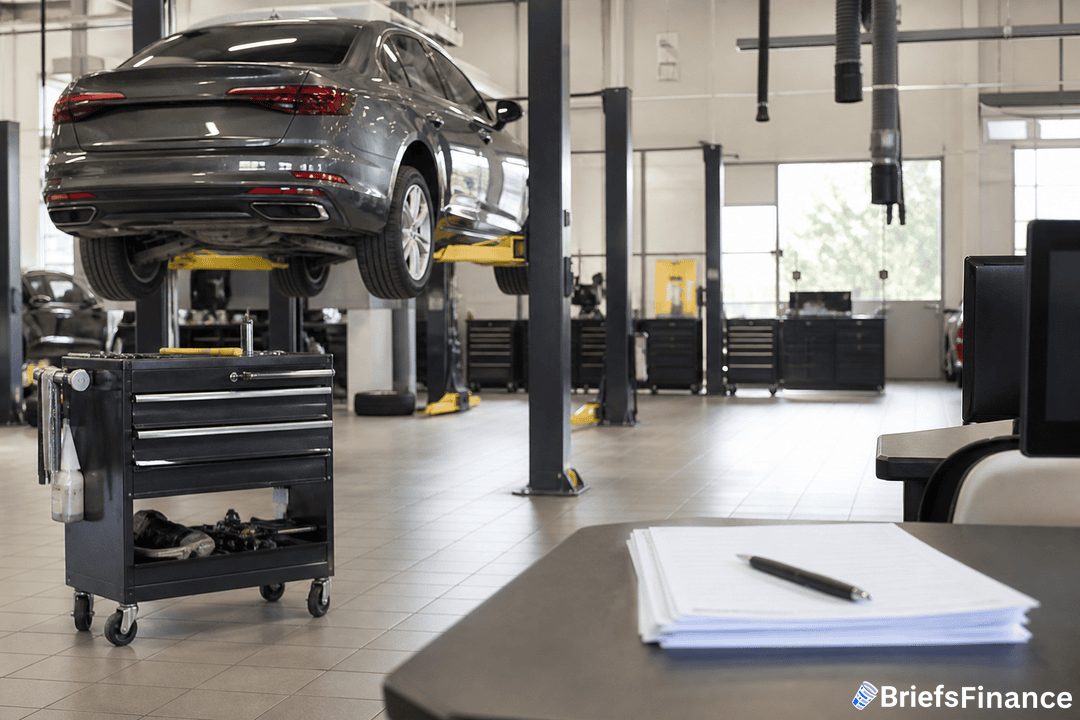
Your local dealership still sells cars. It just depends on the repair bay and the finance office for a lot more of its profit now.
A dealership has four ways to make money: new cars, used cars, parts and service, and finance and insurance, often called F&I.
The first two get the attention, but the last two are doing more of the heavy lifting.
Why Service Counts So Much
Erin Kerrigan, who follows the dealership business, calls that setup a hedge. A hedge lets one part of a business balance out weakness in another.
"The auto retailer remains one of the more attractive hedged business models," Kerrigan said.
"If you lose $10 of new vehicle revenue, you only have to pick up $1 of service to have your gross margin remain flat," Kerrigan said. Gross margin is the money left after the direct costs of a sale.
The gap shows up in the margins. New car margin is about 5%, while service margin is about 50%.
Even as major automakers went bankrupt, the service bays kept money coming in.
Sales Boomed, Then Faded
Dealers had a remarkable run from 2018 to 2022.
Average profit before taxes per dealership jumped from $1.9 million to $6.8 million as tight supply pushed new-car prices up.
The best financial decisions come from understanding the whole picture. Join Market Briefs free and get the full brief each morning.
Automakers reacted by building more expensive, higher-margin vehicles. That trend is now weakening.
Since the 2022 peak, average gross profit for publicly traded dealership groups slipped to about $3.9 million in 2025.
The service department kept climbing.
The average dealership's parts and service gross profit reached $5 million by 2025, up from $3.3 million five years earlier.
The finance office is another quiet source of profit. F&I brought in about 4% of total revenue from January to June.
F&I, however, generated 23% of gross profit. Kerrigan says F&I has proved very stable and even grown slightly.
Kerrigan also argues some of those add-ons are more useful than their reputation suggests. "If you're spending $50,000 on a new car, a lot of people don't feel comfortable leaving that fully exposed," she said.
The Competition Is Closing In
The catch is that dealers no longer own the service market. According to Cox Automotive, dealerships captured 33% of service visits in 2017, but that figure fell to 29% by 2025.
Independent chains are grabbing more of that business.
The share of customers who named places like Jiffy Lube, Meineke, or Walmart as their main repair shop jumped from 20% in 2020 to 42% in 2025.
Ducker Carlisle calls that a 22-point swing in five years. A change that big does not happen by chance, the firm says.
Dealers also have a perception problem. Many shoppers assume a dealership charges more, but Cox data shows the average parts spend at a dealer was $261, compared with $275 at a general repair shop.
The franchise dealers have noticed. "The franchise dealers have come to realize the importance of service and parts," Kerrigan said.
Franchise dealers have grown in the mid-single digits since Covid, she says. Part of that comes from higher levels of warranty and recall work, and part comes from their push to be more competitive on price.
What It Means for Your Portfolio
The service lane and the finance office are now central to dealership profits. That helps explain why the warranty pitch at the end of a car purchase is probably not going away.
For your portfolio, the dealership's hedge is the point. When new car sales weaken, the repair bay and F&I can carry more of the load.
The challenge is that independent shops are competing hard for service work, and that fight will not fade as dealers head into 2026.
If dealers keep working on price, the person with an older car may be the one who benefits. That is one part of the auto market where the customer still has some choice.
Markets move every day, and most of it never reaches you in time. Get the free Market Briefs daily newsletter and stay ahead of it.