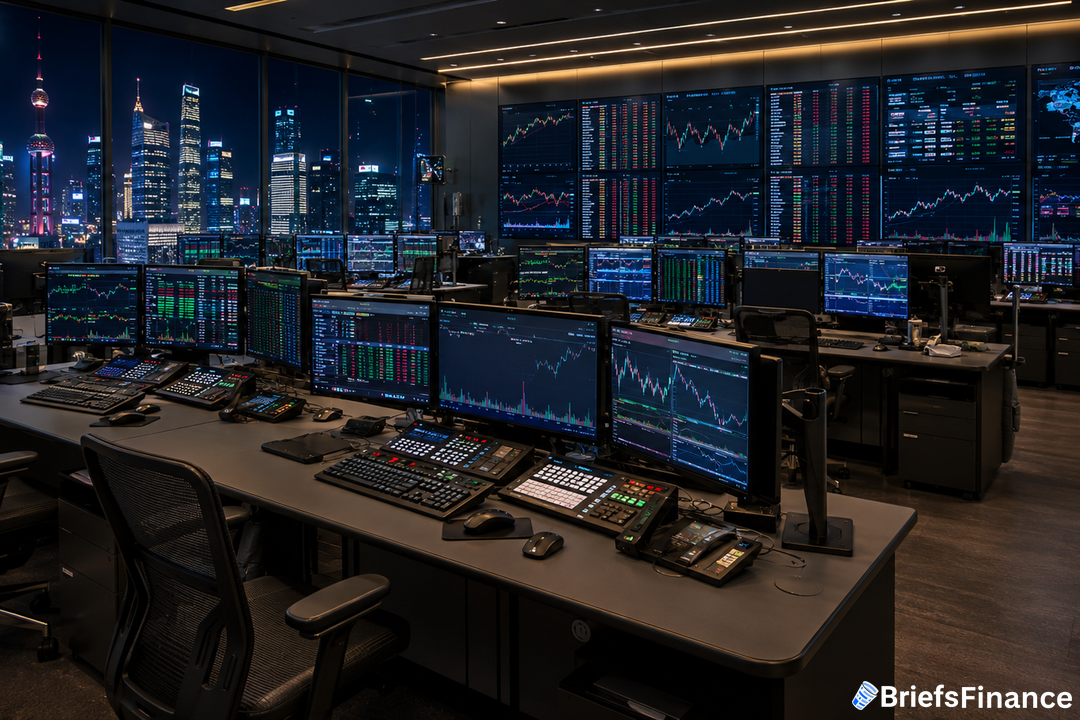
Human stock pickers are losing to machines. Investors are abandoning traditional star managers and piling money into quant funds that use artificial intelligence. The performance gap is so wide that even the best human traders can't keep up.
This outperformance is not a one-off. Over the past five years, quant funds have consistently beaten discretionary managers by an average of 13 percentage points, but the gap widened sharply last year to over 20 points.
The Rise of Quant Funds
Quant funds use computer models and AI to scan thousands of stocks at once.
Citic Securities Co. reported that last year, quantitative funds focused on stocks gained 44.7%, outperforming discretionary managers by 20.3 percentage points.
That is the biggest lead since 2021. Over the prior five years, the average lead was just 13 points.
The demand is staggering. Seconds after Shenzhen ChengQi Asset Management opened a product, investors bought over 100 million yuan.
People familiar with the matter say that in May, Ubiquant, a leading quant firm, collected 2.6 billion yuan (equivalent to $384 million) for a new fund in under two hours.
Get your free investing masterclass bonus when you join Market Briefs, our free daily newsletter
Last year, fund managers launched 6,296 new quant products, more than double the prior year and 46% of all new hedge funds. Over 80% of new products registered by top managers came from quant funds.
The total assets managed by quant funds have surged past 2.6 trillion yuan, more than doubling in under twelve months.
The chief operating officer of BigQuant.cn, Chen Xu, stated: "Quants' breadth in covering thousands of stocks has prevailed over the depth of research pursued by discretionary long-only managers. "Quants have finally become mainstream and there's no turning back"."
The Winners and Losers
Ningbo Lingjun Investment Management posted the highest return among top quants last year - over 70%. The firm recovered from a crisis in 2024 by improving its risk controls and algorithms. Now it aims to add 20-40 billion yuan to its current assets of 40-50 billion yuan.
Shanghai Minghong launched 157 new products last year. By the end of May this year, it had already launched another 149. As of May 31, 74 quant firms managed over 10 billion yuan each.
For the first time last year, quants overtook discretionary funds in that category. Only 139 total funds are above that threshold.
Not everyone is thriving. Traditional stock pickers are scrambling to adopt AI. Shanghai Minority Asset Management, once a discretionary manager, is now using AI agents. Founder Zhou Liang wrote in a May article: "The moat that once protected us has become a walled prison. "Evolution is not a choice - it is a matter of life and death"."
Global firms are also present. More than 30 global firms operate a hedge fund business within China. Yet just a few, such as Two Sigma and D.E. Shaw, employ fully systematic approaches. Most have less than 500 million yuan in assets.
What to Watch
As more money flows in, machines will compete against machines. The average excess return of index-enhanced quant strategies - a popular approach that aims to beat a benchmark - has already fallen by more than half from a year earlier to 4% for the period through April 30 this year.
Only 14% of those products have posted positive excess returns every month since October. Shanghai Mengxi Investment Management, which has posted monthly gains since October, warned: "As China's capital markets continue to mature and pricing efficiency improves, the threshold for quant managers to generate excess returns will inevitably rise. "This is a challenge many quant managers will have to confront"."
Industry observers say the top firms have built a "technological moat" that smaller rivals can't cross. Guolian Minsheng Securities published a report on that moat. Inflows will likely keep concentrating on the largest players.
The easy alpha - the extra profit above a benchmark - is fading. Beating the market will only get harder.
Subscribe to Market Briefs, our free daily newsletter, and claim your bonus investing masterclass