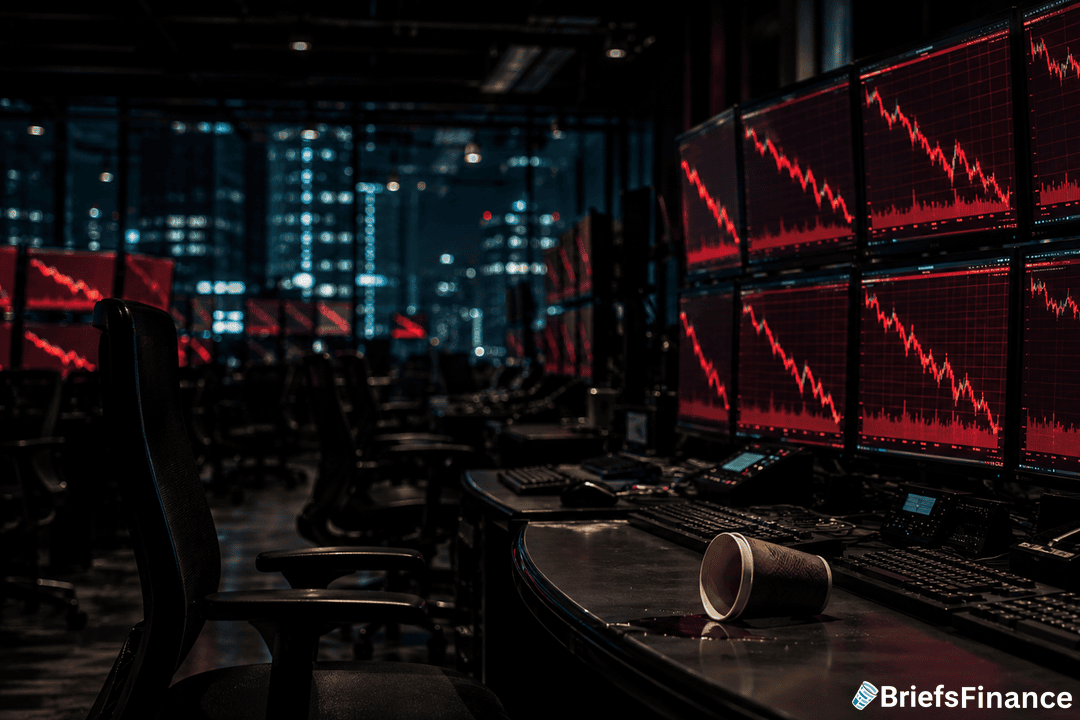
July Was a Heavy Month for Big Money
By the end of July, the tech trade had gone from market favorite to money pit. That is the most extreme example of how hard the sell-off hit funds.
The damage went far beyond one firm. JPMorgan's Aug. 6, 2026 note, built on Pivot Path data, put July's drop for tech-heavy hedge funds at 10.2%, an unprecedented monthly loss for that group; that figure excludes Situational Awareness.
Only three prior months were worse for multi-strategy funds: the COVID crash in 2020, the global financial crisis in 2008, and the dot-com bust in 2000.
Hedge funds often amplify their bets with borrowed money. When July's losses piled up, forced selling and margin calls made the downturn feed on itself, which is why a single month ranked with the worst historical episodes.
Why the Tech Trade Broke
July's slide had more than one trigger. Chinese competition in the most advanced AI algorithm work shook confidence, some investors started to wonder if memory chips were overvalued, and others lost faith that AI expansion would keep meeting the market's high hopes.
There was also circular financing, a warning sign that some money in the AI boom was moving around in loops. On top of that, funds were cutting back on leverage, meaning borrowed money, taking profits, and closing out momentum trades, which are bets on stocks that have been moving hard in one direction. When big players all try to exit at once, prices fall faster than the fundamentals alone would suggest.
Get the free Always Be Buying eBook and learn the simple system for building wealth on any income
The exchange-traded funds show how wide the damage spread. The momentum ETF MTUM dropped 12.6% in July. The memory-chip fund DRAM lost almost 32%.
The semiconductor fund SMH fell nearly 18%. Another chip fund, SOXX, declined 21%.
Some of Situational Awareness's top first-quarter stock holdings took direct hits:
- Sandisk fell more than 46% in July.
- Sandisk slipped about 5% on Thursday after its revenue outlook disappointed traders.
- Bloom Energy dropped 32%.
- Nebius slid 31%.
- CoreWeave lost around 28%.
- SharonAI fell 43%.
What the Rebound Means for Your Portfolio
The sell-off started to reverse about a week ago, and earnings from hyperscalers get the credit. Hyperscalers are the large cloud companies that spend heavily on AI, and their stronger returns justified the big spending.
That helped markets recover.
The rebound is real, but the July damage may limit how much borrowed money those funds can use to push it higher. If hedge funds lower their risk and prime brokers tighten credit, funds have less borrowed money to work with.
Prime brokers are the banks that lend to hedge funds. In JPMorgan's words, hedge funds' tech investment capacity could become "structurally more limited going forward."
That warning is not about one fund. It is about how the market's next move up could look.
If that happens, the bigger shift would be who carries the rally. JPMorgan's Nikolaos Panigirtzoglou wrote that "the tech trade would become over the longer term even more dependent on retail investors and thus more susceptible to the swings emanating from leveraged ETFs, retail option buying and retail margin accounts."
In plain English, ordinary investors may end up holding more of the tech trade. Leveraged ETFs use borrowed money to make bigger bets, options are contracts on future price moves, and margin accounts let investors borrow to buy stocks.
All three can make swings sharper in both directions.
That does not mean the AI story is over. For your portfolio, it means the market's steering wheel may end up in more hands, and when more hands are on it, every bump in the road feels a little bigger.
Download the free Always Be Buying eBook and start putting your money to work today