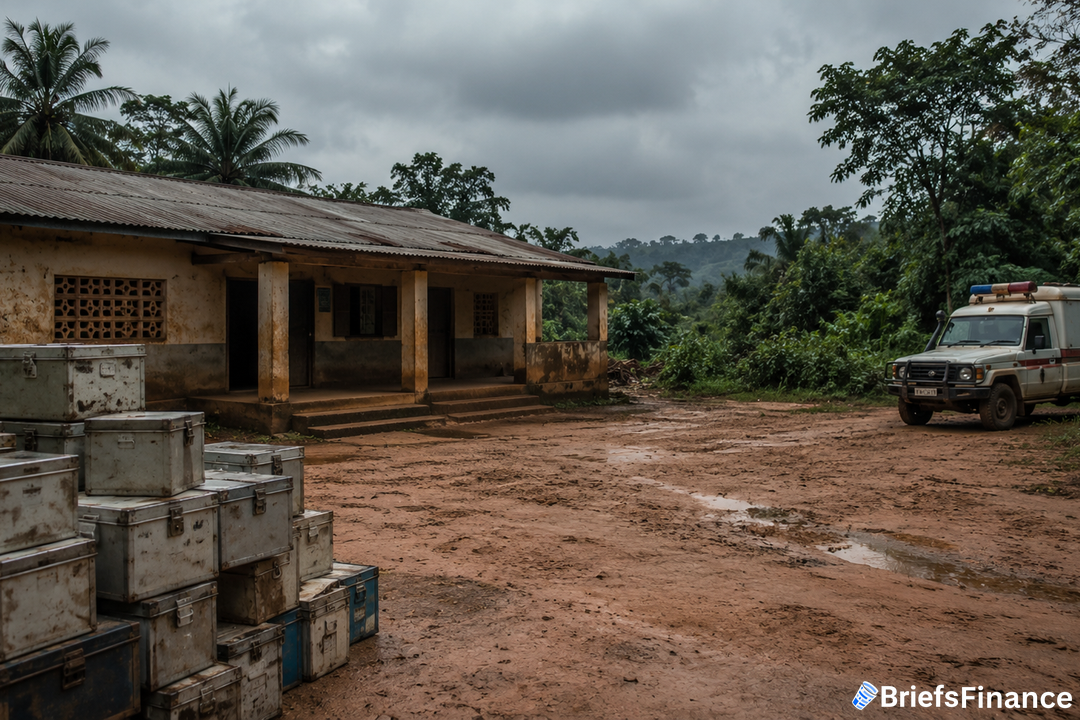
Last month, world leaders promised $1.5 billion to fight Ebola in the Democratic Republic of Congo. That money has not arrived yet. Now South African President Cyril Ramaphosa is demanding that those pledges become real cash. The outbreak is growing and the death toll is climbing.
The Numbers Behind the Outbreak Data is unavailable for May 15-16 and June 26, so the true numbers could be higher. Ramaphosa warned that the delay is costing lives.
Why the Money Matters The Ebola outbreak is caused by the rare Bundibugyo strain. Unlike other strains, there is no approved vaccine or specific treatment for it. That makes containing the outbreak harder.
Get your free investing masterclass bonus when you join Market Briefs, our free daily newsletter
The outbreak is in the conflict-affected Ituri province. Health workers cannot reach many communities because of violence. Ramaphosa called for a ceasefire to allow aid and medical supplies to get through.
Protecting the Frontline Ramaphosa also urged communities to protect health workers and volunteers. "We appeal to every community to stand with and protect our frontline health workers and volunteers," Ramaphosa said. "They are risking their lives to save others and they must never face fear, stigma or violence while serving our people." The pledged funds are essential for sending medical supplies and expert support. "We need to rapidly convert the pledges made into financing, technical assistance and the deployment of urgently needed medical countermeasures," Ramaphosa added.
What to Watch Watch whether donors convert their pledges into actual funding soon. If the money does not arrive, the outbreak could spread further in a region already struggling with conflict. The $1.5 billion is like a promised rain that has not yet fallen on dry soil.
Broader Context of the Outbreak The Democratic Republic of Congo has weathered multiple Ebola outbreaks in the past decade, but this one is uniquely dangerous. Meanwhile, the Ituri province has been a flashpoint for armed groups for years, forcing health teams to operate under constant threat.
Previous epidemics in volatile regions have shown that funding delays can allow the virus to jump borders, especially when contact tracing and safe burials are interrupted by violence. With no medical countermeasures available, every day without resources increases the risk of a larger, uncontainable crisis.
Because no licensed vaccine exists for the Bundibugyo strain, stopping the virus depends completely on careful contact tracing, isolating patients, and conducting safe burials - every one of these methods is greatly obstructed by the ongoing violence.
Subscribe to Market Briefs, our free daily newsletter, and claim your bonus investing masterclass