The headline numbers
China's gross domestic product expanded 4.5% year-on-year in Q3, a touch ahead of the 4.4% economists expected and stronger than the 4.3% pace in Q2. Growth averaged 4.6% across the first three quarters - roughly matching the government's 4.5% to 5% objective for the year.
"The rebound in September salvaged the lukewarm performance in July and August," said Tianchen Xu, a senior economist at the Economist Intelligence Unit.
What pushed the rebound
Xu credited three drivers: more effective government investment that halted a steady slide in fixed asset investment, an "ever-strong" external sector, and a favorable comparison with last year's weak base. That export muscle showed up in a record $133.5 billion trade surplus for the month.
September activity data reinforced the pivot. Industrial production rose 5.5% from a year ago, in line with forecasts, while retail sales increased 1.1% and beat the 0.6% estimate. The urban jobless rate was 5.2% in September. Producer prices posted their fastest increase in more than four years, rising 5% year over year in September, while consumer inflation stayed under 1%. As Sheana Yue, a senior economist at Oxford Economics, put it, this mix "potentially leaves firms to absorb more of the cost shock through lower margins rather than higher selling prices."
Property slump and uneven demand
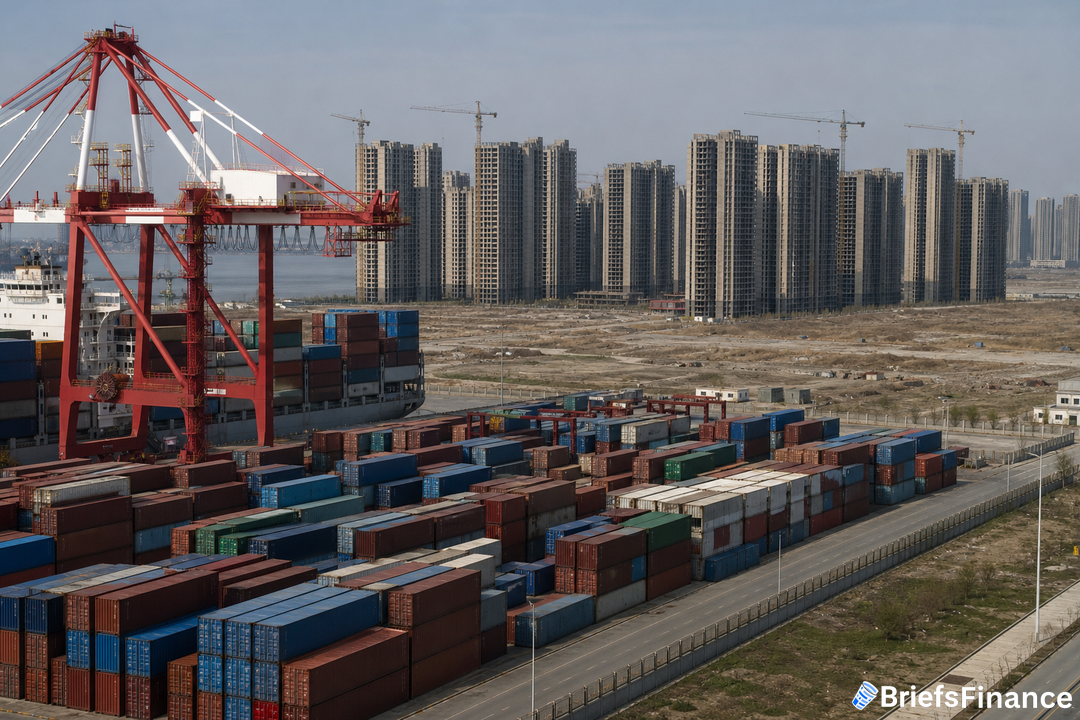
Momentum continues to favor manufacturing and foreign customers, whereas households and private investors remain cautious. Fixed asset investment in cities fell 7.2% in the January to September stretch from a year earlier, a touch better than the 7.3% drop economists had penciled in. Real estate development spending weakened further, down 20.6% over the first nine months compared with a 19.9% fall in the first eight.
"The prolonged housing slump will continue to limit the spillover from stronger industrial activity to the wider economy," Yue said, noting that Chinese households have seen property wealth erode. She also pushed back on talk of stabilization, arguing that sales, new starts, and prices do not yet show the market "bottoming out."
When global headlines shift, a clear daily summary helps, so sign up for the free Market Briefs newsletter to stay informed
Policy stance and what it means for your portfolio
Beijing has leaned hard on exports this year, though that engine faces pressure from rising energy costs and growing unease among trading partners. Eswar Prasad, who teaches economics at Cornell University, said, "It is clear that domestic imbalances between supply and demand continue rising." He added that the government "might become more sanguine and maintain a passive approach, rather than infusing stimulus into the economy in tandem with much-needed reforms."
Most economists expect the People's Bank of China to leave benchmark lending rates where they are for the rest of the year, putting the onus on the budget. Authorities have recently stepped up fiscal backing, unveiling in late September a set of targeted rate reductions and mortgage subsidies. Earlier this month, they also assigned 550 billion yuan of previously unused debt quota to ease local-government strains and back infrastructure projects. Yue expects the announced measures to be implemented more quickly, which should bolster investment and overall activity over the next few quarters.
The bottom line: industrial strength and export demand are doing more work than consumers and property, and policy looks set to lean on fiscal levers rather than rate cuts. For portfolios, that points to tailwinds for exporters and infrastructure-linked names while the housing downtrend keeps domestic demand uneven. Xu expects the current forces to carry into Q4 and projects full-year growth of 4.7%.
Markets and policy are always evolving, get concise context in five minutes with the free Market Briefs and never miss essentials