Free NewsletterPro Login
S&P 500 6,287 +0.42%
DOW 44,521 -0.18%
NASDAQ 21,103 +0.71%

Warning: Undefined variable $funds in /var/www/briefs.co/htdocs/wp-content/plugins/oxygen/component-framework/components/classes/code-block.class.php(133) : eval()'d code on line 491

Warning: foreach() argument must be of type array|object, null given in /var/www/briefs.co/htdocs/wp-content/plugins/oxygen/component-framework/components/classes/code-block.class.php(133) : eval()'d code on line 491
/* the link was here */

Samsung Profit Surges on AI Memory Demand; Supply Constraint Seen Through 2028

Published Jul 31, 2026
[tts_player]
Share:
Samsung Profit Surges on AI Memory Demand; Supply Constraint Seen Through 2028
Summary:
  • Samsung's operating profit soared 1,814% year over year as revenue jumped 130%.
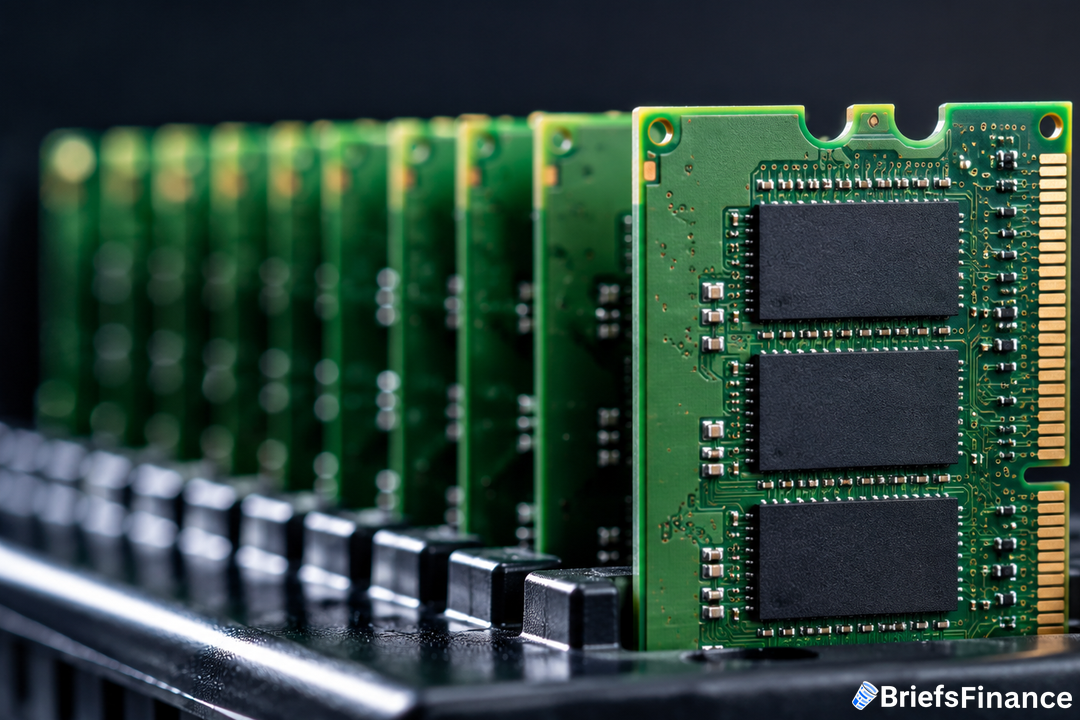
  • Record demand for DRAM and NAND memory drove the result, fueled by AI server buildouts.
  • The company began shipping HBM4E samples and expects memory supply to stay tight through 2028.

Another Quarter, Another AI Chip Boom

The AI boom keeps writing the same story. Companies that make the guts of data centers are printing money, and Samsung Electronics is the latest to prove it.

The year-over-year numbers are absurd. Operating profit soared 1,814% compared to the same quarter last year. Revenue jumped 130%. Even compared to the previous quarter, profit was up 56% and revenue rose 28%.

The reason? AI servers need a lot of memory. Samsung sells two main types - DRAM and NAND - and both saw record demand.

The company also started shipping samples of its newest high-bandwidth memory, called HBM4E, to major customers. Samsung's HBM4 is its newest high-bandwidth memory, engineered to run cutting-edge AI processors such as Nvidia's Vera Rubin Platform.

"The AI infrastructure buildout is still paying its suppliers handsomely, and Samsung expects more to come, pointing to strong memory demand in the second half as agentic AI adds another layer of appetite for its chips," said Josh Gilbert, who serves as lead analyst for APAC at eToro.

Get the market news that matters in a five-minute read with Market Briefs, our free daily newsletter

One Weak Spot in a Strong Picture

Not every part of Samsung is on fire. The mobile and networks business segment lost 700 billion won. That is a meaningful chunk of change, but it gets dwarfed by the memory chip operation, which is carrying the whole company.

The danger is that Samsung might be leaning too hard on one leg. "The strength of the memory business is remarkable, but so is Samsung's dependence on it," Gilbert pointed out.

It is not like Samsung is ignoring that risk. The company set up a dedicated robotics division that reports directly to the CEO. It is also looking at potential partnerships and acquisitions to speed things up in that area. But for now, chips are the story.

Broader Market Context

The AI chip boom has lifted all major memory makers. Domestic rival SK Hynix also reported a record quarterly profit, though it missed analyst estimates, highlighting Samsung's ability to outperform. Meanwhile, Samsung and Broadcom have deepened their partnership, working together on memory and foundry tech. To keep up with AI demand, Samsung is pouring more money into building a factory in Pyeongtaek and additional infrastructure.

What the Supply Outlook Means for Investors

Here is the part that matters for your portfolio. Samsung says memory supply will start to tighten in 2027. The company has already signed multi-year supply agreements with its top five global data center customers. Those deals lock in revenue for years and suggest the big tech companies see no slowdown coming.

The bottom line: When a key supplier says demand will outrun supply for years, the stocks that benefit from that trend tend to keep attracting money. Nvidia's Vera Rubin Platform uses Samsung's HBM4, and Broadcom is collaborating with Samsung on memory and foundry technologies. Samsung and its memory rivals are well positioned.

There is one more thing to watch. Samsung said it is not currently reviewing an ADR issuance for a U.S. listing but considers it a possible option. If it eventually goes that route, American investors would get direct access to shares without dealing with over-the-counter tickers like SSNLF.

For now, the message is simple. AI demand is not fading, and the companies that make the components are cashing in. Samsung's numbers prove that boom is still in full swing - and likely has years left to run.

Join Market Briefs, our free daily newsletter, for a quick daily rundown of the markets
Disclosure

Recent News

1 2 3 46

Get Market Briefs delivered to your inbox every morning for free!

No fluff. No noise. No politics. Just finance news you can read in 5 minutes.

Blogs

June 29, 2026
Portfolio Diversification: Why Putting All Your Eggs in One Basket Destroys Wealth
  • Real diversification means spreading investments across all 11 economic sectors plus bonds, alternatives, and cash so no single bet can sink the portfolio.
  • Different sectors perform at different times, so a diversified portfolio captures upswings while smoothing the brutal drawdowns that wipe out concentrated bets.
  • Total market index funds offer the simplest path to diversification, and annual rebalancing is what keeps the structure working over time.
Read More
June 29, 2026
Non Taxable Income: What It Is and Why It Matters
  • Non taxable income is money you receive that you don't owe income tax on.
  • The tax code treats workers, investors, and business owners very differently, and investors often come out ahead.
  • Learning how income is taxed is a quiet superpower for keeping more of what you earn.
Read More
June 29, 2026
Semiconductor Stocks: A Simple Guide for Investors
  • Semiconductor stocks are companies that design and make computer chips, the brains inside nearly every modern device.
  • The AI boom has turned chips into one of the market's most important and most watched groups.
  • They offer big growth potential, but come with high valuations and a notoriously cyclical history.
Read More
June 25, 2026
How Stocks Work: A Simple Guide for Beginners
  • A stock is a slice of ownership in a company - buy one, and you own a piece of the business.
  • You make money two ways: the share price rising over time, and dividends paid to shareholders.
  • The simplest path for most beginners is buying into the whole market through a low-cost index fund.
Read More
June 25, 2026
Stop Loss vs Stop Limit: What's the Difference?
  • A stop loss order sells your stock once it hits a trigger price, prioritizing getting you out.
  • A stop limit order only sells within a price range you set, prioritizing price over a guaranteed exit.
  • The trade-off: a stop loss almost always executes; a stop limit might not if the price moves too fast.
Read More
June 25, 2026
Energy Stocks: A Simple Guide for Investors
  • Energy stocks are companies that produce and supply the power the world runs on, from oil and gas to newer sources.
  • They make up one of the 11 sectors of the market and tend to move with energy prices and big-picture shifts.
  • Like any sector, the key is diversification and understanding the forces driving demand.
Read More
June 18, 2026
What Is a Stop Loss Order? A Simple Guide
  • A stop loss order automatically sells a stock once it falls to a price you set.
  • It's a tool to cap losses or lock in gains without watching the market all day.
  • It works best for active strategies, and can backfire if used carelessly on long-term holdings.
Read More
June 18, 2026
Best S&P 500 Index Fund: How to Choose One
  • The best S&P 500 index fund for most investors is simply the cheapest, most established one that tracks the index well.
  • Funds like VOO, IVV, and SPY all hold the same 500 companies, so the biggest difference is the fee.
  • Pick one, automate your buys, and let time do the heavy lifting.
Read More
June 17, 2026
What Are Penny Stocks? Risks and Rewards Explained
  • Penny stocks are very low-priced shares of very small companies, often trading for just a few dollars or less.
  • They promise huge gains but carry huge risks: low liquidity, high failure rates, and wild price swings.
  • Most investors are better served by quality companies and funds than by chasing cheap shares.
Read More
June 17, 2026
Best Stocks for Beginners With Little Money
  • The best stocks for beginners with little money usually aren't individual stocks at all - they're low-cost index funds.
  • You can start with $100 or less and use small, regular investments to build wealth over time.
  • Focus on diversification and consistency, not on picking the next big winner.
Read More
1 2 3 24
Share via
Copy link