What Happened
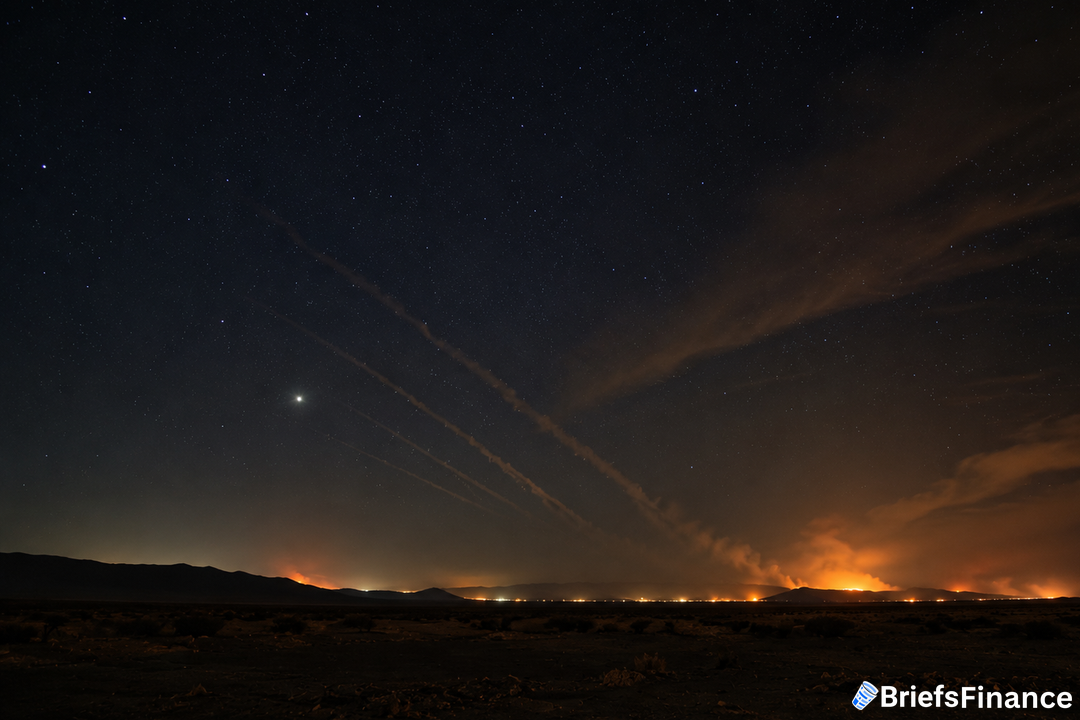
The back-and-forth between the U.S. and Iran has not slowed down. U.S. Central Command said its latest strikes, which hit at 9 p.m. ET Monday, targeted Iranian military command centers, maritime capabilities, and missile and drone launch sites. The goal, according to Centcom, is to stop Iran from attacking commercial ships that move through the Strait of Hormuz.
Iran has been hitting back just as hard. Early Tuesday, an Iranian attack on a tanker crossing that waterway led to the crew evacuating and leaving the ship. On Monday, Iran knocked out several power generation and water desalination plants in Kuwait. The Kuwaiti authority responsible for power, water, and renewables verified the strikes and reported that the fires were put out and repairs are in progress.
Meanwhile, at the same time, Yemen's Houthi fighters, who are supported by Tehran, announced a naval blockade targeting Saudi Arabia starting Monday. They claimed that Saudi forces bombed the Sanaa airport. The coalition led by Saudi Arabia in Yemen stated it would forcefully counter the naval embargo.
Get the market news that matters in a five-minute read with Market Briefs, our free daily newsletter
Why the Strait Matters for Oil
The Strait of Hormuz is a narrow chokepoint that handles about 20% of the world's oil traffic. The U.S. military reported that Centcom helped guide roughly 900 trade ships and 450 million barrels of oil across the strait starting in early May.
Oil prices have already started to feel the pressure. Brent crude futures for September, the global reference, increased 1.1% to $90.20 per barrel. West Texas Intermediate crude futures for August, the U.S. benchmark, rose 1.1% to $84.13 per barrel.
The threat does not stop at the Strait of Hormuz. Saudi Arabia's Petroline, a roughly 750-mile east-west pipeline, links Abqaiq on the Gulf's eastern shore with Yanbu on the Red Sea. That pipeline could help move oil if the strait gets blocked.
But the Houthi blockade threatens the Red Sea ports at the other end of that pipeline. Jorge León of Rystad Energy cautioned that the Houthi danger endangers about 2.5 million barrels daily of Saudi crude while Hormuz traffic remains halted. A disturbance at Bab el-Mandeb would jeopardize both Saudi exports and one of the few alternative paths that could offset the major drop in Hormuz shipments.
León further noted that absent a truce, with Hormuz mostly shut and the Houthi danger to Red Sea vessels growing, the chance of a large oil price surge would be considerable.
Ceasefire Hopes and Obstacles
Mediators from the region have offered a 10-day truce plan to both Washington and Tehran. But analysts are not holding their breath. ING strategists Warren Patterson and Ewa Manthey said that "large divisions remain between the US and Iran. And President Trump said the US would retaliate following the deaths of several American troops." President Donald Trump made that clear on Truth Social, posting, "Every time Iran kills an American Soldier they will pay for that killing many times over!" He also stated that this order was communicated to all military commanders.
Join Market Briefs, our free daily newsletter, for a quick daily rundown of the markets