Free NewsletterPro Login

Warning: Undefined variable $stocks in /var/www/briefs.co/htdocs/wp-content/plugins/oxygen/component-framework/components/classes/code-block.class.php(133) : eval()'d code on line 448

Warning: foreach() argument must be of type array|object, null given in /var/www/briefs.co/htdocs/wp-content/plugins/oxygen/component-framework/components/classes/code-block.class.php(133) : eval()'d code on line 448

Warning: Undefined variable $funds in /var/www/briefs.co/htdocs/wp-content/plugins/oxygen/component-framework/components/classes/code-block.class.php(133) : eval()'d code on line 472

Warning: foreach() argument must be of type array|object, null given in /var/www/briefs.co/htdocs/wp-content/plugins/oxygen/component-framework/components/classes/code-block.class.php(133) : eval()'d code on line 472
/* the link was here */

Fervo Energy Is Turning Oilfield Drilling Tools Toward Emissions-Free Power

Published Sep 5, 2026
[tts_player]
Share:
Summary:
  • Fervo's Cape Station in Milford, Utah, is expected to begin delivering power to the grid in the coming month, setting a U.S. milestone as the inaugural enhanced geothermal system to reach commercial operations.
  • By adapting oil and gas drilling and fracking methods to build man-made reservoirs, the company says it could open the door to tens of gigawatts of steady, zero‑emission power.
  • Fresh off a May IPO that raised nearly $2 billion and an offtake deal with Google that puts contracted capacity near 1 GW, Fervo still has to show it can deliver cost-competitive geothermal at scale.

How Fervo plans to make geothermal everywhere

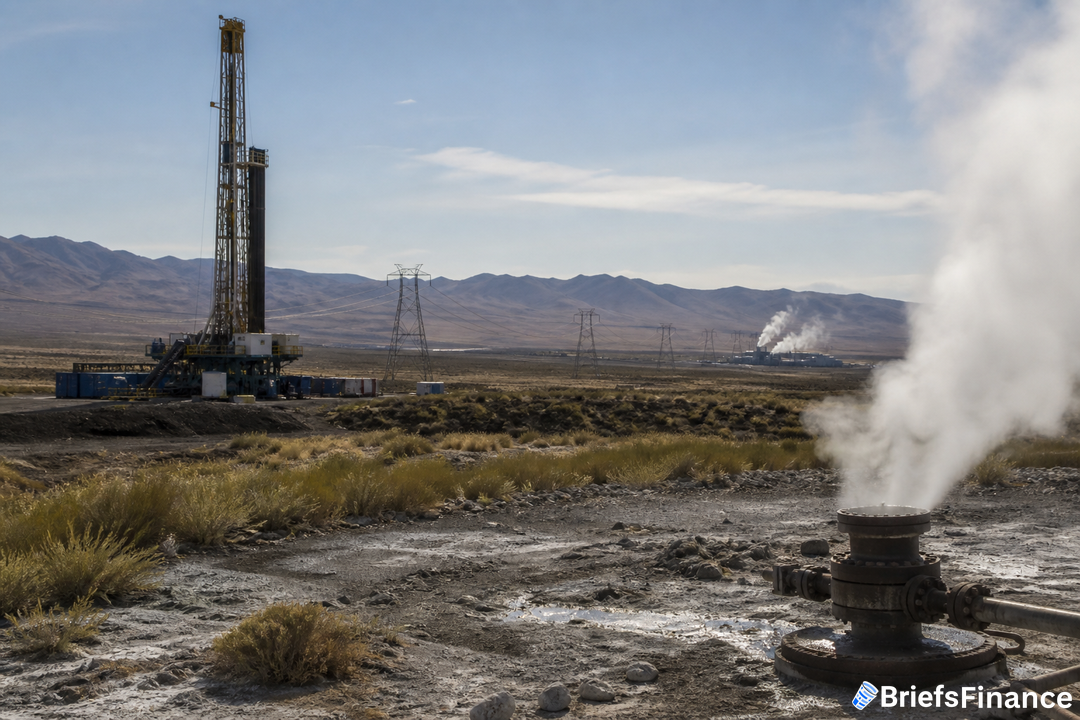
Cape Station sits in the Utah desert, reached after a long drive on gravel backroads and far from any major metro. Fervo is tapping heat more than 2 miles down by drilling paired wells, including a horizontal section that stretches for over a mile, to create the kind of reservoir traditional geothermal had to stumble upon by luck.

The playbook borrows heavily from oilfield know-how. Fervo drills an injection well and a separate production well, cracks the surrounding rock, sends water down where temperatures top 400 degrees Fahrenheit, then brings the hot fluid up to feed a heat exchanger that makes electricity. At the plant, rows of industrial fans cool the geothermal brine before the non-potable water is recirculated back underground in a sealed loop, a process that takes only minutes from surface to reinjection. The rigs on site are supplied by Helmerich & Payne, a familiar name in the Permian Basin, but here the prize is carbon-free power.

Next door is the Department of Energy's Frontier Observatory for Research in Geothermal Energy, or Forge, which is gathering data to help private companies like Fervo commercialize enhanced geothermal. Years before the current data center power scramble, CEO Tim Latimer and CTO Jack Norbeck founded Fervo in 2017 after Latimer began working in South Texas as a drilling engineer. Back then, venture investors and oil and gas operators were skeptical that hotter, harder wells in granite would work. That has flipped.

Recognizing that locations matter, Fervo accumulated nearly 600,000 acres of geothermal rights across the West at an average of $4 per acre. Similar land can now fetch more than $400 per acre.

Tech, drilling, and the learning curve

Enhanced geothermal pushes beyond shale norms: tougher rock, higher heat, and longer well life. To handle that, Fervo developed new approaches for drill motors, bit design, and drilling fluids. Its bit of choice is a polycrystalline diamond compact design, and Latimer says the package has delivered a "step change in performance for geothermal drilling."

The company is obsessive about data. Underground sensors relay real-time information to screens in the driller's cabin and to staff at headquarters in Houston, while an on-site geologist studies the granite coming up to keep drilling in the sweet spot. The payoff shows up in cycle times.

At the Nevada pilot, the first wells took 70 days to drill down to 11,220 feet measured depth. At Cape Station Phase I, the average fell to 21 days with measured depth increasing to 14,483 feet. Phase II is aiming for 19,448 feet, its deepest so far.

Even when industries innovate, steady investing builds wealth over time, so download the free Always Be Buying E-Book

Latimer's long-term view: "[B]ecause we can drill consistently… we've removed a lot of the uncertainty and the exploration risk that has plagued geothermal for years," and "[We] put geothermal on the kind of learning curve that has yielded dramatic cost reductions in other industries … We're expecting dramatic cost reductions in both the drilling side of the business and the power plant side of the business through that modularity and standardization."

Costs, customers, and the commercial test

Costs have been falling as Fervo drills more. Cape Station Phase I came in around $7,000 per kW. Phase II targets about $5,500 per kW, helped by hotter rock and larger pipe that boost output per well.

Latimer says the long-run goal is $3,000 per kW. Federal tax credits that apply to geothermal were preserved under President Donald Trump's One Big Beautiful Bill Act, but Fervo still needs to bring costs down further to compete broadly.

On the surface side, expenses are easing too. The first power plant, at 33 MW, arrived as one-off components. Phase II plants are standardized at 50 MW and tracking to cut construction time by more than 30 percent. The company uses Organic Rankine Cycle turbines, and those are not experiencing the supply crunch hitting the gas turbine market; companies such as GE Vernova have said they are sold out for years.

Commercial traction is building. A new offtake with Google helps put total contracted capacity near 1 GW, and Fervo says it is deep in talks with other buyers. Southern California Edison, Shell Energy, and NV Energy are buyers as well.

The company has not disclosed detailed PPA terms, and many hyperscalers have agreed to pay premiums over market rates, partly to satisfy climate commitments. Fervo is also lining up both grid-connected projects and behind-the-meter setups for customers that want faster delivery, including data centers.

What Cape Station and the IPO mean for your portfolio

Cape Station sits alongside DOE's Forge and, if it goes live next month, would mark the first U.S. enhanced geothermal system to reach commercial status. Fervo argues that speed is its edge, leaning on mature oil and gas supply chains rather than the constrained gas turbine market.

The company went public in May in an oversubscribed IPO that raised nearly $2 billion. Shares hit a record on May 15 and are down about 57 percent since. Management says the capital will fund expansion across project sites throughout the Western U.S., with an eye to repeating standardized GeoBlocks widely. In Latimer's words: "We now have the capital to pursue it, and we want to repeat these GeoBlocks all over the West and then all over the world until we realize a more reliable, affordable, and sustainable electric grid." For your wallet, the near-term markers are simple enough to track: Cape Station flipping on, costs trending toward those targets, and whether buyers keep signing up at a pace that matches the demand boom.

Disclosure

Recent News

1 2 3 68

Get Market Briefs delivered to your inbox every morning for free!

No fluff. No noise. No politics. Just finance news you can read in 5 minutes.

Blogs

September 4, 2026
An Interest Rate Hike in 2026? The Fed Just Broke Its Own Script
  • The Federal Reserve spent a year signaling cheaper money, and its new chairman just warned that an interest rate hike may be coming instead.
  • The Fed is stuck between high inflation and a weak job market, and fixing one makes the other worse.
  • Higher rates also reprice roughly a third of America's $40 trillion national debt this year, which is why Washington wants cuts so badly.
Read More
September 3, 2026
5 Passive Income Ideas That Pay You Whether You Work or Not
  • School teaches one formula: work, earn, spend. Stop working and the money stops, so the wheel never ends.
  • Five assets pay you without your labor - dividends, rent, interest, royalties, and the things you already own.
  • $80,000 a year of cash flow takes about $1 million invested at 8%, or roughly 20 years of $1,000 a month.
Read More
September 2, 2026
The Best Way to Invest 10k: Three Options To Transform 10K into 10 Million
  • Passive investing in stocks or real estate targets around 10% a year, and time in the market matters more than the price you get in at.
  • Active investing means putting your time in alongside your money, which raises the target to roughly 20% a year and raises the risk of losing it all.
  • Investing in yourself has no ceiling, because a new skill can create a new income that no market return can match.
Read More
September 1, 2026
The Tax Write Offs the Rich Are Using in 2026 While the IRS Shrinks
  • The 2026 tax brackets landed lower than they were headed, and the standard deduction jumped from a planned $8,350 to $16,100 for single filers.
  • New write offs for overtime, tips, seniors and car loan interest are live now, and most of them are written to expire in 2028.
  • About a third of IRS auditors have been fired, and four assets do most of the work for people who want income without a matching tax bill.
Read More
August 31, 2026
America Is Running Out of Debt Buyers. Treasury Bills Are the Government's Fix
  • The government took in about $5 trillion in taxes in 2025 and spent about $7 trillion, and the national debt is now over $40 trillion.
  • Investors, banks, and foreign countries are all lending less to the U.S., so starting September 9 the government plans to sell more short-term treasury bills and use that cash to buy back its long-term debt.
  • Government interest rates set the floor for your mortgage, your car loan, and your credit card, and short-term Treasury ETFs like SGOV are one way investors are playing it.
Read More
August 23, 2026
How to Get the Most From Your Guideline 401k
  • Guideline is a company that provides low-cost 401k plans, popular with small businesses and their employees.
  • A "Guideline 401k" follows the same core rules as any 401k: tax-advantaged growth, contribution limits, and often an employer match.
  • The biggest results come from capturing the full match, choosing low-cost funds, and picking Roth or traditional to fit your situation.
Read More
August 23, 2026
Principal 401k: What to Know About Your Plan
  • Principal is one of many companies that manage workplace 401k plans, so a "Principal 401k" is simply a 401k where Principal is the provider.
  • The rules of a 401k are the same no matter who runs it: pre-tax or Roth contributions, tax-advantaged growth, and often an employer match.
  • The biggest wins come from grabbing the full match, picking low-cost funds, and knowing whether Roth or traditional fits you.
Read More
August 23, 2026
What a Tariff Dividend Means for Your Money
  • A "tariff dividend" is the idea of taking money the government collects from tariffs and paying some of it back to citizens.
  • To judge the idea, you first need to know what a tariff is: a tax on imported goods, usually paid by the companies bringing them in.
  • Tariffs ripple through prices, businesses, and your investments, so the smart move is understanding those ripples, not just the headline.
Read More
August 23, 2026
No Tax on Overtime: How Overtime Pay Is Taxed
  • "No tax on overtime" refers to a tax break that lets certain workers deduct some overtime pay, lowering the income they get taxed on.
  • A deduction does not mean overtime is truly tax-free. It means part of that pay is subtracted before your tax is figured.
  • The bigger money lesson: how you earn money changes how it is taxed, and investors often get the friendliest treatment of all.
Read More
August 23, 2026
Reading the Silver Price Forecast for 2026
  • Nobody can honestly promise a specific silver price for 2026. Any exact number is a guess, so treat forecasts as opinions, not facts.
  • Silver is unusual because it is both a precious metal and an industrial metal, so its price answers to two very different forces.
  • Instead of chasing a forecast, learn the drivers - inflation, interest rates, recession fear, and industrial demand - so you can judge any prediction yourself.
Read More
1 2 3 26
Share via
Copy link










