Free NewsletterPro Login

Salt Hank's French Dip Steals the Food Crown at the 2026 US Open

Published Sep 4, 2026
Share:
Summary:
  • At an August 27 media preview for the 2026 tournament menu, one item owned the buzz: Salt Hank's French dip.
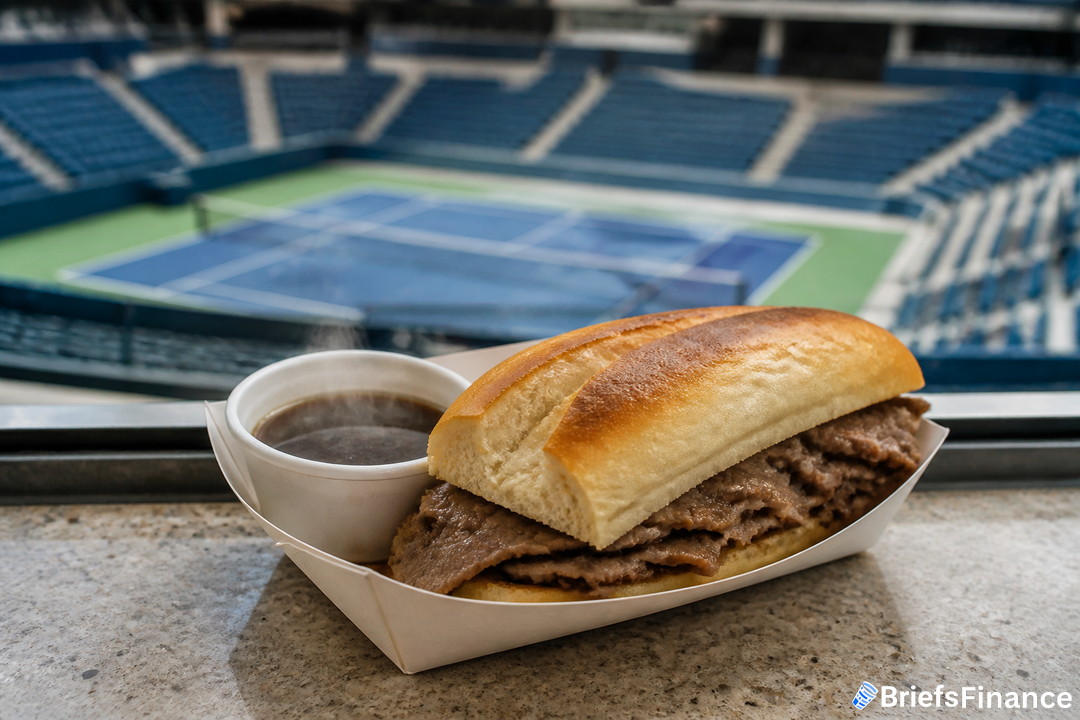
  • The $38 sandwich features Pat LaFrieda 850 scored prime rib with caramelized onions, provolone, horseradish aioli, a baguette, and housemade jus.
  • Founder Henry Laporte, whose brand was acquired by Wonder in August, says they brought literally all of their equipment and staff into the booth to keep the quality restaurant-level.

What stood out at the preview

I spent August 27 working through the US Open's new 2026 bites, from handrolls to something dubbed Pasta Ramen, a luxe mashup of shrimp scampi and ramen. The food scene felt like a co-headliner alongside tennis and merch, and one thing clearly stole the show.

Salt Hank's French dip was the conversation starter. Chefs and guests kept pointing me toward it. One chef even handed me a sandwich, laughing that he might be sabotaging himself if I ranked the offerings.

I also sampled a $38 hot pastrami from Carnegie Deli, a $24 Mission-style burrito at Dos Toros Taqueria, Fuku's original chicken sando for $19 as the brand marks its 10th year at the Open, and a $39 chilled lobster roll from Red Hook Lobster Pound. It is a meat-heavy lineup, and if you try to hop stand to stand in the food village, it can feel like too much of a good thing.

Anatomy of a $38 crowd-pleaser

The sandwich is sold from Salt Hank's kiosk in the food village, positioned right across from Arthur Ashe Stadium. The build is classic comfort with premium parts: prime rib from New York butcher Pat LaFrieda, sweet caramelized onions, melted provolone, and horseradish aioli on a baguette, served with housemade jus. At the Open it runs $38 and includes matchstick fries and the jus.

Bite for bite, it is rich and unapologetically messy. The prime rib is tender, the baguette stays intact even after soaking, and the horseradish gives a gentle pop at the finish. One attendee who had eaten it at the brick-and-mortar told me the Open version was "pretty spot on."

For context, the West Village flagship prices the French dip at $34, with crispy shoestring fries adding $6. During the tournament, the Bleecker Street restaurant is closed. As Henry Laporte put it, it was impossible to split focus between the restaurant and the Open, so "we brought literally all of our equipment, all of our staff, and put them in the booth." His goal: "We wanted the quality to stay like a restaurant-quality sandwich at the US Open, in the concession stand, which I think we've pretty much achieved at this point."

The money story behind the headlines is usually the part that matters. Join Market Briefs free and get it every morning.

The rise of Salt Hank's and the Wonder acquisition

Salt Hank's is the brainchild of Henry Laporte, who built a fan base with indulgent TikTok cooking videos, then turned his breakout hit into a business. In 2025, he and chef Daniel Rubenfeld opened the West Village shop anchored by the French dip. Lines formed daily down Bleecker Street, and Laporte's social following grew into the millions.

The brand has since gone beyond the original address. This year marked its first appearance at the US Open, and in August, Wonder acquired Salt Hank's; its service allows people to place a single delivery that pulls from several different restaurant brands. That deal sparked some online skepticism. As one commenter wrote on Eater's Instagram, "Too bad I never got to eat it while it was still good and before the ingredients and processes get degraded in the name of the mighty gods, Scalability and Profit Margin."

Laporte knows the worry. "We're still getting every ingredient from the same suppliers. Pat LaFrieda 850 scored prime rib," he said. "And everything we're serving right now is prepped in a Wonder Kitchen for the US Open. And it's been indistinguishable from the restaurant." Asked what comes next, he was blunt: "The plan is just to make sure the sandwich stays the exact same and doesn't get screwed up."

The other viral item and what this means for your wallet

A $100 caviar chicken-nugget box grabbed the spotlight last year. It first appeared at the US Open in 2025 and was limited to attendees holding Club Level courtside tickets, but it has since been expanded to broader availability. Inside the box are six Korean-inspired fried chicken nuggets finished with crème fraîche, chives, pickled daikon, plus 30 grams of Petrossian caviar. Opting for a caviar-free six-piece runs $26.

Fans split into two camps. Some said the nuggets felt no better than a fast-food classic in fancier clothes, and they balked at the math of $16.67 per nugget. Others pointed out that the specific Petrossian caviar and quantity included retail for over $100 by themselves, suggesting the box effectively prices the nuggets and toppings at zero.

That tug-of-war on perceived value puts Salt Hank's $38 French dip in perspective. Nearly forty bucks for a sandwich sounds wild, but after eating it, it did not feel out of step with the experience the Open is selling. If you are budgeting for a day at a marquee event, food is now part of the draw, not an afterthought, and the must-try item may be as memorable as the match you came to see.

Disclosure

Recent News

1 2 3 … 106

Get Market Briefs delivered to your inbox every morning for free!

No fluff. No noise. No politics. Just finance news you can read in 5 minutes.

Blogs

October 16, 2026
How Boring Math Makes You Rich: The Briefs Money Spreadsheet, Explained
  • Briefs Money shows you what to do with every paycheck, and in what order: how much to spend, save, and invest, when to build an emergency fund, and which debt to pay off first.
  • The Climb to Wealth course walks you through the system step by step, and the Personal Finance Spreadsheet is where you track your own numbers.
  • Investing is one piece of building wealth. The system that gets money to your investments, and keeps it there, decides the outcome.
Read More
October 16, 2026
Common Investing Mistakes: Why a Stock Grade Is One Tool, Not the Whole Toolkit
  • The Briefs Score shows growth, income, and wealth preservation investors how well a stock fits their goal, with a separate letter grade for each one.
  • The most common mistake is treating the letter as an instruction. An A tells you a stock scores well for one goal, not that you should buy today.
  • Research works best as one input in a process you own. The grade shows how a stock stacks up. You supply the goal, the timeline, and the rules for being wrong.
Read More
October 16, 2026
How to Read a Company's Numbers Without a Finance Degree (Using Briefs Terminal)
  • Briefs Terminal lets you size up any public company in about ten minutes: what the stock costs, what it earns, how fast sales are growing, and what it pays you, all on one page.
  • It lines those numbers up against the company's closest competitors for you, so you can tell if a number is impressive or just average.
  • Below that are the income statement, balance sheet, and cash flow statement from the company's SEC filings, the latest news, and transcripts of its earnings calls.
Read More
October 16, 2026
What Type of Investor Am I? The Three Investor Archetypes, Explained
  • Briefs sorts its stock grades and monthly reports by three investor goals: growth, income, and wealth preservation. Pick yours and you know which report and which grade to read first.
  • Growth investors want stocks that beat the S&P 500. Income investors want to get paid in cash. Wealth preservation investors want stocks that hold up when the market drops.
  • The same stock can score an A- for one goal and a D- for another, so picking your goal comes before picking any stock.
Read More
October 16, 2026
How to Build a Stock Watchlist That Isn't Just Stocks You Heard About
  • A watchlist on Briefs Terminal lets you group stocks by the idea you're tracking and follow each one's price, one-day move, and 52-week high and low in one place.
  • Each list has its own name and description, so you always know why a stock is on it, and you can make as many lists as you have ideas.
  • The monthly growth, income, and wealth preservation reports under the Briefs Research tab hand you new themes to track that you didn't hear about online.
Read More
October 16, 2026
How to Choose an ETF That Matches Your Idea (Using the ETF Planning Tool)
  • The ETF planning tool takes an idea like "I want to invest in fast food companies," asks what you mean, and finds the ETFs that match, with the reasons, the holdings, and the sources.
  • Build a Plan then shows what your money could grow to in those ETFs over the years you choose, with conservative, expected, and optimistic estimates next to the S&P 500.
  • It gets you from an idea to an actual plan without researching dozens of companies one at a time.
Read More
October 16, 2026
Is This Stock a Good Buy? How to Use the Briefs Score to Tell If a Stock Fits the Way You Invest
  • The Briefs Score shows growth, income, and wealth preservation investors how well a stock fits their goal, with a separate letter grade for each one.
  • One stock can score very differently for each. Nvidia showed an A- for growth and a D- for income, because it grows fast and pays almost no dividend.
  • Seven sub scores under each grade show what earned the letter, so you can see exactly where a stock is strong or weak for your goal.
Read More
October 16, 2026
How to Tell an Asset From a Liability: The One Question to Ask Before You Buy Anything
  • The typical American household earned more in 2025 than in any year on record, yet only 30% of Americans say they could pay a surprise $1,000 bill from savings, so the problem isn't income but what the income gets spent on.
  • An asset puts money in your pocket and a liability takes money out, and the wealthy buy assets first, then let the assets pay for the fun stuff.
  • Before you buy anything, ask one question: does this put money in my pocket, or take money out of my pocket? Then you need a plan for the money you keep.
Read More
October 16, 2026
How to Build Your First $2,000 Emergency Fund and Wipe Out Every Debt Over 10%
  • Your first money goal isn't investing, it's $2,000 in its own account named Do Not Touch, built by moving 10% of every paycheck into it automatically.
  • More than a third of American adults couldn't cover a $400 surprise bill with cash or savings, according to the Federal Reserve, and that's how one bad day turns into years of credit card payments.
  • Once the $2,000 is there, attack every debt charging more than 10% interest, highest rate first, because you can't out-invest a 22% credit card so paying it off is the investment.
Read More
October 16, 2026
How to Invest Through a Crash: 3 Rules From the Worst-Timed Investor Alive
  • Meet Bunty, a fictional investor with the worst timing in history: he put $100,000 into the market in four chunks right before four crashes, never sold, and by 2025 it had grown to more than $500,000.
  • Investors who jump in and out of the market miss its best days, and missing just a handful of those days can cut your final result roughly in half.
  • The fix is ABB, Always Be Buying: you buy on a schedule through booms, crashes and scary headlines, which matches the market, and beating it takes knowing where the money is moving first.
Read More
1 2 3 … 29
Share via
Copy link










