Free NewsletterPro Login

Warning: Undefined variable $stocks in /var/www/briefs.co/htdocs/wp-content/plugins/oxygen/component-framework/components/classes/code-block.class.php(133) : eval()'d code on line 448

Warning: foreach() argument must be of type array|object, null given in /var/www/briefs.co/htdocs/wp-content/plugins/oxygen/component-framework/components/classes/code-block.class.php(133) : eval()'d code on line 448

Warning: Undefined variable $funds in /var/www/briefs.co/htdocs/wp-content/plugins/oxygen/component-framework/components/classes/code-block.class.php(133) : eval()'d code on line 472

Warning: foreach() argument must be of type array|object, null given in /var/www/briefs.co/htdocs/wp-content/plugins/oxygen/component-framework/components/classes/code-block.class.php(133) : eval()'d code on line 472
/* the link was here */

US Deal On Venezuelan Oil Complicates China's Latin America Strategy

Published Sep 4, 2026
Share:
Summary:
  • Washington ousted Nicolás Maduro in January, then moved to secure leverage in Venezuela's oil sector through a new arrangement.
  • China was Venezuela's top crude buyer and biggest creditor, lending more than $100 billion since 2000 and taking about 80% of Venezuelan oil exports last year.
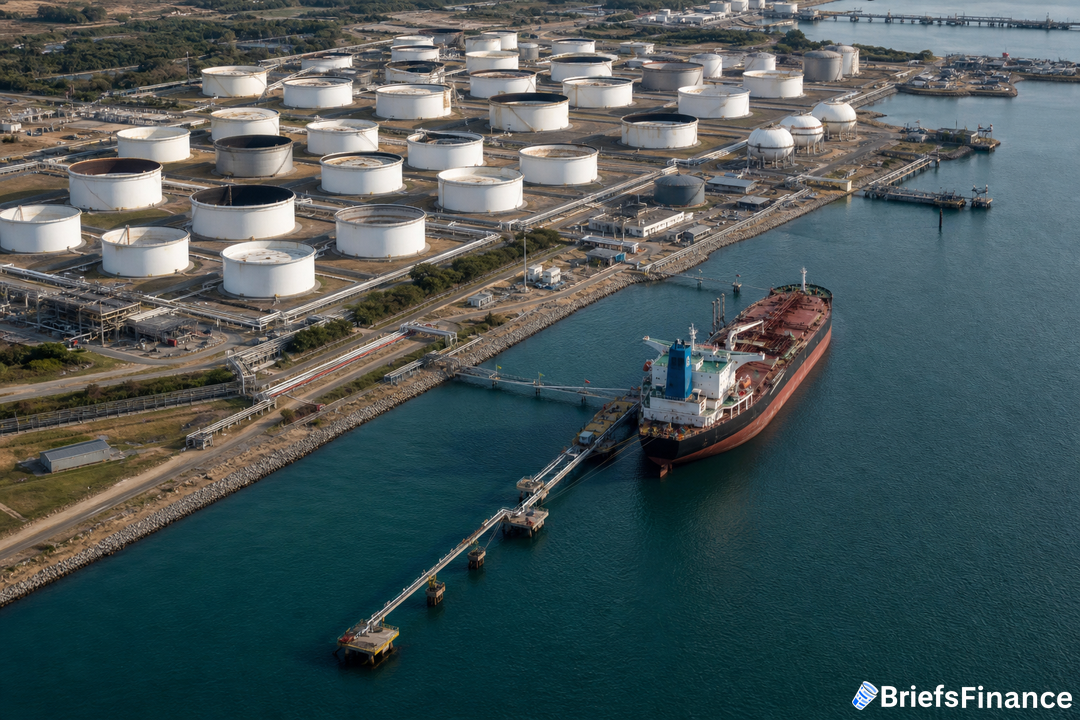
  • The US says the agreement gives it majority control of roughly one fifth of Venezuela's proven reserves - more than 65 billion barrels - via 100-year field concessions to NABEP that include US purchase and ownership rights.

What Washington did and what it wants

In January, the United States removed Maduro from power. Soon after, the administration backed an arrangement that opens the door to Venezuela's oil patch. Venezuela's interim government granted North American Blue Energy Partners (NABEP), led by Venezuelan businessman Alejandro Betancourt, 100-year rights to develop 17 oil fields. In return, NABEP handed Washington a 35% stake in the parent company, granted the United States the option to buy 20% of current and future output at cost, and gave the United States the right of first refusal on the remaining 80%. The White House framed the move as limiting Chinese and Russian influence under its "Donroe Doctrine," saying most of the fields in the plan had been run by Chinese and Russian firms or by "corrupt cronies of Maduro and Chavez."

The US says the purchase structure gives it majority control over about 20% of Venezuela's proven reserves, which it put at more than 65 billion barrels. On the ground, it is smaller Chinese and Russian companies that have been displaced so far, while Caracas has largely left key Chinese assets untouched amid broader contract reshuffling.

How deep the China-Venezuela ties go

China elevated its relationship with Venezuela to an "all-weather strategic partnership" during Maduro's 2023 state visit. Venezuela has reliably backed Beijing's positions on Taiwan and Hong Kong. Meeting Maduro in Moscow last year, Xi Jinping called the relationship an "ironclad friendship" and said China would "firmly support Venezuela in safeguarding state sovereignty, national dignity and social stability." Maduro's January removal was diplomatically awkward for China, coming a day after a high-level Chinese delegation visited Caracas.

Trade and finance bind the two closely. For almost twenty years, China has ranked as either Venezuela's leading or runner-up trade partner, and two-way commerce reached more than $7.4 billion last year. Since 2000, Chinese state-backed lending to Venezuela has exceeded $100 billion, according to AidData, the most for any country in Latin America.

Much of that was to be repaid in oil. Lending has ebbed as Venezuela's industry struggled with sanctions, corruption and underinvestment, and estimates of what is still owed range from $10 billion to $20 billion.

Security ties exist too. Venezuela is among the region's larger buyers of Chinese arms, purchasing $495 million in the decade through 2020, the Center for Strategic and International Studies reports, citing SIPRI.

When global events alter the investing backdrop, steady plans endure, so download the free Always Be Buying E-Book today

Oil flows, field control and what changed

China bought around 80% of Venezuela's crude exports last year, but shipments have halted since Maduro's ouster in January, based on vessel tracking compiled by Bloomberg. Those barrels mattered more for paying back oil-backed loans than for China's overall energy security, since Venezuela supplied just 4% of China's total oil imports last year.

Venezuela's Merey crude is prized for making bitumen used in roads and construction. Its steep discount to similar grades made it a staple for China's independent refiners, though heavier Canadian barrels can substitute at a higher cost. Chinese state firms have projects in the Orinoco belt and beyond, but they are not dominant producers.

Output tied to Chinese entities is under 10% of Venezuela's production, while Chevron's operations account for more than 25%. Even before the US move, Chinese companies had claims on portions of Venezuela's reserves. Analysts at Morgan Stanley, citing Wood Mackenzie, estimate Sinopec and CNPC together have claims of about 4.4 billion barrels.

The repayment fight and the bigger regional play

The new US structure could complicate China's path to getting repaid. US Energy Secretary Chris Wright told Bloomberg TV that China will have no debt claims on revenue from Venezuela's new oil production. Beijing says its cooperation with Venezuela is compliant with international and domestic law, involves no third party, and that its lawful interests must be protected. One route for recovery would be through Venezuela's broader sovereign debt restructuring.

The geopolitical ripple is larger than one country. Ecuadorian political risk expert Christian Reyes, who is based in Beijing, said, "Venezuela isn't necessarily a precedent for direct expropriation, but it may be a precedent for coerced exclusion." He added that the US is more willing to treat parts of Latin America's economic ties with China as a security issue and use leverage to enforce those boundaries. Still, unwinding China's presence would be hard given its deep entanglement across the region. The US is Latin America's largest trading partner and China is second, with Chinese companies embedded in power grids, mining, electric vehicles and infrastructure.

What matters for your wallet: the US says it now has majority control linked to about one fifth of Venezuela's oil reserves and secured long-term field rights plus purchase and priority options. If those terms shape where cash flows go, that could affect who gets paid back first and which firms benefit. Watch how this redirects oil revenue streams in Venezuela and how China responds across Latin America's trade-heavy sectors.

Disclosure

Recent News

1 2 3 … 98

Get Market Briefs delivered to your inbox every morning for free!

No fluff. No noise. No politics. Just finance news you can read in 5 minutes.

Blogs

October 5, 2026
What Is the Briefs Connector? A Simple Guide
  • The Briefs Connector lets your favorite AI read Briefs research, like Pro reports and the Briefs Score.
  • Without it, an AI asked about investing can give answers that sound right but aren't backed by that research.
  • It explains the research, but it won't tell you what to buy or sell.
Read More
October 5, 2026
Is a Recession Coming? What the Last Five Rate Hiking Cycles Say
  • The Fed has started raising rates again, and in the last five hiking cycles going back to 1994, a recession never started while the hikes were underway.
  • The pain showed up where there was a bubble to pop - housing in 2008, dot-coms in 2000, the pandemic money-printing boom in 2022 - and usually after the hikes ended.
  • Private equity and private credit are feeling this cycle first, and how far the pain spreads depends on how high rates go and how long they stay there.
Read More
October 2, 2026
Fed Interest Rates May Rise Again in 2026 - and the Newest Culprit Is AI
  • Fed Governor Barr told a meeting our head of investing research attended that higher rates are likely in 2026, lower inflation may not come soon, and AI is now pushing prices up.
  • The same week, President Trump asked the biggest AI companies to police themselves under an accord that's morally but not legally binding, because the White House sees AI as a race with China.
  • Higher rates put downward pressure on asset prices and squeeze borrowers, but the way through hasn't changed: own investments, buy on a schedule, and treat downturns as discounts.
Read More
October 1, 2026
Housing Market 2026: Why Office Buildings Are Cracking Before Houses Do
  • Office buildings are selling for 80% to 95% off because their five-year loans are resetting at much higher rates while half-empty floors have gutted the income those buildings are valued on.
  • Housing is under pressure, not cracking: a $400,000 mortgage costs $975 more a month than at 3%, but six of every seven mortgages are still under 6% and those owners are staying put.
  • Whether pressure turns into cracks is a race between unaffordability and the economy, and either way Jaspreet's rule is to treat your house as a liability and buy only what you can afford.
Read More
September 30, 2026
Dividend Investing vs. Growth Investing: Why the Slower Portfolio Can End Up Bigger
  • "What stock should I buy?" is the wrong first question. Growth, income, or wealth preservation comes first, and the goal changes which stocks even make sense.
  • At $500 a month for 30 years, 13% growth builds about $1.75 million. 10% growth plus a reinvested 4% dividend builds a little more than $2.2 million and pays a little more than $80,000 a year.
  • Income investors have US dividend ETFs, REITs, and international dividend funds to study. Growth investors have the Nasdaq 100, AI and chip funds, and small caps. None of it is a recommendation.
Read More
September 29, 2026
Why Is Gold Going Down? A 5.2% Treasury Yield Just Took Its Job
  • President Trump rejected Iran's deal to reopen the Strait of Hormuz, oil prices jumped back up, and gold fell instead of rising.
  • Treasury yields hit their highest level in more than 20 years, so investors sold gold and bought Treasuries that pay interest.
  • Higher Treasury yields make the national debt, mortgages, car loans, and credit cards more expensive, with the Fed's next rate decision due October 28.
Read More
September 28, 2026
The Strategic Bitcoin Reserve: Why the Government Wants Bitcoin to Explode
  • The US government holds about 328,000 Bitcoin, worth roughly $25 billion, and since a 2025 executive order it keeps seized coins instead of selling them.
  • Washington wants a bigger pile of assets so its $40 trillion national debt looks smaller next to them, which lets it keep borrowing and spending.
  • Bitcoin's wild price swings, and a government holding a coin built to escape governments, are the two risks investors need to watch.
Read More
September 25, 2026
BRIEFS EXCLUSIVE: 43% Of Respondents Say Bills Outran Their Income Over Past Two Years
  • 43% of the 494 Market Briefs readers surveyed said their bills grew faster than their income over the past two years, even though 79% could cover a surprise $5,000 expense tomorrow.
  • Half of readers own gold or crypto, the two classic bets against a weaker dollar, and only 13% bought nothing at all in the last 12 months.
  • The median reader says it takes $150,000 a year to feel financially secure, about $62,000 above the U.S. median household income.
Read More
September 25, 2026
The Economy Is Booming. So Why Did Stocks and Bonds Fall Together?
  • S&P Global says the US economy is growing at its fastest rate since 2021, with corporate profits up 28.9% in a year, almost four times the historical average.
  • Stocks and bonds fell at the same time, which is not how the two markets normally behave, because Treasury yields above 5% now compete with stocks for investors' money.
  • Jaspreet Singh lays out three ways to invest through a shift like this: always be buying, buy the crash, or follow the money before it hits the headlines.
Read More
September 24, 2026
The 2026 Economic Reset Is Starting: Are We in a Recession, or Is the Pain Still Ahead?
  • The Federal Reserve has flipped from stimulating the economy to fighting inflation with higher interest rates, while the White House still wants growth at almost any cost.
  • The national debt tops $40 trillion, has outgrown the entire U.S. economy, and its interest payments are now the government's fastest-growing expense.
  • Higher rates bring pain for private equity, private credit, and speculative assets, but they open opportunities for investors holding cash, treasuries, and value assets.
Read More
1 2 3 … 28
Share via
Copy link