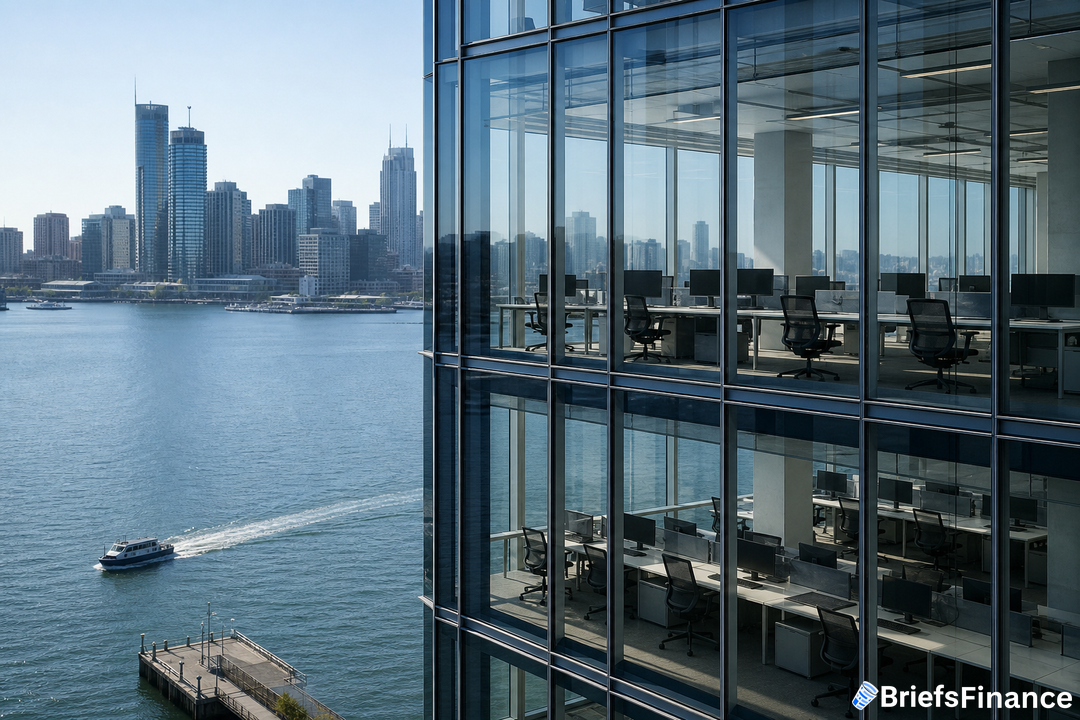
Inside the new HQ
Anchored on a Boston Harbor pier, the reimagined three-story building traces its roots back 113 years, when it functioned as a cargo facility and gateway for immigrants. In the 1980s, Fidelity played a role in transforming it into an exhibition and event venue with support offices. Now, after a full redevelopment, it's become the company's newest home base.
The vibe blends industrial bones with Seaport polish: exposed beams and ducts, crisp white staircases with metal mesh railings that nod to ship gangways, and expansive windows framing the tall ships dock. Staff will find courtyards, coffee bars and dining spots, a quiet library-style area with shelves of books, and showers for those who bike in.
By the doorway of the on-site health center, a wall shows a video loop of a tree with its leaves rustling. Late last week, a few early arrivals were already working in, including one employee having lunch in a curved chair beside a mural of a mossy boulder on wheels. There's also a sweeping, restaurant-worthy bar lit by warm lamps for company events, while nearby booths are open anytime.
Commonwealth Pier's broader overhaul adds more retail and a 5,400-square-foot space for the Museum of American Finance. The free Smithsonian affiliate, long based in New York City, began operating at the Boston site this summer.
How Fidelity plans to use the space
From the outset, the layout was crafted to get people working together face to face. As teams move in, they're encouraged to grab couches, chairs and shared spaces rather than settle into rows of cubicles. A spokesperson said the office is meant to foster collaboration and innovation. To help newcomers navigate, a robot will cruise the corridors and point people to meeting rooms.
All of Fidelity's business lines will be represented in the Seaport headquarters, and many of the firm's fund managers will work there. The build kicked off in 2020, right as remote work cast doubt on supersized offices, but the aim here is clear: make in-person teaming easier.
Where you work is changing, and so is what your salary actually buys. Our CEO Jaspreet Singh breaks it down on September 29th in his free workshop on how to profit from a dollar that is losing its value.
Why it matters for Boston and for Fidelity
Fidelity had been preparing to move from its 855,000-square-foot downtown headquarters to the 735,000-square-foot Seaport site. Then, this spring, it informed staff in Boston and select other markets that, beginning in September, they would return to working onsite five days per week. To fit everyone, the company is holding onto both buildings, making it a major employer in two of Boston's key office districts.
According to CBRE Group Inc., both areas posted 20% vacancy by the close of Q2, compared with pre-pandemic figures of downtown at 6% and the Seaport at 9%. Keeping both sites "affirmed its commitment to Boston when there's a lot of swirling negative headlines," said Mark Fallon, Hunneman's director of research and strategy, who added that Hunneman was not involved in the project.
Meanwhile, the business backdrop is strong: assets under management reached $7.8 trillion in the second quarter, up 23% year over year. Under CEO Abigail Johnson, the privately held firm founded in Boston in 1946 by her grandfather has leaned more into alternatives such as cryptocurrencies. Her father, Ned Johnson, guided Fidelity's rise as a 401(k) powerhouse late in the 20th century.
City records show a 24% increase in Fidelity's Boston headcount from 2016 to 2025. And while local finance jobs trended down after the financial crisis, recent signs include JPMorgan Chase & Co.'s planned hiring ahead of relocating to Boston's newest office tower, as well as KKR & Co.'s 133,000-square-foot downtown lease signed last year.
What this means for your money
A growing asset manager planting flags in two busy neighborhoods can boost daily activity around services those workers use, even as vacancies remain high. If you track how big firms organize talent, note that Fidelity says every business unit will have a presence at the Seaport HQ, with many fund managers there too. A setup designed to get teams in the same room can affect how decisions ripple through research and funds, which is useful context if you follow where ideas in the investing world get made.
A bigger office does not fix a smaller paycheck. Join our CEO Jaspreet Singh on September 29th for a free workshop on how to profit from a dollar that is losing its value.