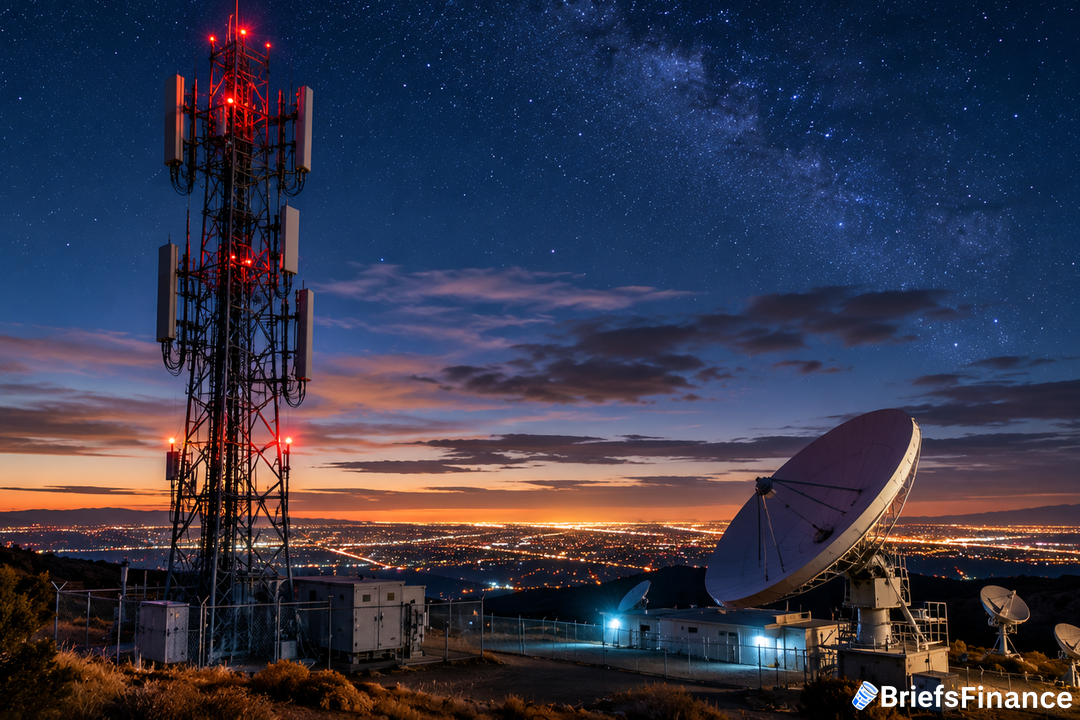
Two of America's biggest phone companies just had a terrible week. AT&T and Verizon both lost more than 11% of their stock value over four straight trading sessions. The reason: a report that Elon Musk's SpaceX might team up with a cable company and enter the mobile phone business.
The Trigger: Charter and SpaceX Talk
According to Bloomberg, Charter Communications and SpaceX engaged in top-level talks about a potential partnership to offer a consumer mobile phone service. Charter is a big cable company, not a wireless carrier. But a deal with SpaceX would let it bypass traditional cell towers.
BNP Paribas analysts said the speculation alone is a problem for wireless stocks. They wrote: "There is no way for a Charter-SpaceX partnership to remove the role of terrestrial cellular networks in the U.S. connectivity market. Given the equity moves today though, clearly the mere speculation is a headwind for the wireless names." Still, investors sold first and asked questions later.
The Market Damage
AT&T's stock fell to $20.16, down 1.5% on the day. That would be its lowest close in nearly two years. Verizon dropped to $41.41, down 1.4% on the day, which would be its lowest since late January.
Get your free investing masterclass bonus when you join Market Briefs, our free daily newsletter
T-Mobile also fell at first, but its stock later recovered. The selloff was not limited to one carrier. It hit the whole sector like a sudden storm that swept billions off the table.
Why This Matters
SpaceX already runs Starlink, a satellite internet service with about 12 million subscribers. Oppenheimer analyst Tim Horan said bluntly: "SpaceX will disrupt the $1.6T communications industry." If SpaceX enters mobile phones through a deal with Charter, it would compete directly with AT&T, Verizon, and T-Mobile.
The three major carriers are already making backup plans. AT&T and Verizon have deals with a satellite company called AST SpaceMobile. Additionally, the three companies are in talks to form a joint venture that would use satellites for cellular backup. But a Charter-SpaceX partnership would be a direct threat to their core business - selling phone service to consumers.
What to Watch
Analysts are watching to see if SpaceX will extend its existing direct-to-cell satellite agreement with T-Mobile, or alternatively strike an equivalent arrangement with Verizon or AT&T. The outcome of those talks could reshape the U.S. mobile market. For now, the big phone companies are safe, but the scare has already cost them billions.
Satellite Competition Heats Up
The U.S. wireless market has long been dominated by AT&T, Verizon, and T-Mobile, but satellite technology is emerging as a potential disruptor. Yet a Charter-SpaceX deal would directly challenge their core consumer phone business, making the threat more immediate than previous satellite experiments.
Subscribe to Market Briefs, our free daily newsletter, and claim your bonus investing masterclass