Free NewsletterPro Login

Warning: Undefined variable $stocks in /var/www/briefs.co/htdocs/wp-content/plugins/oxygen/component-framework/components/classes/code-block.class.php(133) : eval()'d code on line 448

Warning: foreach() argument must be of type array|object, null given in /var/www/briefs.co/htdocs/wp-content/plugins/oxygen/component-framework/components/classes/code-block.class.php(133) : eval()'d code on line 448

Warning: Undefined variable $funds in /var/www/briefs.co/htdocs/wp-content/plugins/oxygen/component-framework/components/classes/code-block.class.php(133) : eval()'d code on line 472

Warning: foreach() argument must be of type array|object, null given in /var/www/briefs.co/htdocs/wp-content/plugins/oxygen/component-framework/components/classes/code-block.class.php(133) : eval()'d code on line 472
/* the link was here */

Water Utilities Sold A Record $21 Billion In Bonds Before Trump's Cuts

Published Jun 18, 2026
[tts_player]
Share:
Summary:
  • Water and sewer bond sales topped $21 billion in 2026, the fastest pace since 2015, led by New York, California, and Texas.
  • Trump's 2027 budget proposes cutting the federal clean water and drinking water revolving funds that have backed cheap loans to utilities since the late 1980s.
  • AI data centers are adding new strain, with researchers estimating the U.S. needs at least $10 billion in new water capacity by 2030 just to support data center growth.

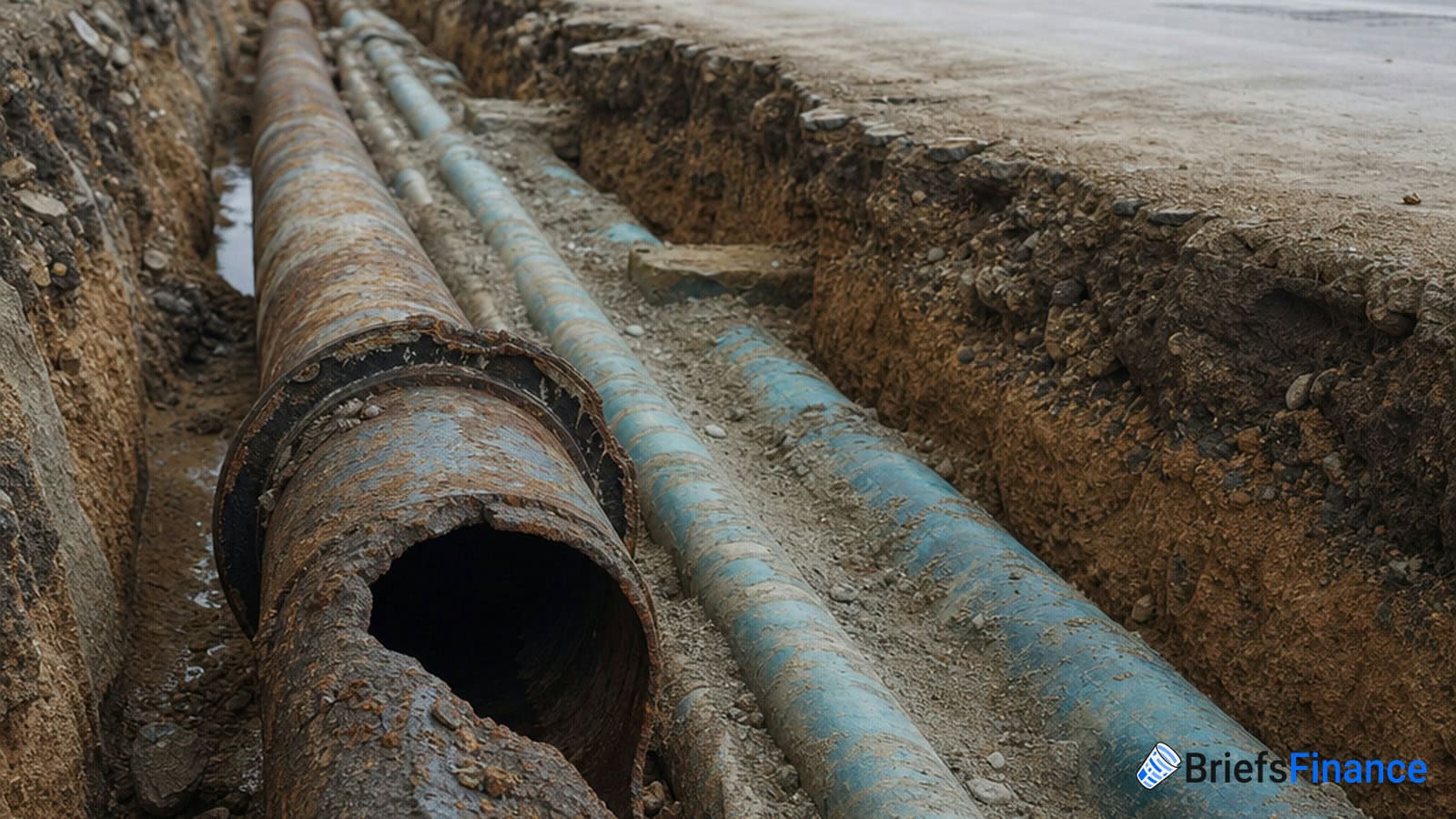
The pipes under American cities are old, the federal money used to fix them is about to shrink, and AI data centers are showing up thirsty.

That's why water utilities are borrowing at a record pace.

A Race To Borrow Before The Money Dries Up

Water and sewer bond sales have topped $21 billion in 2026 according to Bloomberg data, marking the fastest pace since 2015, with New York, California, and Texas leading the way.

The rush comes ahead of Trump's 2027 budget, which proposes deep cuts to two big federal programs - the clean water and drinking water state revolving funds that give cities cheap loans to repair pipes and treatment plants.

Those programs have been the backbone of water funding since the late 1980s and 1990s, lending out billions each year at low rates.

If those funds shrink, utilities will need to find the cash somewhere else - and the municipal bond market, where cities and states borrow money, is the obvious place.

And the pressure won't ease soon - a trade group representing 4,300 utilities says the country needs to nearly triple the pace of water spending over the next 25 years just to keep up.

We break down infrastructure moves like this one every morning in Market Briefs - five minutes a day, and you get a free investing masterclass when you sign up.

Demand Is Already Outrunning Supply

The squeeze is showing up at the state level, with the State Water Implementation Fund for Texas hitting its capacity limit last month after project requests piled up to $4.2 billion against a pool of nearly $2 billion.

Thirteen applications got turned away.

Illinois tells a similar story, with water bond sales jumping from just $16 million in 2021 to over $1 billion last year - and this year already past $940 million.

Construction costs are making it worse, with inflation hitting the water sector especially hard because the backlog of overdue projects is so large.

The AI Wild Card

Then there's the new pressure: data centers, which need huge amounts of water to keep their servers cool.

Amazon recently said its data centers use 2.5 billion gallons a year, and big tech companies have been racing to build new sites in regions like Arizona, Texas, and northern Virginia - many of which are already short on water.

That demand is hitting local water systems that weren't built for it.

Researchers estimate the U.S. will need at least $10 billion in new water capacity by 2030 just to support data center growth. That's a bill nobody had budgeted for five years ago.

What To Watch

The first thing to watch is the federal budget fight, where the proposed cuts to those revolving funds could push even more water utilities into the bond market in 2027 - making the Texas waitlist look more like a preview than a one-off.

The pipes won't fix themselves, and the federal check might not come.

Want this kind of read on the market every weekday morning? Join 350,000+ investors reading Market Briefs - delivered free, with a 45-minute investing course thrown in as a bonus.

Disclosure

Recent News

1 2 3 64

Get Market Briefs delivered to your inbox every morning for free!

No fluff. No noise. No politics. Just finance news you can read in 5 minutes.

Blogs

August 31, 2026
America Is Running Out of Debt Buyers. Treasury Bills Are the Government's Fix
  • The government took in about $5 trillion in taxes in 2025 and spent about $7 trillion, and the national debt is now over $40 trillion.
  • Investors, banks, and foreign countries are all lending less to the U.S., so starting September 9 the government plans to sell more short-term treasury bills and use that cash to buy back its long-term debt.
  • Government interest rates set the floor for your mortgage, your car loan, and your credit card, and short-term Treasury ETFs like SGOV are one way investors are playing it.
Read More
August 23, 2026
How to Get the Most From Your Guideline 401k
  • Guideline is a company that provides low-cost 401k plans, popular with small businesses and their employees.
  • A "Guideline 401k" follows the same core rules as any 401k: tax-advantaged growth, contribution limits, and often an employer match.
  • The biggest results come from capturing the full match, choosing low-cost funds, and picking Roth or traditional to fit your situation.
Read More
August 23, 2026
Principal 401k: What to Know About Your Plan
  • Principal is one of many companies that manage workplace 401k plans, so a "Principal 401k" is simply a 401k where Principal is the provider.
  • The rules of a 401k are the same no matter who runs it: pre-tax or Roth contributions, tax-advantaged growth, and often an employer match.
  • The biggest wins come from grabbing the full match, picking low-cost funds, and knowing whether Roth or traditional fits you.
Read More
August 23, 2026
What a Tariff Dividend Means for Your Money
  • A "tariff dividend" is the idea of taking money the government collects from tariffs and paying some of it back to citizens.
  • To judge the idea, you first need to know what a tariff is: a tax on imported goods, usually paid by the companies bringing them in.
  • Tariffs ripple through prices, businesses, and your investments, so the smart move is understanding those ripples, not just the headline.
Read More
August 23, 2026
No Tax on Overtime: How Overtime Pay Is Taxed
  • "No tax on overtime" refers to a tax break that lets certain workers deduct some overtime pay, lowering the income they get taxed on.
  • A deduction does not mean overtime is truly tax-free. It means part of that pay is subtracted before your tax is figured.
  • The bigger money lesson: how you earn money changes how it is taxed, and investors often get the friendliest treatment of all.
Read More
August 23, 2026
Reading the Silver Price Forecast for 2026
  • Nobody can honestly promise a specific silver price for 2026. Any exact number is a guess, so treat forecasts as opinions, not facts.
  • Silver is unusual because it is both a precious metal and an industrial metal, so its price answers to two very different forces.
  • Instead of chasing a forecast, learn the drivers - inflation, interest rates, recession fear, and industrial demand - so you can judge any prediction yourself.
Read More
August 23, 2026
What to Do When Reddit Stocks Go Viral
  • "Reddit stocks" usually means stocks getting hyped in online communities, where crowds can send a price soaring or crashing fast.
  • These tips can be entertaining and sometimes useful, but they are opinions, not research, and often come loaded with hype.
  • The safe move is to treat every online tip as a starting point, then do your own homework before risking a dollar.
Read More
August 23, 2026
Why Is Bitcoin Dropping Right Now?
  • Bitcoin drops for a mix of reasons: interest rates, big-picture money policy, regulation news, and simple shifts in how much risk investors want to take.
  • Bitcoin has a fixed supply and no earnings, so its price runs almost entirely on supply, demand, and sentiment.
  • Sharp drops are normal for bitcoin. Understanding the drivers matters more than reacting to any single day.
Read More
August 23, 2026
The Fidelity 500 Index Fund, Made Simple for Beginners
  • The Fidelity 500 Index Fund is a low-cost fund that tracks the S&P 500, an index of 500 large U.S. companies.
  • Buying it means owning a tiny slice of 500 businesses at once, which spreads your risk in a single purchase.
  • Index funds like this win over time mostly by keeping fees low and letting compounding do the work.
Read More
August 23, 2026
USA Penny Stocks: Risks and Rewards Explained
  • USA penny stocks are very low-priced shares of very small companies, often trading under $5 and sometimes under $1.
  • They dangle the dream of huge, fast gains, but carry brutal risks: low liquidity, wild swings, and high failure rates.
  • Most investors build wealth faster with quality companies and funds than by chasing cheap shares.
Read More
1 2 3 25
Share via
Copy link










