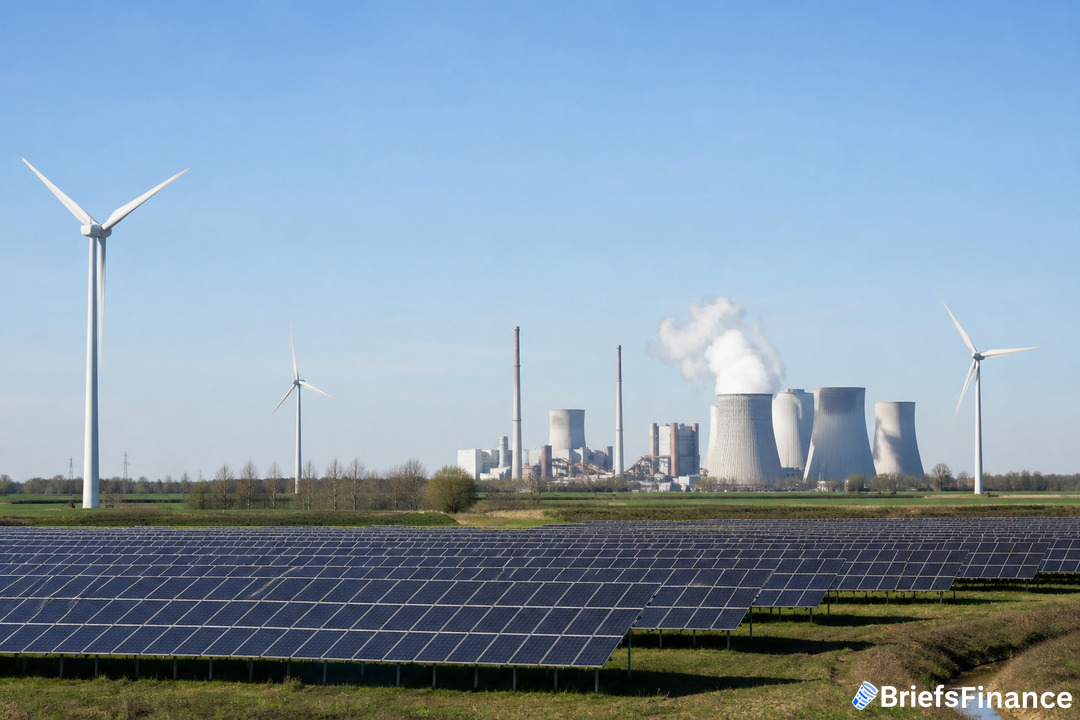
What BNEF sees
BloombergNEF's new U.S. Clean Energy Market Outlook says developers are set to notch a record year for clean-power additions this year, and to beat that pace again in 2027. The buildout continues despite higher borrowing costs, trade frictions, and uncertainty around equipment prices and availability.
Solar remains the biggest source of new clean generation. Developers are expected to install 48.9 gigawatts in 2026 as they advance projects that qualified for expiring tax credits. Nonetheless, new tariffs and the winding down of certain tax perks prompted a cut in the 2026 to 2036 utility-scale solar outlook, lowering it to 430 gigawatts, a 7.5% drop.
Geography matters here too. A large share of new sun and wind capacity is projected for Texas and the broader Southwest. BNEF also expects a quicker ramp-up in green additions after 2030.
Data centers are reshaping the mix
Data centers have become a central force in U.S. power planning. BNEF now projects installed data-center capacity at 118 gigawatts in 2030, a 52% increase from its December view. By 2035, typical data center load may rise to 120 gigawatts - roughly five times today's usage - with close to half linked to AI workloads.
That surge has a fossil-fuel flip side. Many new facilities will use on-site natural gas systems, feeding a broader gas expansion. BNEF estimates 67.8 gigawatts of new gas-fired generation could be added by 2030, while only 14.3 gigawatts are slated to retire over the same period - a sizable net increase. As Hall Welborn, a report author, put it, "When we look at the picture holistically, we still see data center growth as a tailwind to renewable energy, but it is tainted by the growing gas pipeline."
When energy and markets shift, staying informed matters, so sign up for the free Market Briefs to get concise updates.
The U.S. is the world's largest natural gas supplier, but rising demand has consequences. According to BNEF, the sector could shift from having excess output to facing a shortfall as early as 2028.
Storage, wind, and who is buying the power
The storage outlook just strengthened. BNEF now projects 383 gigawatts of batteries installed through 2036, up 35% from earlier this year, supported by federal incentives that remain even as some renewable supports wind down. Onshore wind also received an upgrade, with cumulative additions through 2036 lifted by 15% to 99.7 gigawatts, partly reflecting data-center demand.
Through August, companies announced more than 15 gigawatts of clean-power contracts, with Meta Platforms and Alphabet's Google accounting for nearly three quarters of the total.
Nuclear's near-term path and the investor angle
Interest in nuclear is rising alongside demand, but new reactors still face high costs and long timelines. More near-term gains are expected from restarting closed units, boosting output at existing plants, and a limited number of new builds, adding 13.7 gigawatts by 2036.
The bottom line: data centers are accelerating both clean-energy projects and gas capacity, while tariffs and tax-credit timing are shifting solar's cadence. For your portfolio, that points to durable pipelines in solar and wind, a stronger case for storage under federal incentives, an ongoing role for gas, and selective momentum in nuclear from restarts and uprates.
Because energy, crypto and housing touch everyday finances, subscribe to the free Market Briefs newsletter for five minute clarity.